


What Is Trade Surveillance?
Trade surveillance is the practice of monitoring and analyzing trades. It includes everything from order, execution, trade policies, and regulatory requirements. Its primary objective is to ensure that every trade transaction is conducted properly. Additionally, it aims to spot insider trading, market abuse, trading misconduct, or any potential violations.
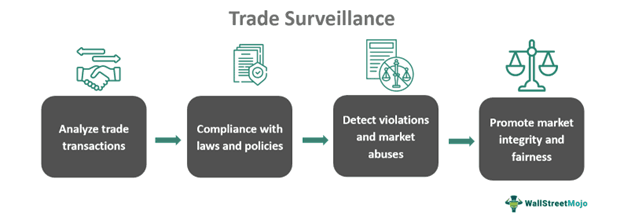
Any form of illicit practice or market manipulation is detected to ascertain fair and transparent markets. Moreover, it aims to maintain the integrity of financial systems and protocols and encourage investors’ confidence. The entire surveillance process relies on multiple sources of data, and hence, it is also called market surveillance.
Key Takeaways
- Trade surveillance is the process of monitoring trades to detect any form of market abuse, manipulation, insider trading, or illicit practices.
- In the US, there is Nasdaq trade surveillance alongside SEC, NFA, and CFTC at the government level to ensure trade surveillance and control.
- Apart from trade volume, execution, and order processes, it uses multiple data sources, including communications, market news, social media, emails, SMS, and phone calls.
- The emerging technologies are AI and ML, visualization tools, blockchain technology, natural language processing, cloud computing, and solutions.
Trade Surveillance Explained
Trade surveillance is the system through which every trade occurring in the financial markets is monitored, recorded, and evaluated parallel to the laws and regulations, trade policies, and regulatory compliance. The whole framework aims to detect any illicit practices existing in trade operations, such as market abuse, insider trading, stock price manipulation, or misconduct. It traces and evaluates large volumes of trade data to spot any form of threat, market risk, and violation of trade policies and compliance.
The process is enabled through various digital platforms, software programs, and cloud-based solutions. New technologies like artificial intelligence and machine learning, along with different tools, are used by brokerage firms to ensure they are not involved in any violations or misconduct of internal trading policies. Firms set up trade surveillance compliance programs, and many global markets have their surveillance solutions. Additionally, third-party providers are offering such services. Companies are also often seen building their own platforms for trade surveillance.
In the US, there is Nasdaq trade surveillance, which is a robust tool. It offers a wide-ranging suite of features designed to track crimes and malicious practices across multiple regions and asset types, rather than just providing small software functions with direct functionalities. At the federal level, entities such as the Securities and Exchange Commission (SEC), Commodity Futures Trading Commission (CFTC), and National Futures Association (NFA) also provide a layer of protection and supervise trade surveillance.
Examples
Here are two examples to help you understand the concept better:
Example #1
Suppose TradeX is a popular brokerage firm in the US with over a million clients and retail investors. They want to encourage fair trading and transparency in operations, so they buy trade surveillance software. This software helps them collaborate with multiple cloud-based solution providers and ensures that every trade initiated through their investors complies with laws and regulations.
Additionally, the software monitors internal staff and management to detect any form of trade violations. It checks on analysts to ensure none are involved in insider trading, stock price manipulations, market abuse, or any other illicit practices. Moreover, it analyzes vast amounts of trade data and provides tools to secure social media, emails, SMS, phone calls, and market news. This example shows how the firm, with the help of the software, can ensure the complete safety and protection of its clients and trading accounts.
Example #2
HashKey Global and Solidus Labs announced a partnership that will focus on trade surveillance. They will give equal priority to derivatives and spot markets on the exchange. The collaboration will offer real-time alerting and market inspection to ensure maximum monitoring and detection of suspicious activities. It also includes more employment generation of trade surveillance jobs in the market and promoting the field.
HashKey Global is one of the global digital asset exchanges that offers licensed digital asset trading services across the world. The company has obtained a license from the Bermuda Monetary Authority. At the same time, Solidus Labs is a crypto native market integrity solutions provider that makes crypto trading safe across all centralized and DeFi markets.
Emerging Trade Surveillance Technologies
The following are some emerging trade surveillance technologies:
- Artificial intelligence and machine learning help firms assess huge volumes of data. In addition, it reduces false positives and anomaly detection.
- The growth of cloud-based surveillance platforms provides real-time processing and convenience scalability, integrating trade surveillance with other functionalities.
- Another emerging technology is the application of behavioral analytics. It is prominent with banks and financial institutions to oversee any form of risk management, such as credit and liquidity risk. They also focus on abnormal spikes in trading volumes and study trading behavior closely.
- Blockchain technology is another emerging technology offering better digital trading transactions and better visibility.
- Natural language processing is another technology that focuses on unstructured data sources, news articles, social media posts, and trader communications. Moreover, it measures market sentiment and potential threats.
- RegTech platforms help in collecting, processing, and analyzing data and simplifying compliance processes.
- Lastly, visualization tools come with area charts, scatter plots, and heat maps to optimize the easy identification of trading platforms and anomalies.
Importance
The importance of trade surveillance is listed below:
- Operates as a monitoring control over financial markets for every trade occurring
- Detects and identifies insider trading, market manipulation, and illicit practices in the market
- Encourage fair trading and promote investor confidence in financial markets
- Ensure every market participant complies with the trading policies, rules, and market regulations
- Market abuse and any potential violations or risky practices are acknowledged
- With emerging technologies and innovation, these systems are becoming increasingly accurate and efficient in protecting market integrity and investor’s money
Trade Surveillance Vs. Transaction Monitoring
The key differences between these two regulatory functions are:
| Trade Surveillance | Transaction Monitoring |
|---|---|
| It monitors trade, including order, execution, and volume. | Transaction monitoring refers to overseeing customer transactions and the flow of money in businesses. |
| It is concerned the capital markets, securities, and other financial instruments. | Transaction monitoring covers deposits, withdrawals, transfers, financial crimes, money laundering, and even terrorism financing. |
| This regulatory function ensures fair trading and protection of all market participants. | It is relatively bigger in terms of assessing customer profiles, corporate culture, sector size, the flow of money, paper trail, accounts, and monetary operations. |
Frequently Asked Questions (FAQs)
Frequently Asked Questions
What does a trade surveillance analyst do?
The primary job of trade surveillance analysts is to: – Work with the surveillance team to check risks across all markets – Protect firms from any form of potential financial and reputational risk – Data analysis and technical documentation – Offer guidance and support to their firm’s new services and initiatives – Constantly monitoring any form of violation of laws, policies, and regulations
How big is the trade surveillance market?
The market is experiencing significant growth. In 2021, it was valued at $888.42 million, and it is projected to reach a staggering $2866.36 million by 2030. This translates to a robust CAGR of around 14% during this decade. These figures were reported by Straits Research, a leading market research firm.
Why is news data important in trade surveillance?
The importance of news data in trade surveillance is: – The news covers broad levels of information, such as corporate announcements, geopolitical events, regulatory changes, and so on. – Investors, in their proactive approach, leverage news data and information to make informed decisions. – News data help analysts link one to another and spot patterns that may lead to market manipulation.