


What Is Wage Expense?
Wage Expense is a company’s cost of hiring workers, employees, staff, and contractors for work, projects, and business operations on an hourly basis. It is typically a variable cost based on the number of hours an individual spends at work during a specific period. The calculation may lead to different results, given the changing number of hours and days in a particular period.
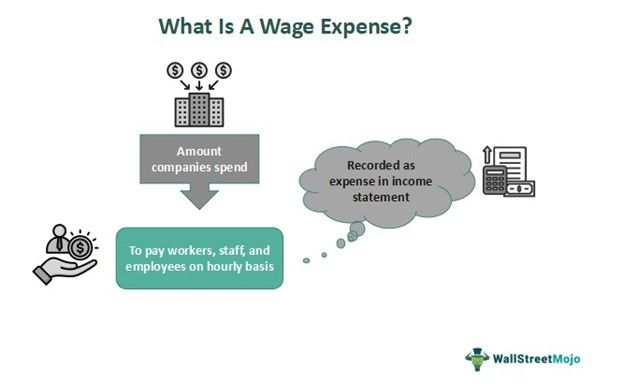
It also includes benefits and payroll taxes recorded on the expense side as an item in the income statement. As per the federal or state government, a minimum wage is set, and the wage offered to workers must be equal to or greater than it. These expenses are recognized as operational expenses for a business.
Key Takeaways
- Wage expense is the compensation offered to workers, staff, and employees on an hourly basis over a period. Besides time as a factor, contracts and pieces of objects also determine the wage calculation.
- It is considered an operating expense for businesses that hire labor to accomplish their projects or tasks.
- In the US, the minimum wage is $7.25 per hour mentioned in the FLSA, although it may vary across states.
- Any employer not following the labor laws is liable for penal consequences; every employer must pay minimum wages set by the government.
Wage Expense Explained
Wage expense is the amount of money compensated to the employees, workers, contractors, and other staff in exchange for their work and services performed for a company on an hourly basis. Every company requires a set of workers for daily operations, tasks, and project completion. For this, each company hires a group of individuals identified as blue-collar workers or qualified staff and company employees. In some scenarios, however, contracts and pieces of objects to be manufactured also become a factor in determining workers’ wages instead of hours or days spent on the tasks.
The wage expense journal entry is done through either the accrual method, where they are recorded once the work is done, or by the cash method, in which the expenses are recorded when the workers are paid. Every company has an accounts department to manage and rightfully pay the compensation to each employee. There is a common confusion about whether a wage expense is a debit or credit entry. However, in accounting, it is written on the debit side of the profit and loss account as every expense and cost is recorded.
A wage expense on the balance sheet indicates wage payables, and it differs from salary expense because the former is a variable cost expense, but the latter is a fixed cost compensation. In the case of wage-related expenses, the wages of workers may vary from individual to individual based on the amount of work they perform and the number of hours they work.
Every country has the authority to regulate labor affairs and wage management. In the US, the US Department of Labor oversees wage regulation and enforces the Fair Labor Standards Act on every company, institution, and entity. Every nation has a set minimum wage; no employer can hire a worker at an offer below it. As of 2024, the Fair Labor Standards Act (FLSA) mentions the federal minimum wage in the United States as $7.25 per hour. Any entity found not paying this minimum amount to workers, staff, or employees might have to face legal consequences.
Examples
Let us consider the following scenarios to understand the concept and its working better:
Example #1
Jonathan is a regular unskilled worker with minimum education and makes a living working at different construction sites and performing labor tasks. He recently joined a construction site, and the contractor offered to pay $4.5 per hour for a nine-hour shift. The whole project was expected to be completed in the next 18 days.
Jonathan readily starts working. He does his work properly, is always present, never fights with any other worker at the site, and is never late to work. By the 18th day, Jonathan goes to the contractor for his payment.
Let us check how to calculate the wage expense in this scenario:
As per calculation,
4.5 per hour and 9 hours would mean = $40.5 per day
Therefore, for 18 days, he would receive:
40.5 x 18 = $729
Hence, $729 is what Jonathan received as the total compensation for his work at the construction site. This amount, furthermore, was recorded as an expense in the site’s income statement.
This example shows a simple calculation; normally, companies hire several workers who tend to work together, so if the contractor has hired a total of 27 employees, including Jonathan, at the construction site with the same hourly rate as his, the total wage expense for the contractor would be –
729 x 27 = $19,683.
Example #2
Suppose Mary moves on and finds a one-day job at a packers and movers company, and the manager offers to pay $1.8 for every box that she moves from the ground floor to a building’s 9th floor.
Again, she starts working and shifts 135 boxes in nine hours. He goes to the manager, who pays her.
$1.8 x 135 = $243
Here, the time is not accounted for because of different wage expenses. Here, Mary worked and was promised payment on a per-piece basis. Again, suppose the manager hired four workers, including her, and the other three shifted 117, 108, and 99 boxes, respectively.
So as per $1.8 per box, the other three managed to earn:
117 x 1.8 = $210.6
108 x 1.8 = $194.4
99 x 1.8 = $178.2
Including Mary’s $243
Here, the total expense related to wages incurred by the packers and movers company becomes:
$(243 + 210.6 + 194.4 + 178.2) = $826.2
This example reflects how it’s not solely the time factor that affects wage expenses but also others, like the piece of the box here.
Wage Expense vs Wages Payable
So far as wages are concerned, there are two terms that are commonly used in the field of accounting. These are wage expenses and wages payable. Though they sound similar, they tend to differ. Let us check out some differences between the two:
- Wage expense is the amount that is recorded to get the exact labor costs incurred by a company. On the contrary, wages payable are the wage amount earned but not yet paid to the employees.
- The former falls under an expense account, but wages payable are a type of current liability account.
- The wage expense journal entry indicates it as an expense reflected in the income statement, while wages payable go under the liabilities section of the balance sheet.
Frequently Asked Questions (FAQs)
Frequently Asked Questions
Is wage expense an asset?
An asset is primarily something a company owns or controls and reaps benefits from. Hence, a wage expense cannot be an asset as it is a cost that companies bear to pay workers, staff, or employers the total compensation for their work.
How to calculate wage expense?
The calculation depends on the factor based on which a company decides to pay a worker. For example, a time-based expense is an hourly-based work with a set hourly rate, and the same goes for per-piece wages and contract-based wages, for which the number of units and contract obligations are accounted for.
What type of account is wage expense?
The account type here is a current expense account, which may consist of salaries, taxes, bonuses, overtime, etc. It includes taxes, bonuses, and all the other benefits offered to the workers. It is essential to maintain the account with consolidated information.