


Introduction
Every hiring manager screening resumes for an entry-level analyst role asks the same silent question: can this candidate build a model, defend a number, and use it to support a decision? Financial analyst skills are the difference between a finance degree that sits in a drawer and a job offer. The role itself remains one of the more resilient paths in corporate finance.
The median annual wage for financial and investment analysts was $101,350 in May 2024, and overall employment of financial analysts is projected to go up by 6% from 2024 to 2034, faster than the average for all occupations, with about 29,900 openings expected each year.
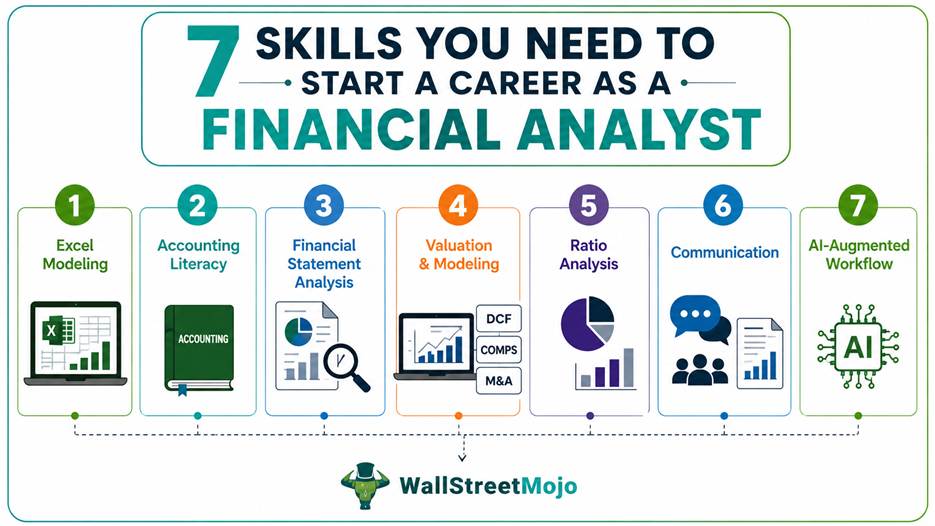
This article breaks down the skills needed to become a financial analyst and explains which ones consistently separate hired candidates from rejected ones. These include Excel modeling, accounting literacy, financial statement analysis, valuation, ratio analysis, business communication, and AI-augmented workflows.
Each section explains what the skill involves on the job and how employers test it.
It also outlines practical ways to build the skill, including structured programs like the Financial Analyst Fast Track Program by WallStreetMojo.
Key Takeaways
- Excel modeling remains a core skill, with employers testing formulas, sensitivity analysis, and integrated three-statement models.
- Accounting and financial statement analysis help analysts interpret company performance, identify risks, and avoid costly valuation errors.
- The financial analyst skills needed to become a financial analyst span valuation, ratio analysis, communication, and increasingly, AI tool fluency.
- DCF, trading comps, and M&A modeling are among the skills needed to become a financial analyst, forming an important technical foundation for finance roles.
- Clear communication helps analysts turn complex financial analysis into actionable recommendations for clients and stakeholders.
- A structured learning path can organize the skills needed to become a financial analyst more efficiently than scattered self-study, while providing case studies and certification.
What Skills Does A Financial Analyst Need?
The skills needed to become a financial analyst include a combination of technical and behavioral abilities. These include advanced Excel, accounting knowledge, financial statement analysis, valuation and modeling, ratio analysis, communication, and increasingly, AI tool fluency. Financial analysts guide businesses and individuals in making investment decisions. They evaluate financial data, study economic and business trends, and assess company financial statements. None of these tasks can be performed competently without the seven financial analyst skills detailed below.
Financial Analyst Skills Comparison at a Glance
The table below compares the skills needed to become a financial analyst by their core tools, employer relevance, and learning difficulty.
| Skill | Core Tool/Method | Why Employers Test It | Difficulty to Learn |
| Excel Modeling | Formulas, pivot tables, sensitivity tables | Foundation for every deliverable | Moderate |
| Accounting Literacy | GAAP/IFRS, three statements | Prevents misreading financial data | Moderate |
| Financial Statement Analysis | 10-K, 10-Q, annual reports | Core analyst deliverable | Moderate to High |
| Valuation & Modeling | DCF, trading comps, precedent transactions | Determines fair value calls | High |
| Ratio Analysis | Liquidity, profitability, solvency ratios | Fast health-check on any company | Moderate |
| Communication | Written reports, stakeholder presentations | Recommendations must be actionable | Moderate |
| AI-Augmented Workflow | ChatGPT, Claude, Excel plugins | Speed and productivity differentiator in 2026 | Moderate to High |
With these differences in mind, let’s look at each financial analyst skill in greater detail.
1. Advanced Excel And Financial Modeling Skills
Excel remains the single most tested financial analyst skill because nearly every deliverable, from a quick sensitivity table to a full three-statement model, gets built in it.
Recruiters routinely hand candidates a raw dataset and ask them to build a working model on the spot. An analyst who only knows basic formulas struggles here. What separates a job-ready candidate is fluency with lookup functions, pivot tables, data tables for sensitivity analysis, NPV and IRR calculations, and circular reference handling in an integrated model. A common real-world example is building a three-statement model for a company like McDonald’s or Netflix. The income statement, balance sheet, and cash flow statement must tie together dynamically as assumptions change.
This is precisely the starting block of WallStreetMoj’s Financial Analyst Fast Track Program. It opens with a dedicated Excel for Finance module covering formulas, shortcuts, and sensitivity analysis before moving into full modeling work.
2. Accounting And Financial Reporting Knowledge
An analyst who cannot read an income statement, balance sheet, and cash flow statement correctly will misvalue a company, no matter how sophisticated the model.
Accounting knowledge is not optional theory. Rather, it is part of the financial analyst skills required to interpret every number an analyst touches. Understanding revenue recognition, depreciation methods, working capital changes, and how SEC filings like the 10-K disclose this information lets an analyst spot red flags a less trained colleague would miss. For example, a sudden spike in receivables relative to revenue growth often signals collection problems long before it shows up in cash flow.
Analysts should also avoid treating net income as a proxy for cash generated, as this can lead to misjudging a company’s actual liquidity position.
3. Financial Statement And Company Analysis
Financial statement analysis means systematically reading a company’s annual report, 10-K, and quarterly filings. The purpose of conducting this process is to assess the organization’s financial health, growth trajectory, and risk profile.
This skill combines accounting knowledge with investigative judgment, making it an important part of the skills needed to become a financial analyst. An analyst studying a company’s 10-K needs to compare management’s discussion and analysis with the actual numbers. They should also check footnotes for off-balance-sheet items and compare year-over-year trends rather than reading a single period in isolation. This is where entry-level analysts often struggle most when developing financial analyst skills, since classroom accounting rarely covers the practical mechanics of a real annual report.
4. Valuation And Financial Modeling (DCF, Comps, M&A)
Valuation skills help an analyst answer the central investment question: what is this company or asset actually worth? Common valuation methods include discounted cash flow (DCF), trading comparables, and precedent transaction analysis.
A DCF model requires forecasting free cash flow, calculating the weighted average cost of capital (WACC) using CAPM, and estimating terminal value. Trading comps analysis uses multiples like P/E, EV/EBITDA, and PEG ratio to benchmark a company against peers. M&A modeling goes further, layering in accretion/dilution analysis and deal structuring. These three methods together form the technical core of investment banking, equity research, and private equity work. They are also among the skills interviewers probe most heavily through technical interview questions.
Building genuine competence here typically means practicing on a real company case study rather than a textbook example. WallStreetMojo’s Financial Analyst Fast Track Program, for instance, structures this stage around a full DCF, trading comps, and an integrated M&A model built around a live acquisition scenario, sequenced right after the modeling foundation is in place.
5. Ratio Analysis And Financial Health Assessment
Ratio analysis is one of the most practical financial analyst skills for beginners, helping assess a company’s liquidity, profitability, and solvency using standardized formulas. Current ratio and quick ratio reveal short-term liquidity. Similarly, return on equity and net profit margin reveal profitability. Debt-to-equity and interest coverage reveal solvency risk.
Analysts also use horizontal analysis (year-over-year trends) and vertical analysis (common-size statements) to spot structural shifts a single ratio might miss. A retail company with a declining current ratio alongside rising inventory days, for example, often signals inventory build-up problems well before revenue growth slows.
6. Communication And Analytical Presentation Skills
Communication is among the essential financial analyst skills because analysts must translate complex data into actionable recommendations. The BLS specifically identifies communication as an important quality for the role.
Financial analysts must be able to clearly explain their recommendations to clients. Detail-oriented review matters because even small issues may have large implications for an investment’s health. In practice, this means writing concise investment memos, building slide decks that lead with the conclusion rather than the methodology, and defending assumptions under questioning from a portfolio manager or client. Analysts who can model well but explain poorly tend to plateau early in their careers.
7. AI-Augmented Financial Analysis Workflows
In the current scenario, employers increasingly expect analysts to use AI tools like ChatGPT and Claude to accelerate modeling, auditing, and research.
These tools should complement financial judgment rather than replace it, serving as a productivity layer on top of traditional analysis.
Employers increasingly seek graduates who can code, analyze, and apply artificial intelligence models in finance. CFA Institute’s business development team also cites AI, machine learning, data science, and coding among key employer requirements.
In the age of AI, employers want human skills alongside technical ones, and the financial sector is undergoing a broader skills revolution that rewards analysts who pair judgment with technology fluency.
Practically, this looks like using AI to run a fundamental analysis on a company’s ratios and growth trends, auditing a model built by a plugin like Claude for Excel, or generating first-draft valuation commentary that the analyst then verifies and refines. WallStreetMojo’s Financial Analyst Fast Track Program dedicates its final phase entirely to this, covering both prompt-based ChatGPT and Claude workflows and Excel plugin integrations, allowing learners to graduate with the traditional modeling skill set plus the AI layer employers are now screening for.
Skill-Building Roadmap: Self-Study vs. Structured Program
The table below compares self-study and structured learning approaches for developing the skills needed to become a financial analyst:
| Approach | Time to Job-Ready | Structure | Cost Consideration | Certification |
| Free YouTube videos + blogs | 12–18 months, with variable results | Self-sequenced, gaps likely | Free but time-intensive | None |
| Individual paid courses | 6-12 months | Depends on course selection | Costs add up per course | Per-course only |
| Structured bundle (e.g., FAFTP) | 2-4 months focused study | Pre-sequenced: foundation to AI | Single bundled price | Consolidated certificate path |
Conclusion
Breaking into financial analysis in 2026 requires more than a finance degree. It requires demonstrable command of the skills needed to become a financial analyst. Such skills include Excel modeling, accounting, financial statement analysis, valuation, ratio analysis, communication, and AI-augmented workflows. Employers now test for all seven, often in a single case study.
Building this skill stack methodically, rather than piecing it together from scattered resources, shortens the path from student to hired analyst considerably. Learners looking for a structured, sequenced route can explore the Financial Analyst Fast Track Program, which walks through this exact seven-skill progression with real case studies and certification.
Frequently Asked Questions
What is the most important skill for a financial analyst?
Excel-based financial modeling is generally considered the most important single skill. This is because nearly every other analyst task, from ratio analysis to valuation, gets executed and presented through Excel.
Do financial analysts need to know coding or AI tools in 2026?
Employers increasingly seek candidates who can apply AI models and data analysis skills alongside traditional finance training. So, while deep coding isn’t mandatory for most analyst roles, fluency with AI tools like ChatGPT and Claude for financial modeling and research has become a meaningful differentiator.
What qualifications do I need to become a financial analyst?
The skills needed to become a financial analyst can be developed through formal education or structured practical training. Financial analysts typically need a bachelor’s degree in business, finance, or a related field. Some employers may prefer candidates with a master’s degree. Certifications such as the CFA can further strengthen a candidate’s profile.
How long does it take to build financial analyst skills from scratch?
The time required to develop financial analyst skills varies by learning approach. Generally, unstructured self-study can take 12 to 18 months. By contrast, a sequenced program covering Excel, accounting, modeling, valuation, and AI workflows can bring a learner to job-ready competence in a few focused months.
Can I become a financial analyst without a finance degree?
Yes, though it requires deliberately building the seven core skills, since employers hire based on demonstrated modeling, valuation, and analytical ability rather than degree title alone. A structured course with case studies and a portfolio of completed models can substitute for formal finance coursework in interviews.
What is the difference between a financial analyst and an investment banker in terms of required skills?
Both roles share core skills in Excel, accounting, valuation, and financial modeling. Investment banking adds deal structuring, M&A modeling, and pitch-book communication, while Financial analyst roles place more emphasis on ongoing company and portfolio analysis.