


What Is A Yield?
Yield is the amount of income an investor will earn over a given timeframe. It can be calculated for a stock, bond, or any other asset class. It does not include capital gains; hence, it is the income-only amount on investment. It is the sum of net income, coupon, and dividend value divided by the investment value expressed in percentage.
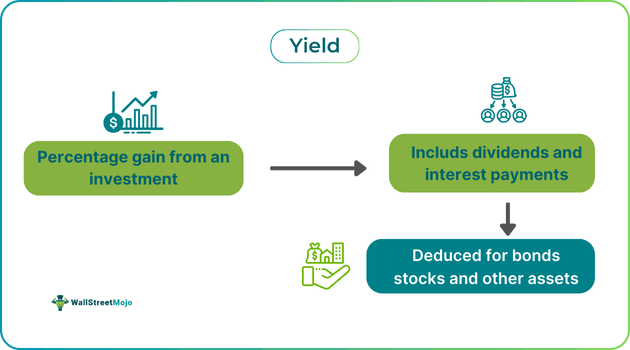
It is an essential financial metric and allows investors and market analysts to understand the potential and prospects of any investment. Any investor operating on the basis of yield is well informed about the net income and all the other sources of gains that they collectively received from the investment. It allows them to predict how much they will earn relative to the market value or from the investment’s initial cost.
Key Takeaways
- Yield is the percentage gain from a stock, bond, real estate, or any other asset class during a particular period.
- In finance, there are five types of yield: stock, bond, maturity yield, yield to worst, and yield to call. Each defines a different scenario and application of yield.
- Yield for stocks is calculated by dividing net income by investment value and multiplying it by 100. In contrast, nominal yield for bonds is derived by dividing annual interest earned by the bond’s face value.
- It is a crucial financial metric, especially when deriving bond yield and comparing yield curves for bonds with different maturity dates.
Yield In Finance Explained
Yield is the gain realized by an investor on the investment they made over a given period. It is an essential financial measure and is expressed in percentages. It can be calculated for stocks, bonds, real estate, or any other financial instrument. Yield is derived from net income from an investment, which means it includes all types of earnings collectively, such as increases in price, coupon payments, dividends, and interest rate benefits. Many people confuse it with return or rate of return, but they are distinct concepts. In a nutshell, they are defined as the cash flow measure for an investor.
Ideally, a yield is computed on a yearly basis, but it can also be calculated for different periods, such as monthly, quarterly, or half-yearly. The annual percentage yield (APY) is the actual interest rate received from an investment in one year; this also includes compounding interest. An investor can compare the APY with different financial institutions to ensure maximum returns and the right investment choices. A yield should never be taken as the total return.
When it comes to deriving yield for bonds, there is also a yield curve taken into consideration, which depicts the curve of different bonds with different maturity dates but the same credit quality. There are three yield curves: normal, inverted and flat. The normal curve depicts low yield for shorter maturity bonds with a slope upward. The inverted yield curve is a slope downwards with short-term interest rates going above long-term rates. Lastly, the flat yield curve depicts uncertain economic conditions with similar yields for all maturity dates.
Types
Following are the five main types of yield in finance –
- Stock yield: This represents the yield calculated particularly from stock investments. There are primarily two types of stock yield: cost yield and current yield. In the former, the purchase price is considered, whereas in the latter, the current price is taken into account.
- Bond yield: It is calculated on bonds that pay annual interest. It is also referred to as nominal yield, calculated by dividing annual interest earned by the bond’s face value.
- Maturity yield: This is only derived when the bond is kept intact till maturity. It determines the total expected return from a bond every year until maturity. This is not calculated on a per-year basis, may vary with each passing year, and hence is different from nominal yield.
- Yield to worst: It computes the lowest potential yield expected on a bond, keeping the possibility of default aside. It represents the worst-case scenario, with the bond issuer’s expectation implying callback, prepayments, and sinking funds. Yet, this yield is an important measure to showcase that certain income requirements will still be covered.
- Yield to call: This is only determined for a callable bond. The bond issuer can redeem a callable bond before its maturity date. This is based on the bond’s yield at the time of its call date. The value in yield to call is deduced from the interest payments, duration until the call date and market price.
How To Calculate?
For stock yield, there are two methods based on the investor’s interest. It can be calculated on the purchase price, which is
Stock yield (cost yield) = (Net income/Purchase price) x 100
Here, the net income is the sum of price increases, dividends, interest payments, and other coupons.
But if the investor wants to calculate the stock yield based on the current market price, the formula will be:
Stock yield (current yield) = (Net income/Current price) x 100
For the calculation of yield on a bond,
Bond yield = (Annual Interest Earned / Face Value of Bond)
The bond yield, also known as the nominal yield, is calculated based on many scenarios and assumptions.
Examples
Below are two distinct examples of yield calculation and scope in finance:
Example #1
Imagine Mary is a stock investor; she invested in a hotel stock, and she bought nine shares of stock at the price of $45. After nine months, the stock price reached $72. During this time, the company also paid Mary a dividend of $18. Now, if Mary decides to calculate the yield after nine months.
Yield = (Income/Investment value) x 100
Income = Annual income is the sum of net income, dividends, interest payments, and other coupons.
Income – (9 x 72) – (9 x 45) = 243 + $18 (dividend) = $261
Investment value – 45 x 9 = 405
Putting the values in the formula
(261/405) x 100 = 64.4%
Therefore, Mary has generated a yield of 64.4% from her hotel stock investment in nine months. This calculation is based on the cost yield method.
Example #2
BlackRock believes that US bond yields are closer to fair after the selloff. A sharp selloff in US treasuries is making the bond market’s valuation fair. David Rogal, BlackRock’s portfolio manager from the fundamental fixed income group, said that after the resilient labor market report, he would prefer an intermediate bond yield.
Investors are able to lock in higher rates on intermediate bonds yet remain less exposed to potential correction in term premiums. BlackRock is working on more economic data. US elections and the Fed’s next policy meeting. It is advised to have a plan, as different outcomes of the elections can have different impacts on the market. At the same time, the 10-year treasury yield in the US has risen to 4.07%.
Yield Vs. Return
The key differences between the two concepts are given below:
| Yield | Return |
|---|---|
| It is the investment gain from a particular time frame. | Return is the amount of investment earned or lost over time. |
| It is expressed in percentage. | The difference from the holding amount value reflects return. |
| It reflects a forward-looking scenario. | A return works in a backward-looking perspective. |
Frequently Asked Questions (FAQs)
Frequently Asked Questions
Is a higher yield better?
<p>Ideally, every investor focuses on gaining maximum yield on their investment, but yield is directly proportional to risk. This means the higher the yield, the higher the risk factor. Hence, for an investor with a low-risk appetite, a low-yield stock or bond is better, but if an investor is willing to take a risk, a high-yield bond or stock investment will suit them.</p>
Is yield a profit?
Yes, it is the net income generated from an investment in percentage terms. It is an important financial metric because it includes all types of income associated with the asset investment, such as interest, coupons, and dividend payments received. Technically, it refers to producing profit.
What is the difference between yield and interest rate?
These are two distinct yet equally important financial metrics linked to a financial investment. Yield is typically higher than the interest rate because it includes other gains in addition to interest. While yield is usually calculated annually, the interest rate can be calculated over different periods and tends to be lower.