


Women-Owned Business Definition
A Women-Owned Business refers to any business that ideally has at least 51% female ownership and is actively controlled, operated, and run by her. It is a prominent concept in the United States and is used as a designation by government agencies, global entities, and business associations.
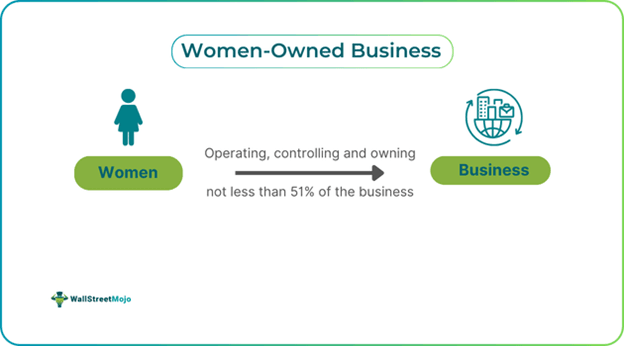
More than one woman can own a woman-owned business enterprise, and the whole concept is introduced to create special programs to encourage and empower more women to participate in business and become owners. Hence, being certified as a women-owned business by US third-party, state, local, or federal agencies offers multiple benefits.
Key Takeaways
- A women-owned business is any enterprise operated, controlled, and owned by a woman or a group of women with not less than 51% of the ownership rights.
- It is a specific designation certified by different third-party, local, state, or federal agencies in the US to create special programs for such businesses.
- Women-owned enterprises bring a positive change in society, break patriarchal norms, inspire the next generation of women, create healthy competition, and make workplaces more comfortable.
- Agencies like the Women’s Chamber of Commerce, WBENC, UNGM, the US Small Business Association, and the Department of Labor set special programs for such businesses.
Women-Owned Business Explained
A women-owned business is any form of business managed, controlled, operated, and owned by one or more women. However, the key factor for a business to be categorized as a women-owned business is that the woman’s partnership or ownership in the company should not be less than 51%. There are women-owned business certifications that various business associations and state, local, or federal government agencies in the US offer to such firms, which, once applied for and obtained, makes them eligible for various benefits.
When a business is registered as a women-owned business, it becomes entitled to special programs that help it through various means of funding, business activities, and legal assistance. One woman joining and owning businesses encourages and inspires other women to come forward and start new businesses and become entrepreneurs, which thereby brings a positive change in society.
Women introduce new products and service ideas that can eventually contribute to the nation’s economic growth by generating employment and revenue. The encouragement of women’s entrepreneurship has helped overcome the layers of generational notions, bias, and norms, restricting women in some parts of the world from taking part in establishing themselves as business owners.
Agencies and authorities like the US Department of Labor, the US Small Business Administration, the Women’s Business Enterprise National Council (WBENC), the US Women’s Chamber of Commerce, and even the United Nations Global Marketplace (UNGM) have definite certification programs for women-owned businesses. The UNGM has allowed suppliers to register as women-owned businesses online since 2017.
7 Reasons to Fund Women-Owned Businesses
Multiple reasons make funding women-owned businesses necessary and preferable. Some of these reasons include the ways that make funding accessible to women entrepreneurs, as well as the methods through which they are made aware of such opportunities. Let us look at some of the most common reasons to fund women-owned businesses –
#1 – Accessible funding option
- Available business loans: As soon as a woman decides to start a venture, varied women-owned business loans are available. The easy availability of these from banks and financial institutions helps them establish their venture. Once registered with the authorities as a women-owned venture, their initiative begins receiving multiple benefits under various schemes, thereby boosting growth.
- Accessible crowdfunding: Crowdfunding can finance female-owned businesses. It mainly works when women have a unique product or service that they want to launch in the market. There are many crowdfunding platforms online that can help women raise capital for their business ideas.
- Buying from women-owned businesses: A simple and effective way to fund women-owned businesses is to buy from them. By doing so, every customer is adding to their sales and revenue, making their business more profitable.
#2 – Raising Awareness
- Women entrepreneurship programs: All the local, state, and federal agencies and business associations strive to set special programs for women-owned businesses and help them start their entrepreneurial journey by helping them through different ways, such as women-owned business grants, paperwork, legal procedures, and financial assistance.
- Women mentorship programs: When women are mentored in the right direction and are offered to be educated and learn business skills, they will automatically tend to start their businesses. This allows them to compete with men healthily.
- Steps against gender discrimination: People who genuinely care about women and their empowerment can come forward and speak against gender discrimination. This brings a positive shift in society, more importantly in the legal and regulatory landscape.
- Enhancing knowledge: Most women lack confidence in entrepreneurship skills, fear failure, are not well educated, and lack networking skills. Simply by educating them with the right knowledge, a major change in society will eventually allow them to fund their businesses.
Top 10 Women-Owned Companies
Below is the list of the top 10 women-owned businesses –
- In-N-Out Burger – Lynsi Lavelle Snyder-Ellingson owns the popular burger chain. Her grandparents, Harry and Esther Snyder, founded In-N-Out Burger in 1948, which Lynsi inherited, becoming one of the youngest American billionaires. After owning the chain, this woman expanded the number of units to more than double, including locations in Idaho, Texas, Colorado, etc.
- ActOne Group Inc. – It is a human resource management firm that Janice Bryant Howroyd started by taking a small loan of $900 from her mom. Currently, the company is active in 33 countries, has over 17000 clients, and generates $2.5 billion in revenue.
- Rodan + Fields – Katie Rodan and Kathy Fields co-founded this multi-level skincare product marketing company. The dermatologists, by profession, formed this company after the success of their acene product, Proactiv. With Rodan + Fields, they began selling directly to consumers. The company records approximately over $1 billion in annual revenue.
- The Wonderful Co. – Couple Lynda and Stewart Resnick bought farmland to sell their agricultural products, such as pistachios, halos, and Fiji water, and owned the label. The estimated yearly revenue of the company was around $4 billion in 2023, and Lynda owns more than 51% of the business.
- Panda Chain of Restaurants – This is an Asian chain of restaurants headed by owners Peggy and Andrew Cheng. Its estimated annual revenue was $5.4 billion in 2023. Peggy is a former engineering student, and the couple shares equal responsibility, being co-founders, co-chairs, and co-CEOs.
- Howard Hanna Real Estate Services Inc. – Started in the 1950s as a small startup, the company has grown to be the largest family-owned real estate broking company. It is established in several states and has generated over $1.1 billion in sales as of 2023. The company is said to be owned by the whole family, but Hanna Cestra, Helen Hanna Casey, and Hoddy Hanna hold major stakes.
- ASI Computer Technologies Inc. – Christine Liang owns the company. She started it with $16,000 of her savings. Though she likes to remain unnoticed, her business has become one of the largest distributors of IT products in North America. In 2022, the company generated an annual revenue of $1.48 billion.
- America Chung Nam – It is one of the largest containerboard manufacturing companies in China. Owned by Cheung Yan and Liy Ming Chung, the company offers services as an integrated supply chain for recyclables worldwide. According to Forbes, both the owners shared a combined net worth of $3.1 billion as of February 2024.
- Perry Homes – Owned by Kathy Britton, the home and real estate company serves in four major markets of the US: Houston, Austin, Dallas, and San Antonio. The company was initially owned by KAthy’s father, and only after his demise she took over the authority. As of 2022, the company raised a yearly revenue of $913 million.
- MTM Inc. – With an estimated yearly revenue of $1.02 billion, MTM is one of the largest non-emergency medical transportation (NEMT) brokers in the US. Alaina Macia owns the company. The firm has scheduled more than 25 million trips for 13.6 million members in the United States and manages over eight million calls yearly.
Examples
Here are two examples of women-owned businesses –
Example #1
Suppose Michael and Mary, a couple, decide to start a restaurant in New York. They had the required capital and worked out every single detail, document, process, location, and construction to start a restaurant.
Now, although both are equally invested in the business, Mary asked Michael to let her have 63% of the restaurant business as she wanted to get their restaurant certified by different US federal agencies and business associations as a women-owned business. Doing this would help the couple take advantage of special programs created for such ventures that they wouldn’t have gained if Michael had owned more than 51% of the restaurant. Mary gets the restaurant registered with the UN Global Marketplace to add to their women-owned business benefits.
Example #2
As of September 2024, the number of women-owned businesses doubled the rate of businesses run by male owners. In fact, Latina entrepreneurs and women owners of color emerged stronger from the pandemic than other women owners. As per Business Wire, women-owned businesses now represent 39.1% of over 14 million businesses and employ over 12.2 million workers. All these women-owned enterprises have also managed to generate $2.7 trillion in revenue.
The report suggests that during the pandemic in 2020, women launched more businesses while men-owned businesses declined. The former added 1.4 million jobs, generating $579.6 billion in revenue, thereby contributing to the economy’s growth even during the worst situation caused by COVID-19.
Importance
The importance of women-owned businesses has been mentioned point-wise below-
- Plays a crucial role in generating revenue for the economy and employment opportunities in the market.
- When women join businesses and own them, it automatically induces a demographic change and brings about a matriarchal change in society.
- Women-owned businesses inspire and encourage the future generation of women to start businesses and become entrepreneurs.
- Businesses have been observed as majorly men’s areas of work, women-owned businesses strive to eliminate this notion.
- When women take control of businesses and operate and manage them on a daily basis, they make the workplace more comfortable and friendly for other female workers.
- It evokes healthy competition among men and women, which eventually generates more business, market operations, employment, and revenue for the whole economy.
Frequently Asked Questions (FAQs)
Frequently Asked Questions
Is it necessary to get certified as a women-owned business?
Yes, it is. Different organizations and agencies in the US give certification to women-owned businesses, which validates that they are connected to them. When women entrepreneurs get certified for their businesses, they are exposed to a vast network of support, new business opportunities, development programs, increased corporate visibility, and government supplies.
What are the benefits of a women-owned business?
The benefits of a women-owned business are – – Variety of funding options available – Certifications help women entrepreneurs compete with dominant businesses – Generation of employment and revenue in the economy – Creates a comfortable, professional environment for women
What are the challenges that a women-owned business faces?
Although there are now many special programs and support available, the major challenges faced by women-owned businesses or women entrepreneurs are – – Male-dominated areas of work, gender bias – Lack of education, confidence, and networking – Work-life balance – Limited mobility and funding – Missing role models, fear of failure