


What Is Group of Eight (G8)?
The Group of Eight (G8) was a political forum formed between the governments of the world’s eighth-largest industrial economies, including the United Kingdom, United States, Germany, France, Italy, Canada, Japan, and Russia. This intergovernmental organization’s primary agenda was to find solutions to global monetary, political, and economic concerns.
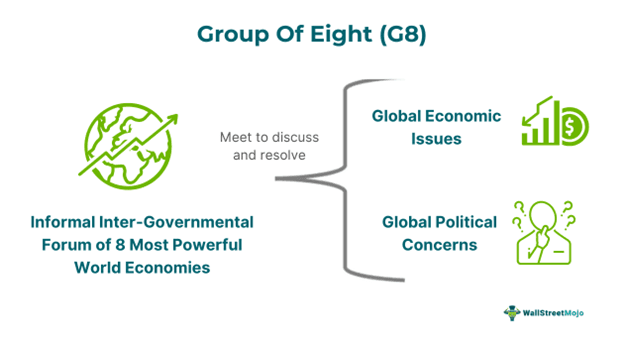
The G8 was an informal forum without any permanent secretariat and proper bureaucratic structure. However, the leaders gathered for annual meetings or summits where they would discuss international issues concerning global security, crisis management, terrorism, economic growth, climate change, and energy. The member countries held significant power and contributed to almost half of the global economy.
Key Takeaways
- The Group of Eight (G8) was an informally created inter-governmental forum that involved the world’s eight most incredible economic powers based on industrialization.
- The G8 included Germany, Italy, the United Kingdom, the United States, France, Japan, Canada, and Russia.
- The primary agenda of G8 was to discuss and find solutions to global economic, political, and monetary problems at its annual summits.
- The G8 was initially known as the G7 before Russia joined the organization in 1997. However, in 2014, Russia was barred from the group due to its annexation of Crimea. After that, the forum was again known as the Group of Seven.
Group of Eight Explained
The Group of Eight (G8) was an informal forum of the world’s eight strongest industrialized nations, i.e., the United Kingdom, United States, Germany, France, Italy, Canada, Japan, and Russia. It was formed to achieve effective global economic and political governance by addressing the critical problems of the international markets.
Although it began with the purpose of redressing economic concerns, the group focused on other global issues during the 1990s, like global security, crisis management, climate change, terrorism, and energy. Further, it started collaborating with other governments, UN agencies, and NGOs to expand its reach to public-policy networks for unanimously handling global policy issues.
The G8 summits were held every year in different host nations. The presidency of G8 shuffled annually between the member countries to offer each nation a chance to plan the annual summit and ministerial meeting. Although the group didn’t have an established bureaucratic structure or any fixed secretariat, it made some significant contributions to global governance. Notably, G8 played a remarkable role in ending the war in Kosovo with the help of NATO, EU, OSCE, and the UN. However, critics believe that G8 was an unfair approach due to its non-inclusive nature.
History
G8 was a reconsidered name given to the Group of Seven, based on the number of countries included as members of this inter-governmental forum. Initially known as the G6, it originated in the early 1970s when the six most powerful countries around the globe attended an informal meeting to exchange views and ideas on addressing the prevailing global oil crisis and economic recession. These nations were the UK, the US, West Germany, France, Japan, and Italy.
However, the group was officially incorporated in 1975 during a meeting at the Chateau of Rambouillet, France. The meeting was hosted by French President Valéry Giscard d’Estaing and German Chancellor Helmut Schmidt. Also, in 1976, Canada became a part of G7, justifying the name of the group. Initially, G7 was concerned with economic issues such as growth, inflation, and trade, but eventually, its agenda started covering political matters. Further, in 1997, Russia was included, transforming the group into the G8, although it only took part in political discussions.
In 2014, Russia was expelled from G8 due to its annexation of Ukraine’s autonomous republic, Crimea, which ultimately reformed the group into G7. Russia also announced its permanent withdrawal from G8 in 2017.
Objectives
As a small group of the eight major industrially powerful countries of the world, the primary purpose of the G8 was to deal with various global concerns unanimously. They aimed to find solutions for better global economic governance. Let’s discuss the top-most aims of G8:
- Address Global Issues: During the G8 annual meetings, the Prime Ministers, Presidents, cabinet ministers, and economic advisors of the member nations participate. They discuss international political, economic, and monetary problems.
- Develop Resolution Strategies: The representatives of the member countries would also provide suggestions, ideas, and solutions to overcome these problems. They would develop strategies for the welfare of the member nations and the world.
- Achieve Global Economic Cooperation: The G8 aimed to attain international economic cooperation and foster the growth of economies worldwide. This was achieved through constant brainstorming and problem-solving on the global front.
Member Countries
The G8 was an expanded version of the G6, which initially included six countries: the UK, the US, West Germany, Japan, France, and Italy. This forum’s major concern was to collectively deal with the economic issues of the global market as the industrial leaders of the world. However, the constant inclusions and exclusions left us with the G7, which is still functional.
Now, talking about the membership of this forum, given below is a brief on the group of eight countries it was made up of:
- United States
- United Kingdom
- Canada
- Germany
- Japan
- Italy
- France
- Russia
Criticisms
The critics have often questioned the relevance of G8 for resolving international issues due to the following reasons:
- Informal Structure: This forum was similarly structured to the UN Security Council, but it included only the powerful economies. It did not have any specific bureaucratic structure or permanent secretariat.
- Not an Inclusive Approach: The G8 was made up of the eight most powerful industrialized countries in the world. However, it did not comprise emerging economies like Brazil, China, India, Mexico, and South Korea, which were equally significant in shaping global market dynamics.
- Restrictive Membership: The forum’s small size and homogeneous group of member countries made it unable to achieve global cooperation and make effective decisions applicable to international markets.
- Deprived Global Interest: These global political powers were often criticized for serving only Western interests while ignoring the prosperity of diverse global economies, thus making them internationally irrelevant.
- Alternative Forums Were More Inclusive: Critics also believed that other organizations, such as BRICS (Brazil, Russia, India, China, South Africa) and G20, were more effective due to their more diverse inclusion in dynamic global economic discussions.
Difference Between Group of Eight and Group of Seven
Although the purpose of both the inter-governmental organizations is to ensure global economic and political cooperation, there exists a minor distinction between the G8 and G7 forums, as discussed below:
Frequently Asked Questions (FAQs)
Frequently Asked Questions
What is the difference between Group of Eight (G8) and Group of Twenty (G20)?
The G8 was an exclusive forum that comprised the world’s most powerful industrial economies. On the contrary, G20 is a group of diverse developed and developing global economies, including Australia, Germany, Argentina, Canada, Brazil, South Africa, the UK, the US, China, Italy, India, France, Indonesia, Russia, Mexico, South Korea, Japan, Saudi Arabia, and European Union. However, both these groups aim to achieve global economic cooperation by resolving international economic and political problems.
Where is the Group of Eight (G8) summit this year?
The 2024 G7 (formerly G8) summit will be held in Borgo Egnazia, Apulia, Italy, from June 13 to 15, 2024. The Italian G7 Presidency will be the host, and the other international partners, comprised of the leaders of five international organizations and 11 nations, will also be invited to the summit.
Why is China not in the Group of Eight (G8)?
Since the G8 entertains only the top most developed economies, China couldn’t secure a place in this forum because its economy is still developing.