


What Is Consensus Mechanism?
The consensus mechanism in blockchain refers to a system that requires the consent (general agreement) of all validators (participants) to maintain the security of the online ledger. The primary purpose of this system is to allow a group of nodes to update the network over a consensus.
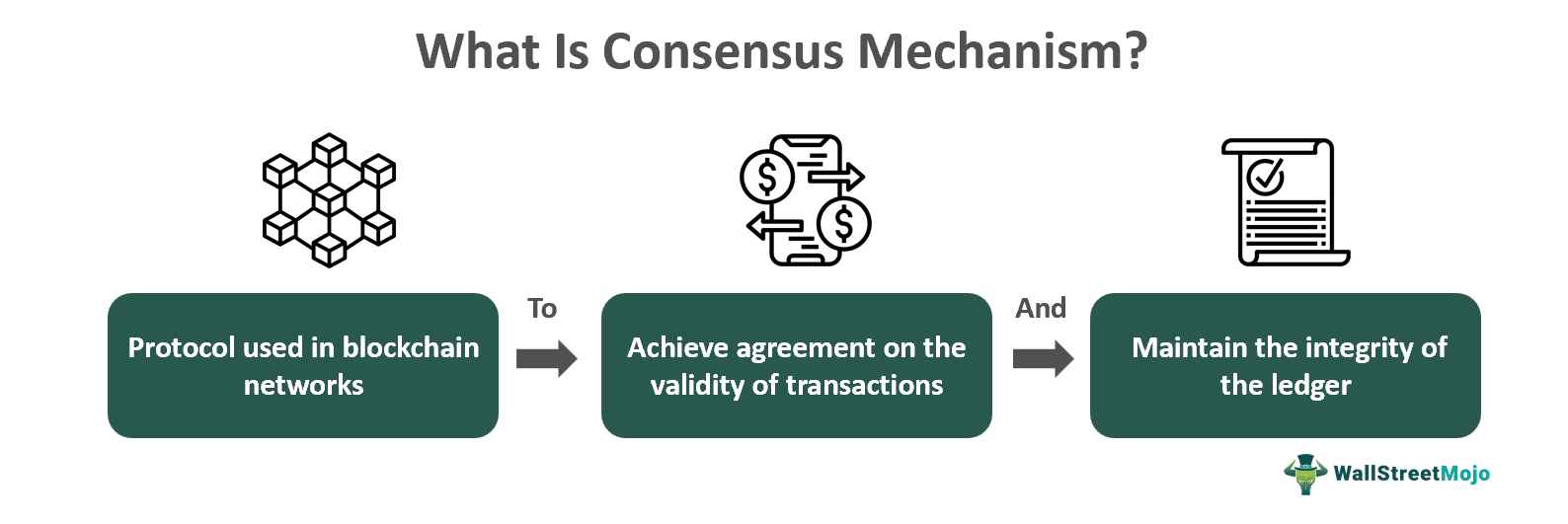
It is a fault-tolerant protocol that refrains faults and malicious failures within the system. However, the origin of the consensus mechanism dates back to the 1980s. Computer scientists Leslie Lamport, Barbara Liskov, and others suggested ways to avoid failures within the blockchain. Thus, every blockchain adapter has a different consensus mechanism.
Key Takeaways
- Consensus mechanism is an essential component of blockchain technology and its corresponding whitepaper. It refers to all validators’ general consent or agreement on an update.
- The initial mention of this protocol dates back to the late 1970s by Leslie Lamport, Barbara Liskov, and others. They aimed to avoid malicious attacks on the system.
- There are various types, namely proof of stake (PoS), proof of capacity, proof of work, proof of burn, proof of elapsed time, proof of activity, and others.
- However, they may consume high computational power and space. Also, every blockchain network possesses a different algorithm.
Consensus Mechanism Explained
The consensus mechanism is a protocol that enables the functioning of the cryptocurrency and DeFi applications within the blockchain. Nodes (computer systems) are present to verify every transaction on the network. And the consensus of each node is equally essential for the blockchain to function. If it fails, it may cause loopholes in the network for malicious attacks. As a result, the presence becomes crucial for the blockchain network.
Transactions conducted on the blockchain are stored in the shared databases known as “distributed ledgers.” They provide easy access to all validators and nodes on the network. The nodes record transactions, validate them and store them in the blockchain network. Further, miners present on the network perform their functions. They validate these transactions using computational power. When they agree on the validated transactions, the information gets updated on the distributed ledger. It is then added to the blocks until complete. Unless each node (computer) adheres to the same rules and forms an agreement, an update does not happen. Hence, the security of the users in the network is protected.
In the consensus algorithm, at least 51% of miners must agree to a decision. In short, this mechanism only performs half of the job, and the rest depends on the miners. As they agree, the update occurs in the network. With this, the system becomes decentralized instead of centralized power. Likewise, the chances of malicious and fault-tolerant threats are reduced. In short, it reduces the human verifiers and the risk of double-spending or Sybil attacks. However, only some sometimes lie with the majority. Although the mechanism considers consensus, the benefit is for the network. Otherwise, the system will reject it.
Types
Let us look at the types of consensus protocols:
#1 – Proof of Stake Consensus Mechanism
It destroys the risk of high computational power, unlike PoW. It uses the staking protocol to provide rewards to miners for their participation. However, its implementation depends on the number of nodes (participants)—for example, Cardona, Solana, Ethereum, and Polkadot.
#2 – Proof of Elapsed Time (PoET)
PoET works on a time-lottery concept that provides a fair chance for validation purposes. This means that random waiting time is allocated to each miner. So, the first node to complete its waiting time gets time to add its block to the network. Intel Corporation developed this mechanism in 2016.
#3 – Proof of Capacity (PoC)
As the name suggests, this mechanism depends on the capacity of the node’s network. In short, computers with higher drive storage can achieve more mining rights and validation than others. A few coins include Burstcoin, Chia, Storj, and others.
#4 – Proof of Work Consensus Mechanism
PoW refers to the protocol where miners compete to validate the transactions. In exchange, they receive coins as a reward for the mining performed. However, it involves high computational power. Thus, it might be expensive for some validators to perform. Some crypto tokens include Bitcoin, Dogecoin, Litecoin, and others.
#5 – Proof of Activity
It is a blend of PoS and PoW mechanisms where miners absorb both systems’ benefits. Here, they have to utilize high power to add a block, and its selection depends on the number of coins held. For example, Decred is a crypto token using this consensus protocol.
#6 – Proof of Burn (PoB)
The PoB is a consensus mechanism that enables the periodic burning of coins for its functioning. Its primary purpose is to eliminate the threat of inflation and high volatility. Besides PoW, Bitcoin even uses a proof of burn mechanism.
#7 – Proof-of-Authority
Although proof of authority protocol is unpopular, selective private organizations still use it. Here, the miners stake their authority or power to perform validation procedures.
#8 – Proof of Importance (PoI)
The proof of the importance of the protocol depends on the importance of the miner. Users with enough quality transactions and reputations can easily add blocks to the network.
#9 – Byzantine Fault Tolerance (BFT)
BFT refers to the ability of the network to continue operating despite faulty components. It has enough energy efficiency and resistance to malicious attacks. Hyperledger Fabric is the most popular of the DeFi (decentralized finance) applications.
#10 – Ripple Consensus Mechanism
It is one of the prime protocols of RippleNet (RTXP). The main goal is to reduce errors during the transaction time of their crypto token Ripple.
Examples
Let us look at some real-time and hypothetical examples to comprehend the concept better.
Example #1
Suppose PSS is a blockchain technology adopted for its cryptocurrency. However, in the initial phase, there were specific malicious cyber-attacks on the system. Plus, even the miners saw a massive rise in the energy consumption units. As a result, a consensus algorithm PoS was installed within the network. Thus, when users solved the mathematical proof, they received PSS tokens as a reward. Besides, this mechanism consumes less computational power (electricity). Hence, it was feasible for the nodes in the network as well.
Although this blockchain had PoS as a consensus mechanism, another blockchain might not have the same. It usually depends on the infrastructure and use cases of the network.
Example #2
According to the latest guidelines published by the IRS (Internal Revenue Service) in 2023, specific taxation rules apply to rewards earned through certain consensus mechanisms, such as proof-of-stake. Miners and validators are required to report both the validation rewards and the fair market value of the cryptocurrencies received. This means taxpayers must include the value of these rewards in their gross income when filing taxes. The fair market value is determined based on the date and time the taxpayer gains control over the validation rewards, reflecting the market value of the assets at that moment. It’s crucial for taxpayers, especially those in the US, to carefully track and report their staking rewards to avoid potential issues with taxation.
Advantages And Disadvantages
Although consensus mechanisms are essential elements of the blockchain network, there are certain limitations to the participants and the system itself. Let us look at them:
| Basis | Advantages | Disadvantages |
| Network Participants |
|
|
| Blockchain |
|
|
Frequently Asked Questions (FAQ)
Frequently Asked Questions
What consensus mechanism does poly mesh use?
The Polymesh network uses the Nominated Proof of Stake (NPoS) mechanism. It is a fault-tolerant algorithm that sets rules, roles, and rewards for the network nodes. Miners, here, use POLYX tokens to acquire a stake in the system.
What do consensus mechanisms optimize?
The leading optimization occurs in these three regions: scalability, security, efficiency, speed, fairness, adaptability, decentralization, and validation procedures. The consensus algorithm ensures that the blockchain network has no loopholes during the creation of blocks.
What consensus mechanism does the EOS network use?
The EOS network uses the delegated proof of stake (DPoS) for its naive coin EOS (utility token). The system typically elects certain producers to validate transactions and add blocks to the EOS network. It enables the development, hosting, and execution of decentralized applications curated for industry needs.
How many consensus mechanisms are there?
There are, in total, 14 consensus mechanisms in the blockchain network. However, every model consists of similar objectives within the system. It includes cooperation, consensus, and collaboration of nodes, as well as providing equal rights to miners and their active participation in the network.