


What Is Forensic Interviewing?
Forensic interviewing refers to a methodology for obtaining data from interviewees, suspects, or witnesses in relation to an impending or ongoing financial investigation regarding fraud. It gathers valuable information for use in legal proceedings like court hearings against perpetrators of financial fraud to investigate and prosecute them.
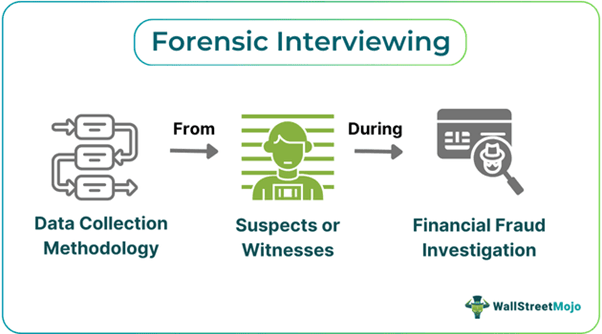
It helps elicit confessions from suspected persons, obtain incriminating information from witnesses, and determine areas needing further investigation. It can be done by engaging individuals in structured conversations to gather details on fraudulent activities to supplement documentary evidence.
Key Takeaways
- Forensic interviewing alludes to a method of collecting information from witnesses, interviewees, or suspects in terms of an upcoming or ongoing financial investigation concerning financial irregularity.
- It collects treasured information for use in felony court litigations, such as legal hearings against perpetrators of monetary fraud, to research and prosecute them.
- To expose suspected fraudsters, scrutinizing public records, conducting background checks, preparing interview questions, using reliable sources, and analyzing evidence, among other things, can be used.
- It streamlines fraud investigations, provides targeted approaches, extracts valuable information, and enhances success with skilled forensic interviewers.
Forensic Interviewing In Finance Explained
Forensic interviewing in finance is a systematic procedure deployed during forensic investigations. It comprises evidence gathering through different techniques, such as key witness interviews and document analysis. It uncovers any financial fraud, misconduct, or irregularities taking place inside a company. Since the 1930s, it has been deeply involved in the financial matters of all companies and the government.
- They can be conducted by following the below steps:
- The preparation of the interview stages commences.
- A team is made to conduct the interviews.
- A perfect rapport is built.
- Then, baselines are established and
- An evaluation of non-verbal and verbal indicators takes place to ascertain the truthfulness.
Not the least, the interview is set up to allow the interviewee to divulge critical information voluntarily. This acts as a potential deterrent to financial fraud, instilling a mental blockade in the minds of wrongdoers. Hence, it upholds the transparency and integrity of accounting systems within a company and industry as a whole.
It finds application in numerous financial scenarios by providing a methodic framework to bring the financial offense to the public’s attention. Further, incorporating legal consultation ensures employees’ rights are respected and adhered to despite varying company policies and jurisdiction. With the advent of various technologies and globalization, financial crimes have become a new feature of the corporate world.
In such situations, forensic interviews have come as a savior of the financial world, extending security and stability by uncovering various types of sophisticated financial crimes. Also, they provide remedies and solutions to address these fraudulent activities by putting in place standard operating procedures for forensic audit and compliance.
Techniques
Auditors and investigators can use the below techniques to conduct detailed accounting investigations:
- Scrutinize the available public records and undertake extensive background checks to get past financial records and dealing of a business.
- Prepare a model set of interview questions to collect important information on the facts to ascertain the gravity of the situation.
- Take help from trustworthy and confidential sources while protecting the sources to get reliable information.
- Analyze all the evidence collected to expose the guilty person and comprehend the extent of fraud committed.
- Carry out surveillance activity to track and monitor official plus personal mail and messages out of and into the company using physical or electronic means to discover hidden fraudulent activities.
- One can also go undercover to prevent alerting the persons involved in financial fraud.
- Analyzing and summarizing the financial records also shed light on a financial scam.
- Various data analysis tools must be used to scrutinize every financial aspect of a company to identify irregularities and anomaly in that indicate the presence of fraud.
- The flow of assets and funds must be tracked to expose all undisclosed transactions, hidden assets, irregularities, and misappropriation of funds through intricate examination of bank statements and financial records.
- Also, individuals can use detailed and tactical interviewing techniques on suspected fraudsters.
Besides, the above techniques could be refined through forensic interviewing training and forensic interviewing certification, which can provide good opportunities for candidates to get forensic interviewing jobs.
Examples
Let us use a few examples to understand the topic.
Example #1
Recent research published on Emerald Insights on 30 November 2023 highlights the critical role of forensic interviewing techniques in uncovering financial crimes within a legal framework. The study examined commercial forensic interviewing methods, emphasizing the importance of aligning these techniques with legal standards to ensure that the information obtained is admissible in court. Two key strategies were discussed: the Person-Centered Approach (PCA) and the PEACE model, both of which contribute to compelling commercial investigative interviews.
The Person-Centered Approach (PCA) focuses on building trust through interpersonal dynamics, using principles such as unconditional positive regard and empathy to create an optimal environment for gathering reliable information. In contrast, the PEACE model provides a structured framework for forensic interviews, consisting of five phases: preparation, engagement, account clarification, closure, and evaluation. Both models serve as essential tools in the context of commercial forensic investigations, with the study suggesting that a combination of these approaches may enhance the overall effectiveness of interviews.
Example #2
Let us assume that HITECH COVID LTD, a medical restorative gear fabricating company, got government grants totaling $30 million to create and supply essential restorative gear amid the COVID-19 pandemic. Nevertheless, the company pronounced bankruptcy, raising doubts about fraudulent financial behavior. Hence, forensic accountants were entrusted with examining the matter and revealed the existence of fraudulent exercises, proving that the company had siphoned off $28 million of government funds for individual gains.
Therefore, through a meticulous examination of money-related records, interviews with company administrators, and examination of procurement and supply chain operations, the legal team unearthed a vast plethora and complex web of forged transactions and distortions. The forensic interviews uncovered intentional misappropriation of cash reserves, fabricated monetary reporting, and connivance among key stakeholders. As a result, this case underscored the importance of forensic accounting in revealing monetary extortion and guaranteeing responsible and honest behavior within the administration of government grants.
Importance
One can understand the importance of this methodology by going through the following points:
- It streamlines the fraud investigation, resulting in time savings that may have been spent on blind searches across financial records.
- It provides a targeted approach to investigative plans recurring the breadth of fraud investigations.
- It has the uncanny nature of extracting valuable information from suspected individuals involved in fraudulent activities.
- A team of highly skilled forensic interviewers increases the overall success in uncovering and proving malfeasance through a well-planned interview program.
- If the interview baseline is set strategically, then it can lead to a determination of demeanor signaling stress or uneasiness in a given response to an interview question from the suspected fraudster.
- It can act as a lethal tool to get candid confessions of financial crime from the actual suspects, corroborating the documentary evidence and leading to a successful court trial.
Frequently Asked Questions (FAQs)
Frequently Asked Questions
When to use forensic interviewing?
Investigating financial misdeeds like theft or forgery is essential. It is used to obtain basic information from witnesses, suspects, or those engaged in unethical activities involving money. These interviews are done to obtain confessions, points of interest that may be implicated, or further evidence that can support legal proceedings and motivate further investigation.
What are the reasons for the failure of forensic interviewing?
There are many reasons why forensic interviews could be more effective, including poor planning, the inability to build a rapport with the interviewer, poor interrogation strategies, and the ability to read clues and wrong inferences from weak non-verbal and verbal signals. Furthermore, a disorganized or rushed interview process may result in the collection of accurate or complete information, which could jeopardize the case and hinder the progress of the investigation.
What are the disadvantages of forensic interviewing?
It entails certain disadvantages like: • Wrong information provided by the interviewee • Manipulating the interview answers • Interview bias can creep into it, leading to doubts over the accuracy and trustworthiness of information. • Lack of interview skills can further deteriorate the quality of information obtained.