


What Is Fractal Markets Hypothesis (FMH)?
The fractal markets hypothesis (FMH) is a theory of investment that suggests market uncertainty leads to ad hoc market crashes and crises. It aims to explain and predict market behavior by considering fractals, crises, chaos, and crashes.
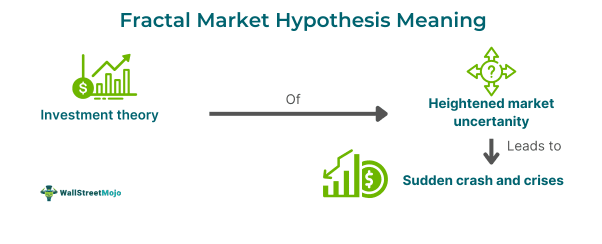
It was developed by Edgal Peters in 1994 as an alternative to an efficient market hypothesis. It accounts successfully for all the turbulence and randomness present in markets as crashes. It uses conventional quantitative techniques along with other theories to elucidate market participants’ and investors’ behavior during anomalies and chaos.
Key Takeaways
- The fractal markets hypothesis (FMH) is an investing theory that suggests that increased unpredictability in markets causes unexpected market crashes and disasters.
- It seeks to explain and anticipate market behavior by taking into consideration fractals, crises, confusion, and market collapses.
- FMH examines investment horizon changes during crises, liquidity situations, and information impacts, predicts investment horizon supremacy, and uses a new-fractal market hypothesis-based model.
- The limitations include difficulty in determining market price fractal properties, its early empirical proof, unclear practical application in the economic and development stages, and lack of monetary policy decisions.
Fractal Markets Hypothesis Explained
The Fractal market hypothesis utilizes concepts from chaos theories and fractals to explain stock market trends. It does this by analyzing the fractal movement of stock prices and cyclical fractal attributes. It explains that investors with different time horizons of investment add to market complexity. It focuses on the role of investors’ time horizons, as short-term investors concentrate on minutes or days of price movements. In contrast, long-term investors concentrate on decades or years of price movements, which can be obtained from TradingView easily.
Price movement chart:
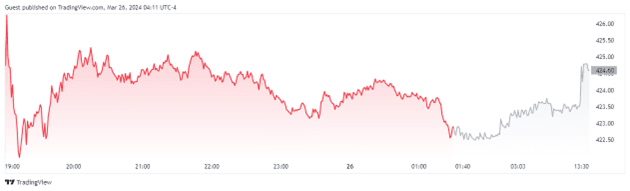
In the above image, the fractal markets hypothesis states that market prices show fractal characteristics over a long time, getting disrupted due to the change in investors’ time horizons and information sets. It elucidates that at times of increased market ambiguity, price movements show likely behavior when observed over various time horizons. This implies that any shift in investors’ focus on trading leads to market crashes. It contains implications for the impact of data on the business cycle, explaining investor behavior and liquidity.
It is widely used to predict the superiority of particular investment horizons during financial turbulence and to help one understand the vitality of liquidity in markets. Many models for risk assessment and market analysis also use FMH based on Levy statistics. It has posed a challenge to the correctness of the Efficient Market Hypothesis (EMH) as it suggests that market prices are volatile and inefficient. At the same time, investors’ behavior and time horizons bring market illiquidity and instability.
In short, it gives a more refined perspective concerning market volatility at times of crisis and instability.
Examples
Let us use a few examples to understand the topic.
Example #1
A research paper published in December 2022 examined the impact of FMH on technology, family business, shariah, the green market, the global market, and sustainability within the European zone. During the COVID-19 pandemic, global markets, family business, technology, and sustainability suffered from large multifractality, making them highly ambiguous, as per the singularity spectrum analysis.
Nevertheless, just before the pandemic began, the green market exhibited much smaller multi-tractability. Hence, the green market becomes more predicate than other sectors. As a result, the study highlighted that the pandemic enhanced the level of complexity in sustainability, global markets, technology, and family business. On the other hand, it decreased the complexity of green markets. Consequently, during pandemics like COVID-19, green stocks trading in the eurozone provide a significant avenue to hedge portfolios against these crises.
Example #2
Let’s say Alice, a day trader on the hectic Old York Stock Exchange, is closely watching her computer screen. She observes that stock prices appear to change at random, but Alice, someone who believes in the Fractal Market Hypothesis (FMH), notices a pattern. A most recent drop in tech stocks matches a smaller drop from a week earlier, creating a significant fractal. This replication across time scales confirms her suspicion of a future correction.
At this point, John, a long-term investor, relaxes. He rejects the market’s short-term turmoil and instead focuses exclusively on the market’s previous fractal growth, which is shown in long-term charts. Their opposing perspectives, based on various temporal frames, reflect the complexities that FMH investigates.
Applications In Finance
Let us delve into the significant role played by the fractal markets hypothesis in finance:
- It looks at changing the investment horizon when there is a crisis and stability. During a crisis, short-term investment is prioritized instead of long-term. As a result, most of the investors become short-term investors.
- It has more focus on liquidity situations in markets affected by investment horizons. If an investment horizon remains uniform in a market, then the market works efficiently, unlike when only a single or a group of horizons becomes supreme, leading to extreme activities.
- FMH studies the manner in which information impacts liquidity and time horizons, underscoring that stability affects individual investing choices while extreme price dipping may encourage long-term investors to sell.
- FMH predicts investment horizon supremacy when times become turbulent, like a global recession, by examining wavelet power spectra and continuous wavelet change.
- Moreover, FMH puts in a new financial risk evaluation model utilizing a fractal market hypothesis-based model and levy statistics financial forecasting systems.
Limitations
It comes with certain limitations, as listed below:
- It advises that market prices will eventually display fractal properties; however, finding the exact duration of such a pattern is difficult because it occurs on a daily, monthly, weekly, or longer basis.
- Being in the early stages of development, it has a nuanced market volatility perspective and limited empirical proof to aid its claims.
- It is significant in economic and monetary policies, but it remains unclear how it can be practically utilized in making policy decisions.
- It holds that agent information and interactions affect market price dynamics, but it becomes difficult to understand the true mechanics working behind the fractal structure.
- Clarify the practical implementation of FMH’s guidance on reducing flash crashes, enhancing market stability, and regulating high-frequency trading activities.
Frequently Asked Questions (FAQs)
Frequently Asked Questions
What are the benefits of the fractal markets hypothesis?
Although it is a new concept of market trading, it has multiple benefits, as listed below; – FMH provides deep insights into the dynamics of the market at times of upheaval in the financial nature consisting of hike uncertainty. – It successfully explains the sudden spurt in market volatility during the recession. – It also offers insights into a shortage of liquidity during crises and crashes.
Is it risky to use fractal markets hypothesis in the normal market scenario?
It may not be wise to use the FMH in a normal market scenario due to the following reasons: – It poses a risk due to its challenging assumptions about the EMH. – It may not always correctly reflect the sentiments of the market and its behavior.
Give one difference between EMH & FMH?
The major difference between the two is that: – EMH relies on the assumption that markets are efficient and investors act rationally. – FMH advises that market prices are fractal, and any change in investor behavior or information can easily disrupt them.