


What Is Augmented Reality (AR) in E-Commerce?
Augmented reality in e-commerce is the integration of technology so that consumers can have an interactive experience while shopping online. AR uses 3D to allow consumers to manipulate, visualize, and comprehend a product’s suitability and functionality. The ultimate result of incorporating AR in e-commerce is driving up customer satisfaction.
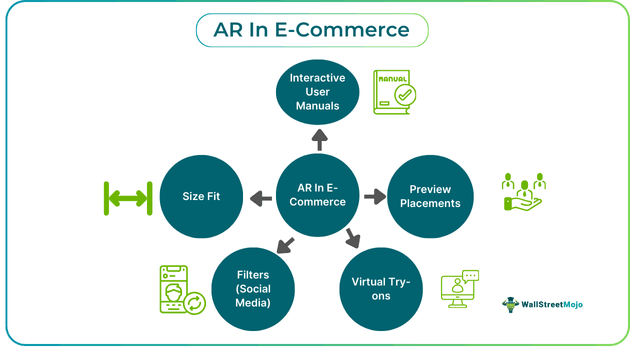
Augmented reality in e-commerce statistics shows that over 70% of online customers think AR provides them with helpful assistance while shopping. A few of the most common types of AR are size fit and virtual try-ons for fashion and beauty brands, social media filters, and preview placements for furniture and other such products.
Key Takeaways
- Augmented reality in e-commerce refers to the use of interactive technology to give consumers an equal or even better experience than shopping in reality.
- The most common ways of integrating augmented reality in e-commerce are facilitating virtual try-ons, size fit checks, previewing the aesthetic applicability of products like furniture and accessories, and creating interactive labels.
- Since customers get a chance to experience the real-life feel of the product, the conversion rates for businesses increase massively, and return rates sharply decline.
- The AR industry’s most significant limitations remain the high costs of development and integration, technical limitations, and user experience.
How Does Augmented Reality in E-Commerce Work?
Augmented reality in e-commerce is the integration of technology that allows users and customers to experience services and preview products in their current environment with a significant level of realism. It helps them understand if the product is a good fit for their needs or choices.
AR’s integration into e-commerce has filled the gap between physical stores and the experience of shopping online. In fact, during the COVID-19 pandemic, the gap became even more comprehensive as physical stores across the world were inaccessible.
Therefore, the use of AR has become even more widespread across industries like fashion, interior design, footwear, furniture, fitness, and social media. Research estimates that there will be more than 1.7 billion AR users on smartphones by 2024.
The three sub-categories of AR used in online businesses can be categorized into three types: Marker-based, GPS-based, and markerless solutions. Each of these categories helps consumers with different aspects of shopping. Businesses also have a combination of two types of Ars assisting their customers with their shopping experience.
When customers get to try the product virtually, e-commerce businesses benefit massively. Return rates plummet, customer relationships improve significantly, and conversion rates are impressively higher.
However, the high cost of integration has always been a problem for online businesses. Moreover, the technical limitations of having particular software and specifications have made incorporating the use of AR challenging.
How To Implement?
According to Augmented reality in e-commerce statistics, the use of AR increases consumer engagement by close to 200%. Therefore, it is clear that online businesses must integrate AR into their websites or applications. Below is a step-by-step process for implementing it.
- Objectives: The first step in implementing AR is understanding what the business wants to help its customers with. Understanding what its customers expect from the shopping experience can even snowball into making them want to come back again.
- AR Tool Identification: Once the goals or objectives are ascertained, the business must understand the tools that best suit its requirements. License type supported operating systems and devices, as well as capabilities, are factors that companies must closely consider before making a decision.
- Integration: Technical expertise is needed to integrate the new AR tool. It must be a frictionless process. Otherwise, it could be counterproductive in terms of giving the customer a fantastic shopping experience.
- Marketing: The only way existing or potential customers understand or learn about a new feature is through marketing. Therefore, companies can make a demo video, share it on their social media, or display instructions within their application to ensure every customer understands the ebbs and flows of the new integration.
Examples
The concept’s theoretical aspects have been established. Now, the practical aspects of augmented reality in e-commerce are explored through the examples below.
Example #1
XYZ Inc. is a furniture company that sells designer furniture at affordable prices on the Internet. However, it was experiencing a decline in the number of customers who ordered after spending considerable time on its website and application.
Their marketing team sent out a survey form. They found that most customers did not purchase because they were unsure if the piece of furniture would fit their physical space and, if it did, would it add to the aesthetics.
Therefore, it was decided that they could emulate the virtual try of the fashion industry with a slight twist and incorporate the same with furniture. Their AR integration allowed consumers to see how the piece of furniture would look in its intended spot.
As a result, their conversion rate shot up by 70%, and their revenue rose by 35% within the next quarter.
Example #2
Despite AR gaining prominence with each passing quarter, it is still considered to be in its nascent stages of development. Research found that only 1% of businesses are integrating AR into their sales strategies. Despite AR increasing customer confidence by over 70% and 40% of customers willing even to pay extra for such features, the numbers of businesses integrating it are shockingly low.
However, its use has been steadily rising. By the end of 2024, the AR market is projected to reach a valuation of about $50 billion.
Benefits
The benefits of integrating augmented reality in e-commerce have been mentioned in this article. However, a few specific critical points are discussed briefly in this section. They are:
- Conversion Rate: One of the significant challenges for online businesses is the conversion rate. The use of AR helps them give customers a satisfactory shopping experience. Therefore, most businesses experience a spike in their conversion rate after an AR-integration event.
- Shopping Experience: Passionate shoppers often miss the feeling of being in a physical store and trying things out before purchasing. Therefore, the use of AR tools can help them with a personalized or customized shopping experience that can significantly improve customer loyalty and customer satisfaction.
- Less Returns: Since customers can virtually try on or place the product and see if it fits their requirements and choices, the returns are significantly lesser. This is because consumers are more confident about their purchase since the element of uncertainty is eliminated.
- Uniqueness: The use of AR to improve customer experience is still upcoming. Therefore, this technology makes businesses stand out from their competitors. It helps a business or a brand elevate its perceived value.
- No Need for Physical Stores: The use of AR reduces the requirement to have a physical store. Since customers enjoy a similar shopping experience, entrepreneurs can save massive amounts of recurring costs of maintaining a physical store.
Limitations
Despite the various benefits, there are factors from the other end of the spectrum as well. The limitations of AR in e-commerce statistics are:
- The first limitation that might sting entrepreneurs is the high costs associated with developing and integrating these technological advancements. The cost is not just monetary but also in terms of deploying time and resources.
- Since the AR industry is still in its early stages, many technical limitations must be acknowledged and addressed. Without addressing them, these shopping experiences might not stimulate as much as a real-life shopping experience.
- While AR has existed for quite a few years now, consumers have been hesitant to use a few types of AR.
- The UX (User Experience) for these integrations must be flawless to ensure users do not get frustrated. Once users encounter such an experience, they might be averse to it in the future.
Augmented Reality Vs Virtual Reality in E-Commerce
Both augmented reality (AR) and virtual reality (VR) help customers experience the feeling of shopping virtually. However, there are a few fundamental and technical differences that set them apart. The differences between AR and VR are:
Augmented Reality
- AR uses digital elements on smartphones, computers, or tablets to give shoppers a feel for the product and determine whether it fits their choices and preferences.
- It improves the shopping experience and customer’s confidence in their choices. As a result, the return rate drastically reduces, and conversions improve significantly.
- It is used to preview products, check if a product fits a particular space, and virtually try on clothes.
- It is highly accessible as it only requires a smartphone, laptop, or tablet.
- It can also be used as an added feature to enhance real-world shopping experience as well.
Virtual Reality
- VR refers to the usage of technology to simulate an immersive experience through VR sets.
- It helps businesses create a virtual environment or a virtual store where consumers can browse through their products.
- It is mainly used for immersive product demonstrations, interactive showrooms, or virtual store experiences.
- Its accessibility is limited in comparison to AR, as VR requires VR headsets and a specific environment.
Frequently Asked Questions (FAQ)
Frequently Asked Questions
How Amazon is using augmented reality?
Amazon is a pioneer in incorporating AR with online shopping experiences. Their most popular use of AR is the cashier-less grocery store, often called Amazon Go. Other than this, they also allow customers to locate products and check how they look in specific spaces to assist them in their shopping experience.
What is the future of shopping with AR?
It is estimated that by 2025, 100 million customers will experience AR in either in-store or online forms. Given its popularity and the required technological growth, AR will bring in retained revenue of over $120 billion.
How brands can use AR?
Brands can use AR in multiple ways depending on the nature of their product and the AR tools they choose. However, a few of the most common ways brands use AR include virtual try-ons of clothes and other beauty products, previewing furniture, and interactive labels. In fact, one of the most common ways of using AR is the use of filters and interactive posts on social media, which has become one of the more prominent ways of generating sales online.