


What Is Return Label?
A return label is a pre-printed shipping label provided by a seller that allows customers to return damaged or unwanted items to a retailer or maker. It simplifies the entire return process for the recipient, seller, and sender customer. This ensures the product is returned to the correct return label address with minimal risk.
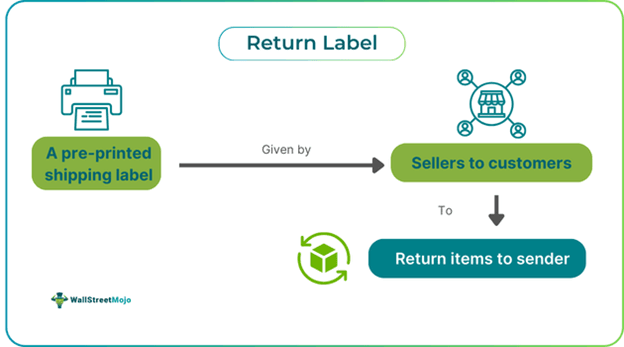
It reduces the risk of damaged packages or lost items in transit to ensure a timely refund. The label comprises the recipient’s address and the sender’s address, as well as vital information like shipping dates and barcodes, instructions for the shipping carrier, and tracking numbers. It helps locate the destination and track the package.
Key Takeaways
- A return label is a pre-printed shipping label offered by sellers that simplifies returning damaged or unwanted products to the retailer or maker at minimal risk.
- There are various types of such labels, including pre-paid, customer-paid, exchange, and gift labels.
- It can be created by selecting orders, choosing to create return labels, selecting carrier service, updating weight, reviewing errors, and confirming to print, email, or download it.
- It boosts revenue through repeat purchases from a loyal customer base. However, unused high-cost labels can reduce profit margins.
Return Label Explained
A return label can be defined as a pre-printed sticker comprising a tracking barcode, seller’s address, and sometimes return authorization number. It helps simplify the return process of items by buyers if they receive the wrong or damaged product or of different sizes, colors, or designs. It does so by removing any need to write the sellers’ address or make payments related to postage by customers. It has become a vital aspect of an excellent, smooth, and streamlined e-commerce experience for customers.
It reduces barriers in the return process, enhances customer satisfaction, and encourages repeat purchases. This can be achieved in two ways:
- Sellers include the pre-paid label in the original packing along with the initial shipment
- Buyers can self-generate the label for return online, prompting the seller to produce printable labels
This influences buyers’ behavior to make repeat purchases by reducing the risk of returning items and building trust. E-commerce businesses use it for all products to their advantage and to increase brand loyalty, trust, and buyers. However, it increases the operational cost related to printing the label and managing the return process. Nevertheless, streamlining the return process to a faster path increases revenue through more purchases.
Types
There are various such labels, such as those from Dillard, UPS, and Amazon return labels. Below, let’s discuss the most common ones.
- Pre-paid Return Labels: This means that retailers provide pre-paid services to help customers return products without the need to pay extra shipping costs.
- Customer Paid Return Labels: Here, the customer must pay the return shipping charges.
- Exchange Labels: Such labels come into play when a customer has to exchange a product for a different product or has a different design, color, or size.
- Gift Return Labels: These labels are used in situations when a gift has to be returned by a customer.
How To Create?
One can create a label easily using the following steps:
- Start by navigating to the “Orders” tab and select the orders that require return labels.
- From the “Actions” menu, choose the option to create return labels.
- The setup screen will appear for label creation.
- Choose the parcel account and carrier service you want to use from the order-related options.
- Adjust the weight of the order as necessary.
- Click Next to proceed after completing these steps.
- Review the details on the next screen.
- Finally, the confirmation will appear, allowing you to email, print, or download the return label.
Examples
Let us use a few examples to understand the topic.
Example #1
Let us assume that Olivia buys a pair of trousers from FashionFeast, an online retailer located in New York City. After receiving the order, Olivian finds that the trousers are the wrong size and that she has to return them immediately within the return period. However, FashionFeast mandates the use of a return label on the trousers as per the company’s return policy.
Hence, she notes down the retailer’s address on the label and also the unique ID. Olivia then repacks the trousers, sticks the label, and submits the package at the local PostQuick office in her town. PostQuick immediately scans the label to update the FashionFeast system and return tracking. Hence, the return package reached the FashionFeast warehouse in a week, and Olivia got a confirmation email of the refund of her purchase of $100.
Example #2
An online article published on 17 Jun 2021 discusses Amazon’s pre-paid return labels, which tracked service related to all domestic returns starting from 5 July 2024. Further, the expenses of return labels, normally about £2.75 through Hermes, would be added to the merchant’s Amazon invoice. Moreover, merchants can use the return-less label option for cheap items, in which buyers get a full refund when they request it without returning the product.
This is because the method will be minimally more expensive than paying after receiving the printed return label. On the other hand, merchants have the option of suing Amazon FBA after incurring 50% fulfillment fees or FBA return fees instead of spending on the costs of the return labels. Additionally, the whole procedure of the return label has been sent to the merchants, as underscored in the article.
Pros And Cons
Let us use the table below to understand the advantages and disadvantages of the label:
| Pros | Cons |
|---|---|
| Enhances customer’s shopping experience. | This may increase the frequency of returns, leading to revenue loss. |
| Acts as a differentiator of business from rivals, augmenting as a powerful marketing tool. | Hinders feedback collection due to reduced direct contact with buyers. |
| An easy return and secure option improve the rates of purchase checkouts. | The management and printing of labels lead to extra operational costs. |
| It offers convenience to buyers who don’t have to arrange or print their labels. | Complicates return eligibility and makes uncertain return management. |
| Encourages repeat buys and customer trust by making returns easier. | Unused high-cost labels may increase profit margin. |
| Increases the possibility of knowing about customer choice. | Increases environmental impact by creating waste from printing labels that may or may not be used. |
| Streamlines the process of return for easing the customer. | Return insights may get reduced, creating hurdles in understanding reasons for return. |
| Helps improve revenues through repeat buys from the trusted customer base. | Cost and inventory management challenges may crop up due to limited control over the returns process. |
Frequently Asked Questions (FAQs)
Frequently Asked Questions
How do I get a return label from Amazon?
If one wants to get a return label from Amazon, then they can start a return of the product using their Amazon account. Then, they will get a return shipping label. Now, one has to get the print of the label or may even get it emailed by the company.
How to print an Amazon return label?
For printing a label after obtaining it from Amazon, one has to do the following: · First, log in to Amazon account · Proceed to the section of order details · Then select return or replace items to generate the label · Finally, the label is emailed to the user or consumer, who can then print it directly.
How to send a return label on eBay?
To send the return label on eBay, one has to use their eBay account to initiate the return. After that, eBay gives the user the return shipping label, which one can print directly or email. Besides, an integrated return label from eBay could also be used to produce and print the return label.
Can USPS print my return label?
Yes, one can use the USPS post office for it.