


What Is Process Verification?
Process verification in manufacturing confirms that the team meets all the particular requirements and standards required for manufacturing. It includes assessing all processes and products to ensure that they align with the specific parameters so that companies can manufacture the right products.
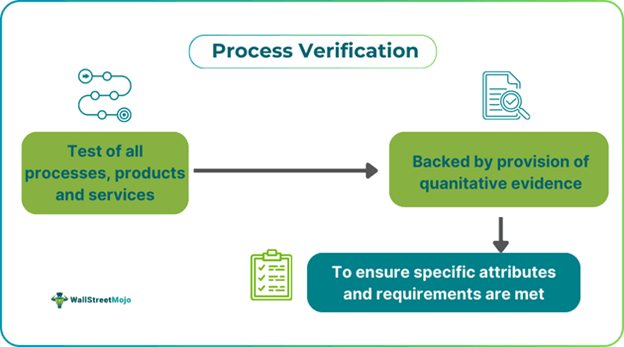
The Quality System Regulation under the FDA defines verification as a confirmation by examination and objective evidence provision that specific requirements are met. Now, there is no specific definition of process verification, but it typically applies to all processes, products, and services. Only when the attributes, requirements, and standards are met can it be concluded that the right product is being produced.
Key Takeaways
- Process verification is the assessment of processes to confirm that they meet the specific requirements and align with the outcome parameters.
- The definition applies to all processes, products, and services in manufacturing and is confirmed through only objective evidence to reflect that the process meets requirements.
- It is performed manually by a human and not with the help of any computer software, program, or application; this also means that opinions differ from one reviewer to another.
- With this method, manufacturers can identify early errors, mistakes, and inconsistencies and change or rectify them to match specific requirements and output parameters.
Process Verification In Manufacturing Explained
Process verification in manufacturing is the assurance that any process, product, or service is rightly set with proper standards aligned with the specified requirements to ensure that it serves the proper function and outcome. Process verification answers the question of whether the right product is being built.
The whole process includes checking on codes, programs, design, manual testing, and documentation. It is based on static testing, which means a testing method where defects, errors, or weaknesses are detected without implementing the function. In the context of manufacturing, it defines a technique to check on the manufacturing process before or without applying to check on whether the process meets the end product and further removes any form of inconsistencies. In manufacturing, a quality assurance team is assigned to perform process verification.
The verification is performed through manual testing and requires some form of quantitative proof and objective evidence to prove that the specifications are met before the manufacturing can begin. In layperson’s terms, it ascertains that a manufacturing process is working and assists in removing any errors or misconceptions before the manufacturing process can actually be implemented. A key aspect to remember is that since all testing is done manually and not by computer software or application, the opinion may differ from one reviewer to another.
Examples
Here are two examples to help one understand the concept better.
Example #1
Suppose David is a carpenter who gets a job to make nine doors and 18 windows for a penthouse. He takes measurements of the door and window sizes and discusses the design, pattern, plywood type, and other details with the penthouse owner. He receives an advance payment from the buyer, goes back to his workshop, orders inventory, and waits for the raw material to arrive.
Now, before starting to work, David calls for a small meeting with all his subordinates and explains the projects to them. He manually checks the raw materials, measuring the plywood size and thickness and testing the toughness, durability, and color grade of the plywood. David also manually tests all his equipment, tools, and machinery to ensure they are working correctly. He also matched the measurements of raw materials with the measurements he took at the penthouse.
Now, the whole testing of inventory, checking on raw material, briefing with team workers, matching measurements, all of this is process verification. David, through this, ensured that all the elements of the process match the specific requirements. Once he is satisfied with the inventory, David begins to work.
Example #2
Suppose David is overseeing a project for a luxury penthouse and has ordered specific materials to match the precise standards discussed with the penthouse owner. Upon inspecting the delivery, he noticed that the inventory received did not align with the required specifications—the materials were off in measurements and quality. Additionally, David finds that some of his equipment and machinery are malfunctioning, which could impact the quality of the manufactured doors and windows.
Acting quickly, David contacts the supplier to return the incorrect materials, requesting replacements that meet the exact requirements. He also arranges for immediate repairs on his machinery to prevent further issues. Thanks to this process verification, David identifies and corrects the errors early, ensuring the materials and equipment are fully aligned with the project standards. Although this resulted in a slight delay, David now has confidence that the doors and windows will be crafted precisely to the specifications discussed, avoiding any compromises on quality.
Importance
The critical importance of process verification is –
- Helps evaluate processes, products, and services that are parallel to specific requirements.
- Process verification plays an integral role at every level, from initial development to production and even upscaling.
- It makes sure that all processes remain in control and are part of the validation process.
- It can only be concluded using a measurement, test, and some form of objective evidence.
- It provides a framework to ascertain that there is a process to check and verify whether the requirements are met with the outcome parameters to validate effective manufacturing.
Process Verification Vs. Process Validation
The main differences between process verification and process validation are –
- Process verification can be done without the finished product. In comparison, process validation requires a product to be performed.
- Process verification is done prior to process validation, as it helps find errors, inconsistencies, bugs, and issues related to products and processes in an early stage. Still, process validation spots errors that cannot be detected through process verification.
- Process verification includes inspections, reviews, manual testing, and walkthroughs. In contrast, most process validation is done using software testing methods such as black box, white box, and non-functional testing.
- In process verification, quality assurance personnel are responsible for the whole conduct, but with process validation, software testers are tasked with running tests.
Frequently Asked Questions (FAQs)
Frequently Asked Questions
What is continuous process verification?
Continuous process verification refers to real-time data analysis and constant monitoring of product quality in real-time to receive immediate insights and information in case there is any deviation from the set specifications. It is part of real-time quality assurance and helps manufacturers make proactive decisions. It is enabled by using sensors, data analytics, and automation tools.
What are the four fundamental methods of process verification?
The four fundamental methods of process verification are – 1. Inspection – It involves going through the product or process and ensuring it satisfies the physical nondestructive examination 2. Demonstration – This refers to ensuring that the process, product, or service offers the proper outcomes 3. Test – Testing is run under a controlled environment with a predetermined series of data and inputs to verify that the process or product offers the correct result as specified by the requirements. 4. Analysis – This stage involves calculations and fitting data into models to confirm test results or discover new information about the process or product.
What are the disadvantages of process verification?
The key disadvantages of process verification are – – It delays the manufacturing process. – If faults are found, it becomes more time-consuming and complex to deal with them. – Process verification itself requires expertise, experience, and skills to perform correctly. – The whole concept may demand extra funds and needs to be foolproof.