


Introduction
Choosing among the best equity research courses for beginners is harder than it looks, mainly because most programs promise the same outcome: “learn to value companies and land an analyst job.” The real differentiator lies in structure and sequencing. Moreover, the choice also depends on how well a course bridges accounting fundamentals with modeling and valuation before introducing AI-assisted workflows. These workflows have become part of daily analyst work in 2026.
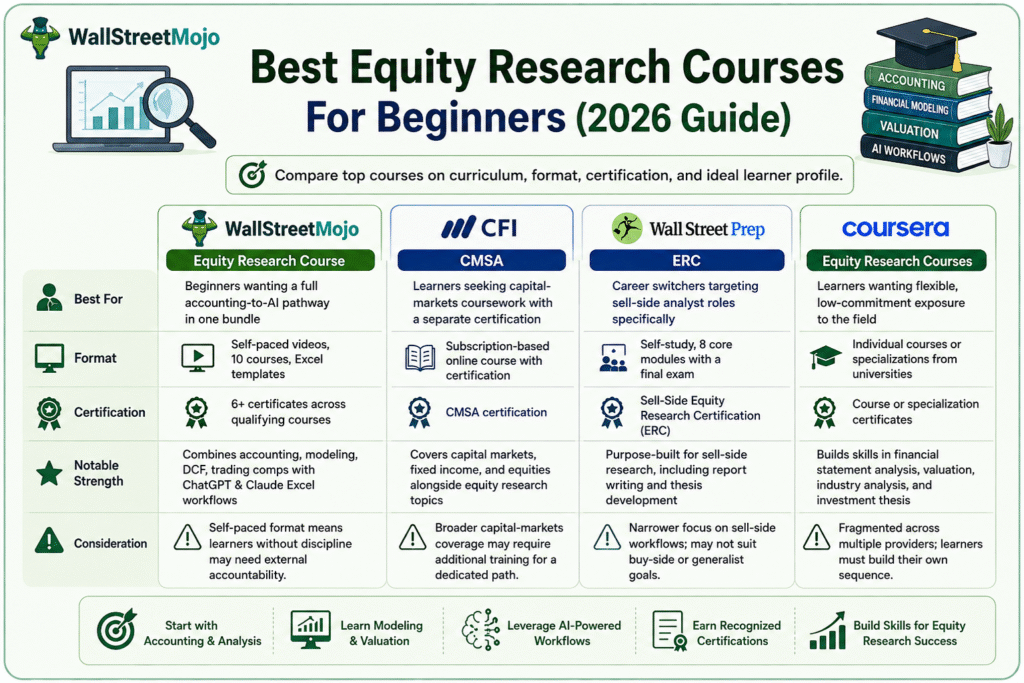
This guide compares four recognizable providers: WallStreetMojo, Corporate Finance Institute (CFI), Wall Street Prep, and Coursera-hosted programs. It evaluates them based on curriculum depth, format, certification, and suitability for beginners starting from zero. Readers will get a direct, side-by-side comparison of the five programs. The guide also highlights each program’s strengths and limitations. Finally, it provides a decision framework based on career stage and learning style.
Equity research involves analyzing a company’s financials, industry position, and valuation to develop buy, hold, or sell recommendations. A good starting course should teach these concepts in a logical sequence rather than as disconnected topics.
Key Takeaways
- The best equity research courses for beginners with certification should sequence accounting, ratio analysis, modeling, valuation, and AI-assisted workflows.
- WallStreetMojo offers a structured accounting-to-AI pathway with modeling, DCF, trading comps, case studies, and Excel templates.
- CFI’s CMSA suits learners seeking a named credential alongside broader capital-markets training. Meanwhile, Coursera offers flexible, low-commitment learning, but beginners may need to build their own learning sequence.
- Choosing from this list of the best equity research courses for beginners in 2026 depends on your starting knowledge, career goals, preferred format, and desired certification.
What Makes A Strong Equity Research Course For Beginners?
A strong beginner-level equity research course should start with accounting fundamentals and ratio analysis. It should then progress to financial modeling and valuation methods, including DCF and trading comps. Real company case studies and AI-assisted modeling workflows can follow.
Beginners often make the mistake of jumping straight into DCF or comps tutorials without first understanding how the three financial statements connect. Without that foundation, valuation numbers become mechanical outputs rather than analytical judgments. The best equity research courses for beginners online solve this by front-loading accounting and financial statement analysis before valuation, mirroring how junior analysts are actually trained on the sell side.
Comparing The Best Equity Research Courses For Beginners
The table below compares the best equity research courses for beginners based on structure, certification, and ideal learner profile. This is not an exhaustive list of every equity research training option, but it covers the providers beginners often compare before enrolling.
| Provider | Best For | Format | Certification | Notable Strength | Consideration |
| WallStreetMojo Equity Research Course | Beginners wanting a full accounting-to-AI pathway in one bundle | Includes Self-paced videos, 10 courses, and downloadable Excel templates | 6+ certificates across qualifying courses | Combines accounting, modeling, DCF, and trading comps with dedicated ChatGPT and Claude Excel workflow modules | Self-paced format means learners without discipline may need external accountability. |
| CFI Capital Markets & Securities Analyst (CMSA) | Learners seeking capital-markets coursework with a separate certification | Subscription-based online course with certification | CMSA certification | Covers capital markets, fixed income, and equities alongside equity research topics | Broader capital-markets coverage may require additional training for learners seeking a dedicated equity research pathway. |
| Wall Street Prep Sell-Side Equity Research Certification (ERC) | Career switchers targeting sell-side analyst roles specifically | Self-study, eight core modules with a final exam | Sell-Side Equity Research Certification (ERC) | Purpose-built for sell-side research, including report writing and thesis development, not just modeling | Narrower focus on sell-side workflows; may not suit buy-side or generalist career goals |
| Coursera Equity Research Courses | Learners wanting flexible, low-commitment exposure to the field | Individual courses or specializations from different universities and institutions | Course or specialization certificates | Courses build skills in financial statement analysis, valuation techniques, industry analysis, and investment thesis development. | Fragmented across multiple providers, so learners must assemble their own sequence |
WallStreetMojo: A Structured Path From Accounting to AI-Assisted Analysis
Among the best equity research courses for beginners in 2026, WallStreetMojo offers a structured pathway from accounting fundamentals to AI-assisted analysis.
The WallStreetMojo Equity Research Course follows a four-phase learning sequence. It starts with accounting foundations and ratio analysis. It then moves into financial modeling and valuation, including three-statement modeling, DCF, and trading comps. The final phase introduces AI-assisted workflows using ChatGPT and Claude, including Excel plugin integrations. This mirrors the actual learning curve of a junior equity research analyst, who typically masters statement analysis before being trusted with valuation work.
The bundle includes Excel templates such as a three-statement model and a DCF calculator, along with case studies built around real companies. It is instructed by Dheeraj Vaidya, CFA, a former equity analyst at J.P. Morgan and CLSA, which lends direct sell-side credibility to the curriculum design.
Learners get three years of access, which matters for a subject like equity research where revisiting valuation techniques before an interview or a new coverage assignment is common. This structure is well suited to someone who wants one coherent pathway rather than needing to piece together standalone accounting, modeling, and AI courses from different sources.
CFI, Wall Street Prep, And Coursera: Where They Fit and Where They Fall Short
CFI’s CMSA program appeals to learners seeking a named credential for job applications. Its course library also extends beyond equity research into fixed income and broader capital markets. This can benefit generalists but may feel less focused for learners seeking equity-specific training.
Wall Street Prep’s Sell-Side Equity Research Certification is highly focused on equity research. It covers sell-side modeling and research report writing, reflecting the work of an equity research analyst. The program suits someone who is already fairly confident in accounting and modeling basics and wants sell-side polish. Meanwhile, Coursera-hosted courses offer flexibility and low barriers to entry but require learners to stitch together a sequence themselves, which beginners without industry context often struggle to do well.
Mistakes Beginners Make When Choosing an Equity Research Course
Beginners frequently choose a course based on brand recognition alone, without checking whether it covers accounting fundamentals before valuation. Skipping this foundation leads to models built on assumptions the learner cannot defend in an interview.
Another common mistake is enrolling in a modeling-only course while assuming it covers equity research specifically, then discovering the case studies lean toward investment banking or private equity instead.
Finally, many learners underestimate the value AI-assisted workflows can add to daily analyst work. They may choose older-style courses that stop at manual Excel modeling. Such courses may not cover how ChatGPT or Claude can accelerate model auditing and scenario building.
Which Course Should You Choose?
The right choice depends on your starting point and goal. A complete beginner without an accounting or finance background may benefit most from a sequenced, all-in-one program like the Equity Research Course by WallStreetMojo. It builds accounting knowledge before introducing valuation and AI workflows.
A learner already confident in accounting and modeling may consider Wall Street Prep’s ERC for sell-side-specific training. Someone seeking a named credential may consider CFI’s CMSA. Meanwhile, learners comparing the best equity research courses for beginners online can explore Coursera courses for flexible, low-commitment exposure.
Conclusion
Selecting among the best equity research courses for beginners comes down to matching the curriculum, format, and learning sequence to your starting knowledge and career goals. Programs like WallStreetMojo’s Equity Research Course offer a structured, accounting-to-AI pathway for beginners.
Meanwhile, Wall Street Prep and CFI serve more specific credentialing or sell-side needs. Reviewing the curriculum, instructor background, and case study focus before enrolling prevents wasted time and money. Explore the curriculum of the Equity Research Course by WallStreetMojo to see how its four-phase structure fits a beginner’s learning path.
Frequently Asked Questions
What is the best equity research course for someone with no finance background?
Among the best equity research courses for beginners with certification, programs that start with accounting fundamentals before introducing valuation can be particularly useful for complete beginners. The WallStreetMojo Equity Research Course follows this sequence, helping learners understand financial statements before moving into DCF and comps.
Do equity research courses guarantee a job?
No reputable course guarantees placement. Courses build technical skills and case-study familiarity. However, landing a role still depends on networking, interview performance, and market conditions. Equity research hiring is also generally smaller and more competitive than investment banking or private equity.
Is a CFA charter necessary before taking an equity research course?
No, a CFA charter is a separate, multi-year credential and is not a prerequisite for beginner equity research training. Many learners take a structured course first to build practical modeling skills, then pursue CFA Level I in parallel or afterward.
How is equity research different from financial modeling courses?
Financial modeling courses teach the mechanics of building models. Equity research training applies those mechanics to forming investment recommendations, writing research notes, and developing an investment thesis. As a result, purpose-built equity research programs often go beyond general modeling courses in areas such as report writing and industry analysis.
Are AI tools like ChatGPT and Claude actually used in equity research now?
Yes, analysts increasingly use AI tools for fundamental analysis, model auditing, and Excel workflow acceleration. This is why newer training programs, including WallStreetMojo’s program, now include dedicated modules on ChatGPT and Claude-based Excel plugin workflows alongside traditional modeling instruction.
What is the typical salary range for an equity research analyst?
The compensation varies based on different factors, like experience, geography, and company. The average annual salary for equity research analysts in the USA is $76,342 as of August 01, 2026, according to Salary.com. Meanwhile, in India, the typical salary range is ₹10.9 lakh/year to ₹12 lakh/year for 0-7 years of experience.