


Introduction
Every year, thousands of finance, accounting, and strategy professionals working inside corporate finance, FP&A, audit, or business analyst roles look for a way into equity research. The appeal is obvious: closer exposure to capital markets, sharper analytical work, and a faster path toward roles at asset managers, brokerages, and investment banks. Making the switch to equity research from a corporate job is entirely achievable. However, it depends on closing a specific and well-defined skills gap rather than simply applying with a generic finance resume.
This article breaks down exactly what separates a corporate finance background from an equity research-ready profile and the technical skills recruiters actually test for when hiring. Moreover, it provides a step-by-step roadmap for the transition and discusses how structured training compares with self-study. Readers will also find current salary benchmarks for equity research analysts in the US and India, and a look at where AI-powered workflows now fit into the hiring bar for 2026.
Key Takeaways
- Equity research from a corporate job requires building financial modeling, valuation, and stock-pitch skills.
- Corporate finance, accounting, audit, and strategy experience provide transferable skills for equity research.
- Sell-side research can provide an entry point for corporate professionals transitioning into equity research.
- AI-assisted Excel workflows using ChatGPT and Claude are becoming increasingly relevant to equity research hiring.
- Structured training can help corporate professionals develop modeling, valuation, and research skills systematically.
- Sector expertise can strengthen a candidate’s equity research profile when combined with rigorous valuation skills.
What Does “Transferring to Equity Research” Actually Mean?
Transferring to equity research from a corporate job means moving from an internal-facing finance function, such as FP&A, corporate accounting, treasury, or business analysis, into a research seat that evaluates publicly traded companies for investment decisions.
The main difference is how each role approaches financial analysis. Corporate finance professionals typically analyze their own company from an internal perspective.
Equity research analysts evaluate multiple publicly traded companies from an external perspective. They use public filings, industry data, and valuation models to assess a company’s prospects and develop an investment view.
Why Corporate Professionals Are Well-Positioned for This Transition
Corporate finance, accounting, and audit backgrounds already carry several skills that equity research desks value highly. The gap is narrower than most candidates assume. This is precisely why recruiters at boutique research shops and asset managers keep an open door for career switchers with the right technical add-ons.
The following table highlights the key skills corporate professionals can transfer to equity research and how they apply in the new role:
| Corporate Background | Transferable Strength | Equity Research Application |
| FP&A / Budgeting | Forecasting, variance analysis | Revenue and cost modeling for coverage companies |
| Corporate Accounting | Financial statement fluency | Reading 10-Ks, annual reports, footnote analysis |
| Internal Audit | Attention to detail, risk flags | Spotting accounting red flags and earnings quality issues |
| Business/Strategy Analyst | Industry research, competitive analysis | Sector coverage and thematic research notes |
| Corporate Development | Deal and valuation exposure | Comparable company and precedent transaction analysis |
The Skill Gap: What Corporate Roles Rarely Teach
Most corporate roles do not require building a full three-statement model, running a discounted cash flow valuation, or benchmarking a company against trading comparables. These are the exact skills that equity research interviews test through modeling exercises and stock pitch assignments. A candidate transferring from a corporate job typically needs to build proficiency in three areas. These areas include financial modeling, valuation methodology, and stock pitch writing backed by ratio analysis and sector data.
Research desks increasingly expect candidates to be comfortable using AI tools such as ChatGPT and Claude inside Excel. These tools can accelerate model building, audit formulas, and speed up first-draft research summaries. This is a newer layer on top of the traditional skill set. It is becoming a differentiator in 2026 hiring rounds, particularly at firms modernizing their research workflows.
Step-By-Step Roadmap To Transfer To Equity Research From a Corporate Job
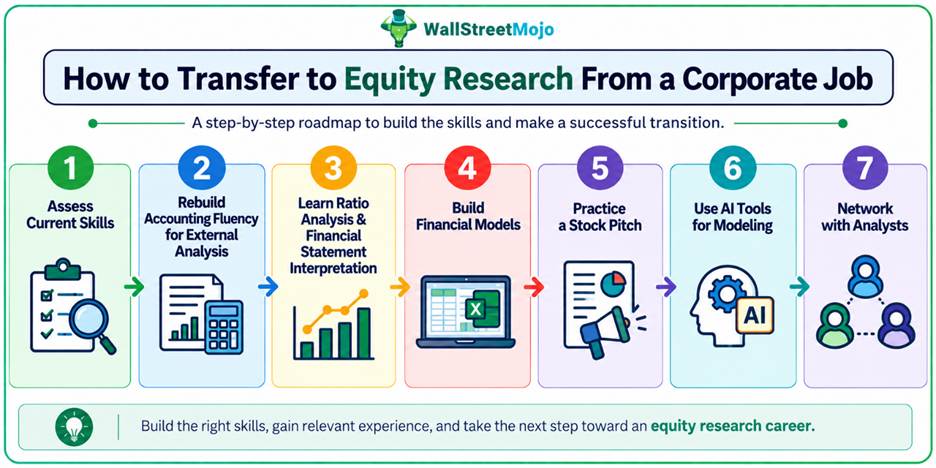
Follow these steps to build the technical skills and experience needed for equity research from a corporate job:
- Audit your existing skill set against a target job description and identify specific gaps in modeling, valuation, and sector knowledge.
- Rebuild accounting fluency for external analysis. This is because reading a competitor’s or a publicly traded company’s filings differs from reviewing internal management reports.
- Learn ratio analysis and financial statement interpretation across liquidity, profitability, leverage, and efficiency metrics, applied to multiple companies rather than one.
- Build full financial models from scratch, including three-statement models, DCF valuation, and trading comps. Use real company case studies to practice modeling rather than relying on template shortcuts.
- Practice a stock pitch on a company in a sector close to your corporate experience. After all, domain knowledge from a corporate job is a genuine advantage in an interview.
- Add AI-assisted modeling workflows by using tools such as ChatGPT and Claude for Excel-based financial analysis. Build familiarity with these tools to stay aligned with evolving equity research workflows.
- Network directly with analysts and associates. This is because equity research hiring, especially at boutique and mid-size shops, still runs heavily on referrals rather than open postings.
Buy-Side vs Sell-Side: Where Corporate Switchers Typically Fit Best
Corporate finance professionals transitioning to equity research from a corporate job generally start on the sell-side. This is because sell-side firms may be more willing to train candidates with adjacent but non-traditional backgrounds. The table below compares sell-side and buy-side equity research across key factors relevant to corporate career switchers.
| Factor | Sell-Side Research | Buy-Side Research |
| Typical Employer | Brokerages, investment banks | Asset managers, hedge funds, PE firms |
| Entry Point for Switchers | More accessible | Usually requires prior research or IB experience |
| Core Output | Published research reports, ratings | Internal investment recommendations |
| Sector Specialization | Encouraged early | Deep specialization expected |
| Corporate Background Fit | Strong, especially with sector expertise | Moderate, better after 1-2 years of sell-side seasoning |
Structured Training vs Self-Study: Comparing The Options
Self-study through free YouTube tutorials and scattered PDFs can teach isolated concepts. That said, most corporate switchers underestimate how much time it takes to stitch accounting, modeling, valuation, and AI workflows into one coherent, interview-ready skill set. Structured, sequenced training closes that gap faster and with fewer blind spots.
The table below compares structured equity research training programs with their coverage, format, and suitability for corporate professionals:
| Program | Structure | AI Workflow Coverage | Best Fit |
| WallStreetMojo Equity Research Course | 10 sequenced courses covering accounting, ratio analysis, modeling, DCF, trading comps, and AI-powered workflows, taught by Dheeraj Vaidya, CFA, FRM, a former analyst at JPMorgan. Morgan and CLSA | ChatGPT and Claude Excel plugin workflows included as a dedicated module | Corporate professionals who want one structured path from fundamentals through AI-assisted modeling |
| Wall Street Prep Sell-Side Equity Research Certification (ERC©) | Job-focused sell-side equity research training covering financial statement analysis, investment thesis, report writing, modeling, trading comps, and DCF | Not a core focus | Candidates seeking focused sell-side equity research training |
| Breaking Into Wall Street (BIWS) Core Financial Modeling | Financial modeling program with case studies covering accounting, three-statement modeling, valuation, DCF, M&A, and LBOs | Not a core focus | Candidates looking to build financial modeling skills |
| CFI (FMVA) | Broad financial modeling and analyst certification covering modeling, valuation, Excel, and related finance skills | AI-related training available through separate CFI courses | Candidates looking for a broad financial analyst training program |
For a corporate finance professional, the value of a sequenced path like the WallStreetMojo Equity Research Course is that it starts from accounting fundamentals rather than assuming prior modeling exposure. Moreover, it builds toward the same Netflix-based DCF and trading comps case study that recruiters expect candidates to be able to discuss confidently in an interview.
Salary and Career Outlook After the Transition
Equity research compensation varies significantly based on specific elements like seniority, market, and location. According to Salary.com, in the United States, the average annual salary for equity research analysts is $76,340 as of September 1, 2026. In India, salary data from AmbitionBox suggest that the typical yearly salary range for equity research analysts with 0-7 years of experience is ₹10.8 lakh to ₹12 lakh.
These figures provide a useful benchmark, but salary is only one part of the career outlook. The broader U.S. financial analyst occupation also has a positive employment outlook. The Bureau of Labor Statistics projects 7% growth in terms of employment from 2025 to 2035, compared with 3% for all occupations.
This suggests that the skills developed for equity research, including financial modeling, valuation, and investment research, remain relevant across a broader set of financial analyst roles. However, BLS data covers the wider financial analyst occupation rather than equity research analysts specifically. So, one should view the information as an indicator of the broader market rather than a direct forecast for equity research hiring.
Common Mistakes Corporate Professionals Make When Switching
Corporate professionals commonly make the following three mistakes when preparing to transition into equity research from a corporate job:
- Applying before building technical skills: Many switchers apply before they can walk through a DCF or defend a stock pitch under questioning. This can signal under-preparation, regardless of their corporate experience.
- Over-relying on certifications: Certifications can strengthen a profile, but they do not replace the modeling practice required to perform well in a timed case study.
- Ignoring sector specialization: Corporate professionals may have valuable industry knowledge from sectors such as manufacturing or FMCG. This experience can support sector coverage on the sell-side when combined with rigorous valuation skills.
Conclusion
Equity research from a corporate job is less about starting over and more about translating existing financial fluency into an external, markets-facing skill set. The professionals who make this transition successfully treat modeling, valuation, and AI-assisted workflows as a structured project, not a side reading list.
For those ready to close that gap methodically, the WallStreetMojo Equity Research Course offers a sequenced path from accounting foundations through AI-powered valuation, built around the same case study approach used in real research interviews.
Frequently Asked Questions
Can I transfer to equity research from a corporate job with no prior modeling experience?
Yes, many successful switchers start with limited or no modeling experience. They build these skills through structured coursework or supervised practice before applying, since interviews directly test modeling and valuation skills.
Is an MBA or CFA required to move into equity research from a corporate job?
Neither is strictly required. That said, the CFA charter or progress through the CFA program is widely respected in research and often strengthens a switcher’s candidacy alongside demonstrated modeling ability.
How long does it typically take to become interview-ready for equity research?
Most corporate professionals need three to six months of focused study covering accounting review, ratio analysis, modeling, valuation, and stock pitch practice. The actual time taken depends on their starting point and hours available per week.
Does my corporate industry background matter when switching to equity research?
Yes, it matters significantly. Sector knowledge from a corporate role, such as manufacturing, FMCG, healthcare, or technology, is a genuine advantage when applying to cover that same sector on the sell-side.
Should I target sell-side or buy-side research first when switching from a corporate job?
Sell-side research is generally more accessible for first-time switchers, since buy-side firms typically prefer candidates with prior research or investment banking experience.
What role do AI tools like ChatGPT and Claude play in equity research today?
Research desks increasingly use AI tools to accelerate model-building, audit formulas, and draft research summaries. Thus, familiarity with AI-assisted Excel workflows is becoming a meaningful hiring differentiator in 2026.