


What Is A Project Manager?
A project manager is a skilled individual who takes charge of a project from its ideation to accomplishment. Such a professional looks after and manages the different aspects of a project, including its scope, budget, resources, quality, schedule, finance, and risk.
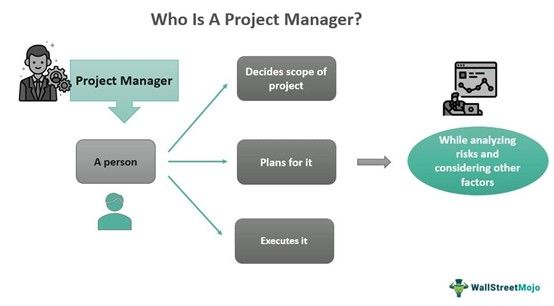
Such an individual ensures corporate goal achievement through the successful execution of a project while performing several functions like implementing the plans, communicating with the top-line managers, leading the team, and looking after the day-to-day operations.
Key Takeaways
- A project manager ideates, handles, and accomplishes a project before the deadline and within the ascertained budget.
- They lead and mentor the project team, coordinate with the top-level managers, clients, and stakeholders, foresee and mitigate risk, make crucial decisions, solve problems, and ensure the project’s timely completion.
- Although they face various strategic and operational challenges every day, they earn attractive perks that pay off their hard work.
- Anyone with a bachelor’s degree in Business Administration or Project Management and at least three years of project management experience can start a career in this job profile.
Project Manager Explained
A project manager helps build a company’s success story by aiming at the successful completion of projects. Companies may have a single project manager or a group of such managers to handle various projects simultaneously. Organizations nowadays have project management software tools included in their system to help managers track a project’s progress easily. The presence of such a manager and a robust software solution ensures better team performance in a company.
The demand for project managers is high in the deadlock competition. They often begin their careers by taking up a small role in a team headed by a project manager. They make their way up to the project coordinator profile and then to the managerial position with their hard work, qualifications, skills, and experience.
Qualifications
Project management is a career requiring certain certifications, skills, and experience. Some of the basic and advanced qualifications that make one eligible for a project manager job are as follows:
- Bachelor or Undergraduate Degree in Business Administration or project management (PM) from a recognized university;
- Project Management Professional (PMP) certification or any other international level certification from a reputed project management institute;
- Masters of Project Management (MPM) program; and
- Agile or Scrum training and certification to learn new project management tactics.
Skills
In addition to the above qualifications, learning about the new project management tools and software is equally important for these professionals. Other than the above degrees, the following skills are crucial for having a successful career in this field:
- Leadership and team handling
- Business management
- Risk management
- Effective communication
- Decision making
- Problem-solving ability
- Time management and organization
Experience
Along with project manager certifications, a minimum of three years of experience in the field acts as a cherry on the cake. However, gaining experience in this field is a real challenge. Following are some of the ways to get practical exposure in the field:
- Finding internships in companies to assist the project managers;
- Volunteering to help in project completion at the current workspace and
- Joining as a trainee in project management entry-level positions.
In addition to the ways mentioned above, companies run various internal programs to mentor and train employees in project management.
Roles & Responsibilities
The project manager position comes with huge responsibilities as it determines the business’s success. They are expected to have a go-getter attitude towards the company’s goal achievement. Following are the roles and responsibilities they perform in an organization:
- Project planning from scratch related to budget, tasks, schedule, strategies, and procedures
- Leading and directing the team by delegating and assigning day-to-day tasks and mentoring the business operations
- Time management and scheduling to ensure that the deadlines are met and deliverables are performed within the desired time frame and budget constraint
- Monitoring the performance of the team and checking the loopholes for better problem-solving and decision-making
- Scheduling frequent meetings and feedback and training sessions
- Conveying the corporate vision and goal to the team
- Communicating with the top-level management, shareholders, and clients to update them about the progress of the project and take valuable input
- Serving as a mediator between the teams for the successful completion of the project
- Performing all the paperwork, documentation, and reporting related to the project
- Preparing an alternative or backup plan to control the situation if something goes wrong and
- Taking responsibility for a project’s failure or poor execution
Salary
This role is stressful but rewarding at the same time. The average salary of a project manager in the United States is $88,491 per year. According to Glassdoor’s recent data, as of March 2023, a project manager’s average annual base pay in the US is $90,708. Also, the additional cash compensation is $7,564 on average and ranges between $1,810 – $31,616.
Project Manager vs Product Manager vs Program Manager
The project manager, product manager, and program manager have different roles in the business organization. Although they all are goal-oriented, the major differences between the three are discussed below:
| Basis | Project Manager | Product Manager | Program Manager |
|---|---|---|---|
| Overview | Heads a project from its ideation to accomplishment | Leads a product from its planning and launch to its last stage | Takes charge of a program comprising various interrelated projects |
| Remains in the role till | Project’s timeline | Job change or retirement | Job change or retirement |
| Manages | Different teams (team changes with the project) | Same team | Group of projects |
| Roles and responsibilities | Project planning, budgeting, team management, scheduling, communicating with stakeholders, directors and clients, risk management, meeting deadlines | Product planning, market analysis, product marketing strategy, consumer behavior and need analysis, product technology, design and launch | Ensuring that the program is directed towards the corporate goal, coordinating with project managers, communicating with cross functional teams, acquiring project resources, and strategy formulation with executive management |
| Aim | Successful execution of the project | Product growth | Organizational goal attainment |
Project Manager vs Project Coordinator
In project management, a project manager and a project coordinator have different roles to play; let us find out how:
| Basis | Project Manager | Project Coordinator |
| Role to Play | Leads the project | Works under the guidance of a project manager to ensure the smooth execution of tasks |
| Responsibilities | Project planning, budgeting, scheduling, monitoring and execution | Supervising and guiding the team members, getting the tasks done daily |
| Level or Position | Senior position | Junior position |
| Accountability | High | Comparatively low |
| Answerable to | Clients, stakeholders and top level management | Project manager |
| Decision making | More of strategic decision making | Operational decision making |
| Salary | High, almost double that of the project coordinator | Almost half that of the project manager |
| Qualification | Usually master’s degree in project management with at least three years of experience | Bachelor’s degree or certification in project management with at least one year of experience |
| Promoted to | Chief Operating Officer | Project Manager |
Frequently Asked Questions (FAQs)
Frequently Asked Questions
Can one become a project manager without a degree?
Companies always prefer someone with a degree to hold the position of a project manager. However, if one does not possess a degree in the relevant field, pursuing project management courses, undergoing certifications, and gaining experience in the field might help one get the job.
Is project manager a good career?
Project managers earn a handsome salary due to the type of work they perform. It is a dignified job profile, but at the same time, it is quite stressful since such an individual is ultimately responsible for the team’s success or failure.
When should project managers engage in risk management?
Project managers must identify the potential risks involved in the project execution to ensure success. However, if a project has high risk in the beginning, risk management regularly is essential for controlling the situation before it worsens.
How does the project manager enable decision-making in the project?
<p>In project management, a small decision can result in a hefty cost to the company. Therefore, a project manager must remember the ultimate goal, the team’s skill set, available resources, budget constraints, possible outcome, and the impact of a decision on the organization before moving ahead.</p>