


What Is Real Business Cycle Theory (RBC Theory)?
A real business cycle (RBC) theory refers to the belief that macroeconomic instability majorly results from real economic shocks like changes in resource availability and technological disturbance. As these factors impact productivity and aggregate supply in the long run, the business cycle shifts.
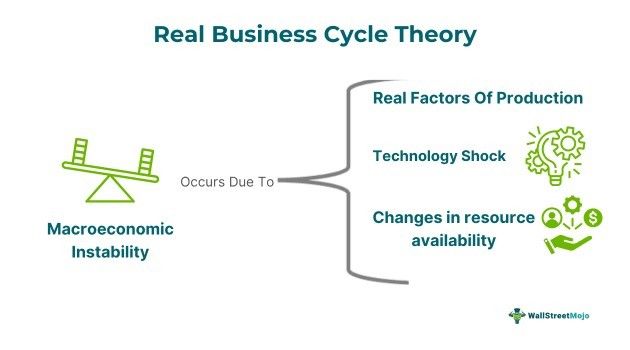
Hence, this theory is concerned with the supply concept in economics. The RBC model considers predictable policies appropriate. However, it highlights policy ineffectiveness, stating that systematic fiscal and monetary policies couldn’t curtail the unemployment level in the economy. Moreover, discretionary fiscal and monetary policies are ineffective in achieving macroeconomic stability.
Key Takeaways
- The real business cycle theory refers to a new classical thought that assumes that changes in economic conditions
- or macroeconomic instability arise because of real supply factors, such as technological shocks or changes in resource availability in the economy.
- Economists Kydland and Prescott nurtured this theory in 1982 in their published work on the U.S. economy-based numerical stochastic general equilibrium model. However, in 1983, economists Long and Plosser made a seminal contribution.
- It also emphasizes that individuals and firms adjust their consumption to achieve market equilibrium automatically.
Real Business Cycle Theory Explained
The real business cycle theory is a critical new classical approach that argues that the changes in the business cycle or economic fluctuations result from technological shocks or advancement and fiscal policy measures rather than other nominal variables like inflation or money supply in the economy. The business cycle can be categorized as expansion, recession, peak, and trough. The RBC theory can be expressed as Kt+1 = It + Kt − δKKt. Here, ‘It’ denotes the gross investment, while ‘δK’ reflects the rate of capital depreciation.
Even after employing the Keynesian theory during the 1950s, the economy witnessed a constant onset of recession and expansion. The RBC theory was found relevant when the classical economic model was considered inadequate for determining short-term economic fluctuations since it believes that prices are flexible. On the contrary, the new classical economists believed that flexible prices can efficiently gauge short-term fluctuations, and the principles of microeconomics (assuming that prices are adjustable) are applicable to the macroeconomic analysis.
Blinder made the initial developments in the identification of supply shocks in 1979, when in the 1970s, the OPEC oil prices surged two times, causing macroeconomic instability. However, the further refinement of the theory can be marked with the publication of the paper on the creation of the numerical stochastic general equilibrium model based upon the U.S. economy by Kydland and Prescott in 1982, and Long and Plosser made the seminal contribution to the concept in 1983. With this publication, the economists considered the supply side of the economy as a significant factor behind macroeconomic instability.
Features
The salient feature of the RBC theory lies in its belief that the technological shock and availability of production resources influence the aggregate supply of goods and services in the economy. Let us now go through the following graph to understand this concept better:
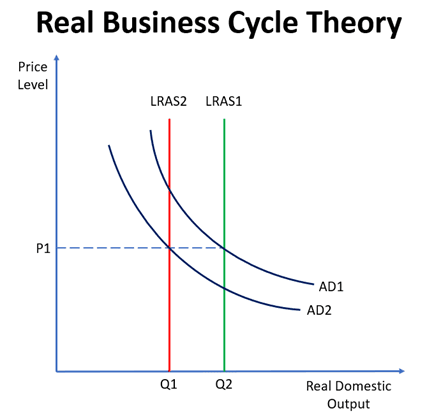
In the above graph, as the availability of resources decreases, the real output (Q) of the economy also declines, and the long-run aggregate supply shifts (LRAS) leftwards. This further leads to a fall in demand (A.D.), causing a leftward shift in the aggregate demand curve. If the price level (P) remains unchanged, then such a situation leads to a recession.
Assumptions
The real business cycle theory of macroeconomics is based upon the following critical beliefs:
- The fluctuation in employment and output levels results from the varying productivity due to massive technological changes.
- Individuals and businesses behave optimally in the long run.
- The overall output is at the natural level.
- There is a significant and random technological change.
- The available production technology falls during the recession.
- Also, the marginal product of labor declined during this period, and so did the real wages.
- Monetary policy errors cause the business cycle to change. Thus, tightening these policies results in recession, and easing them leads to an economic boom.
Examples
The real business cycle theory has overcome the pitfalls of the classical economic models. Its relevance in understanding the triggers of macroeconomic instability can be gauged through the following examples:
Example #1
Suppose, in an economy, there is a shortage of coal, and such a condition will lead to a subsequent fall in the supply of electricity (which uses coal for production). Also, steel production and supply witnessed a notable decline in the country. A decrease in production in these sectors results in higher unemployment. However, the buyers and sellers would accordingly adjust their consumption to automatically correct the market instability.
Example #2
Similarly, let us consider another example where a colossal technological shock, say the introduction of 5G technology, affected the mobile industry. The firms decreased the production of mobile devices with outdated technology, leading to a decline in their supply in the market. Also, engineers who had expertise in only 4G technology started losing their jobs, resulting in more unemployment. Also, the buyers automatically adapted to the new technology, decreasing their consumption of the 4G mobiles, thus helping the economy to attain an equilibrium.
Example #3
In March 2026, per reports, gas shortages and raw material disruptions linked to the West Asia conflict were affected Indian factories. Production at some gas-dependent industrial units had fallen by as much as 30% compared with pre-war levels. This illustrates the supply-side mechanism highlighted by Real Business Cycle Theory, where reduced availability of essential production resources can lower output and disrupt economic activity.
Criticism
Some economists have contradictory views of this theory, such as the monetarist view, mainstream view, and coordination failures view, all resulting in the following criticisms of the RBC theory:
- The foremost drawback is that the real business cycle theory focuses majorly on the supply side of economics while ignoring the demand factors.
- The assumption that the overall output is generated at the natural level is unrealistic since it doesn’t allow for the cohesion of wages and prices.
- It fails to clearly contemplate the way unfavorable economic shocks impact the overall economy.
Frequently Asked Questions (FAQs)
Frequently Asked Questions
Why is the real business cycle theory important?
The RBC theory assumes that the markets have no imperfection. Therefore, households optimize their utility in the long run, while firms aim to make higher profits based on their rational expectations. Consequently, there is an efficient market equilibrium that doesn’t require any government interventions.
What is the role of money in the real business cycle theory?
In real business cycle theory macroeconomics, two primary mechanisms exist. The first one is the kind of aggregate price surprises resulting from heterogeneous individuals or groups. The other mechanism states that there is a trade-off between leisure and real money, which leads to a variation in the desired liquidity services.
How is real business cycle theory different from Keynesian?
The Keynesian theory emphasizes that market prices are rigid and that the output level can fluctuate with changes in consumption, spending, and government expenditures. The labor market also exhibits significant supply. </p><p>On the other hand, according to the real business cycle theory, the technological shocks result in business cycle shifts, and all trade gains are fully realized.