


Part of our Accounting Concepts guide
What Is Shift Differential?
Shift differential refers to the amount that a company’s workers get paid for working in shifts outside of their usual shift in a workday. It includes shifts through the weekends, from Monday to Sunday, and employees get paid for the same.
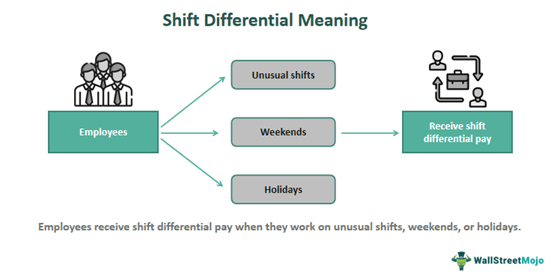
Employees get paid more through this arrangement for opting to work with shift timings that others may not usually choose to work with. In addition, they get to justify working additional hours beyond their usual hours. This also helps the employer get work done even at odd hours and ensure the delivery of products or services.
Key Takeaways
- Shift differential refers to the amount paid to the employees for working over their usual shift timings. It includes days from Monday through Sunday.
- Employers typically determine the pay as a percentage of the employee’s normal standard pay.
- When choosing a percentage or figure for shift differentials, certain factors are considered.
- These factors include duties, expertise, hours, and whether the employee is paid hourly or on a salary.
- The usual payroll deductions and charges for normal salaries or wages also apply to differential pay. Hence it is an essential component of each qualified employee’s gross compensation.
Shift Differential Explained
Shift differential refers to the amount paid to the employees for working over their usual shift timings. It includes days from Monday through Sunday. Employees who work unfavorable shifts, like evening or midnight jobs, receive differential pay as additional compensation for working additional shifts. The employers decide how much compensation to be paid. An employee’s salary can be negotiated with the company to include a differential rate.
The concept is prevalent not just in private jobs but also in jobs under the government. The U.S. government’s night differential is part of the federal wage system (FWS) and included in the employee’s basic pay. An FWS employee is eligible for a night shift differential pay when the majority of hours worked during their regular non-overtime shift occur in either of the two recommended shifts.
(a)3 p.m. to midnight with a 7.5 percent differential and
(b) 11 p.m. to 8 a.m. with a 10 percent differential pay. Other related provisions are found on the Office of Human Resources Management webpage.
Employers may compensate staff with extra paid time off (PTO) instead of paying shift differentials. Workers on the third shift are compensated more than the second. Employers may also give a weekend differential instead of the night shift differential. They could instead choose to pay them on the weekends in addition to second and third shifts. They decide the conditions.
Employers typically determine the pay as a percentage of the employee’s normal standard pay. What wages to give out is, hence, fully up to the employers. When choosing a percentage or figure for shift differentials, factors are considered. These factors include duties, expertise, hours, and whether the employee is paid hourly or on a salary. Similarly, when an employee is scheduled to work an eligible shift, the differential will be applied to any hours of paid time off, including vacation, sick leave, compensatory time, and funeral leave. The usual payroll deductions and charges for normal salaries or wages also apply to differential pay. Hence, it is an essential component of each qualified employee’s gross compensation.
How To Calculate?
Four steps are involved in calculating the shift differentials:
- Determining the normal rates
- Determining the differential
- Multiplying the normal rate by the differential
- Adding the differential value to the normal pay
In brief-
- Determining the normal rate: This is the rate the employees get paid initially, in their nominal working time.
- Determining the differential: This is the rate that the company offers as compensation for working beyond the shift timings. The rate varies from company to company; most companies keep it between 10% and 20%.
- Multiplying the normal rate by differentials: The initial payment will be multiplied by the differential pay offered.
- Adding the differential value to the normal pay rate: The value derived from step three has to be added to the initial payment to arrive at the actual amount that would be paid.
Examples
Check out these examples for a better idea:
Example #1
Suppose Dave is a factory worker and has a health emergency in the family; to pay off the medical bills, he uses up his credit card limit. He has to pay off the amount as quickly as possible; otherwise, the interest rates would shoot up, which would be an unnecessary expense. Since it’s difficult to look for a higher paying job in the short term, he decided to work overtime as his company is open three shifts a day and continuously producing. His work hours were 40 hours a week (Monday to Friday) from 8 a.m. to 5 p.m. This was the first shift, and to work overtime, he chose the second shift (5 p.m.-12 a.m.) to work on.
Example #2
Suppose Danny gets paid $50 an hour for his standard work shift (40 hours a day, 8 a.m. to 5 p.m.). His employer offers a 10% differential. The amount he receives as a shift differential would be calculated as follows:
Normal rate=$50
Differential pay = 10% of $50, which equals $5.
The final pay Danny gets will be $5 + $50 = $55 an hour. He will be paid $55 for working non-standard shifts.
Benefits
Some of the advantages of differential pay are listed as follows:
- Employers can get people to work at odd hours. This means that the production facilities do not get affected. In other words, it increases productivity.
- They can help increase profits with increased productivity.
- Employees make additional money and their purchasing capacity increases.
- They feel motivated to work harder. It instills dedication and discipline.
Shift Differential vs. Overtime
Here are the key differences between the two:
Frequently Asked Questions (FAQs)
What time does the shift differential start?
The night shift differential is the wage given for work done by the employee. The time considered includes the majority of the current-rate employee’s standard, non-overtime hours, which occur between 3 p.m. and 8 a.m. It is usually calculated as a percentage of the employee’s basic pay.
What time does the shift differential start?
There are usually three shifts in certain companies, the morning, evening, and night. Morning shifts are typically from 8 a.m. to 5 p.m., evening shifts from 5 p.m. to 12 a.m., and night shifts from 12 a.m. to 8 a.m. They may, however, vary from company to company.
Is shift differential included in base pay?
The regular compensation rate used to determine an employee’s overtime rate must include differential shift pay. It is because the amount is a percentage of the worker’s base salary or an additional flat fee per hour. Thus, it cannot be separated.
Recommended Articles
For more on Accounting Concepts, explore these related articles from our Accounting Concepts guide.