


What Is A Trade Repository (TR)?
A trade repository is an officially registered entity that collects and maintains records of over-the-counter (OTC) derivatives or securities trade transactions. Its core fundamental objective is to store, match, and validate transaction reports. Authorized regulators use this data to monitor market activities.
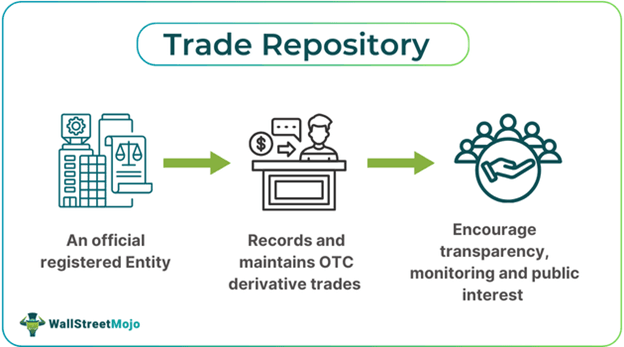
The stored records are also made available as part of public information to promote transparency and induce public interest. Trade repository or TR is a European Union markets term. In the United States, they are called swap data repositories. Likewise, every country has its trade repositories that act as an authorized entity to record trade transactions. A country can have one or multiple trade repositories.
Key Takeaways
- A trade repository is an individual or entity that centrally gathers and maintains records of over-the-counter derivatives trades and securities transactions.
- Trade repository or TR is a term used in the European Union. In the United States, they are referred to as swap data repositories (SDRs). Every nation has its own single or multiple repositories.
- TRs in the EU are regulated by ESMR and SFTR, but in the US, SDRs are created and facilitated by the Dodd-Frank Act.
- Trade repositories help in risk management, transparency improvement, market surveillance, maintenance of records, simplifying transactional reporting, and so on.
Trade Repository Explained
Trade repository is an authorized entity in the European Union under the European Market Infrastructure Regulation (EMIR) and Securities Financing Transactions Regulation (SFTR), which is responsible for collecting, recording, maintaining, and keeping the derivatives trade transactions centrally organized for reporting, and making public information available through different platforms. On the other hand, trade repositories are known as swap data repositories in the United States. These were created in 2010 as a result of the Dodd-Frank Act in order to create a central location for the reporting and recording of swap data.
SDRs perform the same functions, but they also include swaps such as credit default swaps, foreign exchange swaps, interest rate swaps, and so on. SDRs are also utilized in the United States for post-trade transparency.
A trade repository benefits in risk management and transparency of records, assists in facilitating regulatory compliance and offers valuable market insights to people. There is no rule that every nation or financial market shall have only one trade repository. Hence, any entity can register itself for a trade repository designation by following the process and meeting the standards and qualifying requirements. This is different for the European Union and the US. Likewise, if any entity wants to withdraw its status of a TR, it can do so by following a different procedure.
According to the European Central Bank, trade repositories are designed to be official registrations of over-the-counter (OTC) derivatives trades and provide a useful tool for reducing the inherent opacity of OTC derivatives markets. Trade repositories are known to provide data validation, reporting insights, post-transaction transparency, and many other services. These services improve operational
List Of Registered Trade Repositories
In the European Union, the list of registered trade repositories follows as:
- Depository Trust and Clearing Corporation (DTCC) Derivatives Repository – Global Trade Repository (GTR).
- Chicago Mercantile Exchange (CME) European Trade Repository – Granted by ESMA
- Intercontinental Exchange – ICE Trade Vault.
- REGIS-TR – Joint venture of Iberclear and Deutsche Boerse’s Clearstream subsidiary.
- UnaVista – Owned and regulated by the London Stock Exchange.
- KDPW Trade Repository – Owned by The Central Securities Depository of Poland.
In the United States, the following are the provisionally registered swap data repositories:
- Intercontinental Exchange Inc. – ICE Trade Vault
- Depository Trust and Clearing Corporation (DTCC) Data Repository
- Chicago Mercantile Exchange (CME) Swap Data Repository
- BSDR LLC
- INFX SDR
Most commonly, a trade repository has a separate division for the EU and the US. For instance, the DTCC derivatives repository handles EU derivative trade transactions, but the DTCC data repository is present in the United States. The same is the case with the CME European Trade Repository for the EU and the CME Swap Data Repository for the US.
Examples
Here are two examples of trade repositories; the first is a basic hypothetical example, but the second example is from real-world news:
Example #1
For a hypothetical example, suppose a registered entity that is regulated by the government and stock exchange regulatory body. The entity collects, records, stores, validates, maintains, and reports all the over-the-counter (OTC) derivative trade transactions that take place in the underlying financial market. For any market regulator, the entity provides the required data and also ensures that public information is made available through different platforms in a timely manner.
By going through the records, any form of data, inconsistencies, errors, and compliance can be identified. This way, the entity acts as a central platform for all the derivatives and securities trade that occurs in the stock exchange. Suppose there is no such entity present; there will be no monitoring, surveillance, and authority over which commodity, securities, or trade were initiated with no record at all. In the simplest form, it can be understood as an accounting journal or record of transactions.
Example #2
In July 2024, the Canadian Securities Administrators (CSA) released the final amendments to the OTC derivatives trade reporting rules. The CSA introduced these changes to coordinate international efforts and streamline derivatives data reporting standards. These regulations, which include OSC rule 91-507 on trade repositories and derivatives data reporting, are applicable to every province and territory.
Some of the major changes include the process for a reporting counterparty to shift to a designated trade repository. Additionally, OTC derivatives transactions are now required to be reported to a specific trade repository, where a Canadian local counterparty will also be involved. CSA has many plans forward, and these new amendments will help CSA become better at its data maintenance and reporting standards globally.
Importance
Its importance is listed below:
- Serves as an authorized entity responsible for recording, storing, matching, maintaining, and reporting derivatives or securities transactions.
- Enhances the transparency of securities and derivatives market transactions.
- Highly regulated by government entities to ensure compliance and regulatory framework
- Helps monitor and supervise derivatives and securities transactions.
- Assists in simplifying the transactional reporting and availability of public information data to regulators and other authorities.
- Acts as a one-stop data management framework for all the records of derivatives and securities maintained.
Frequently Asked Questions (FAQs)
Frequently Asked Questions
How to become a registered trade repository?
In the EU, the registration is authorized by ESMA through a highly formalized process. ESMA makes sure the information provided by the applicants meets the technical standards. In the US, trade repositories are called swap data repositories. Any entity planning to acquire the status of an SDR must apply to the SEC to be registered as an SDR. The applications are to be filed with the CFTC electronically. To obtain and maintain registration, the entity must comply on a continuous basis with three core principles: antitrust considerations, governance arrangements, and conflict of interest.
What is the role of a trade repository in EMIR reporting?
The role of a TR in EMIR reporting is as follows: · To officiate all derivative trade transactions to trade repositories. · EMIR has developed regulatory and technical standards that every repository has to follow and implement in its reporting process. · Trade depositories through EMIR reporting seek financial stability and prevention of derivative market risks.
What are the tips for maximizing the benefits of trade repositories?
The tips to maximize the benefits of TR are: · Practice accurate and punctual reporting. · Make use of data analytics and advanced tools to extract insights. · Stay updated with market changes and policies. · Work on effective operation efficiency, transparency, and regulatory compliance.