


What Is A V-Shaped Employee?
V-shaped employees refer to working professionals who specialize in a particular set of skills and possess in-depth knowledge and expertise in a particular field or area of work. They lack the breadth of skills and are most likely to struggle with new challenges outside their knowledge.
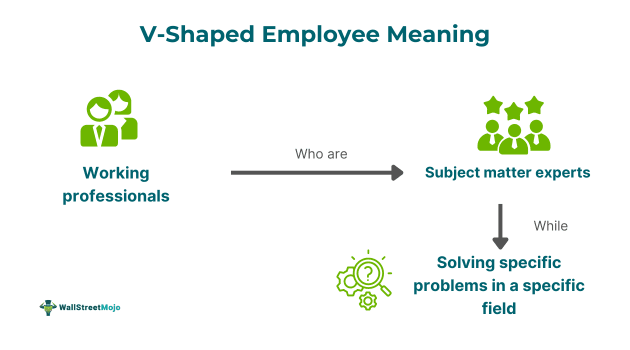
Such employees are extremely valued in an organization for their immense knowledge and expertise regarding a particular work. They tend to become the top performers in their field and have a basic understanding of other departments but never excel at it. Based on the shapes, there are six different employee types apart from the V-shape: I, T, Pi, M, E, and X-shaped.
Key Takeaways
- A V-shaped employee is an expert in a particular field but lacks the adaptability to learn and acquire knowledge outside of their expertise.
- Such employees struggle when assigned to a new project or operations outside their work area and may perform sub-optimally.
- They are represented by the letter V, explaining the in-depth knowledge on the y-axis and the lack of adaptability on the x-axis.
- The opposite of them is T-shaped employees, who are appreciated for their extreme adaptability in fast-moving modern corporations.
V-Shaped Employee Explained
V-shaped employees are complex problem solvers known as subject matter experts in a company when it comes to solving a specific problem in a specific field. Simply put, they hold expertise and in-depth knowledge in a particular field and have chosen it as a career and long-term profession. Such employees have devoted their lives to a particular area of work and, therefore, are usually the top rankers and hold a reputation for their contributions.
Every company comprises different types of employees, each playing their role and contributing in their own manner. Though some have broad skills and, therefore, are known to make tough decisions, face challenges, and lead a team simultaneously, some employees are experts in particular areas, and everyone values them for their work.
These employees only relate to their work of action and do not have any important role in other departments; they also need help to perform in different workplace scenarios unfamiliar to their line of work. Moreover, a company primarily selects and hires them because of their in-depth knowledge. With changing times, modern companies often look for employees with a breadth of skills and a broader scope of work, but a V-shaped employee is still present in management.
Characteristics
The characteristics of such employees are –
- Such employees have devoted knowledge of a particular subject, which is one prominent reason for their recruitment.
- They possess knowledge outside their area of interest but do not excel and operate with minimum basic skills.
- Every organization has a place designed for such employees in their hierarchy and management.
Examples
Below are two hypothetical examples to understand the topic better:
Example #1
Suppose Jeremy runs a tire manufacturing company with a well-established business and numerous clients. His company often has a big cash flow and fund transactions. Jeremy also has multiple sources of income and a small portfolio of stocks and other assets. Jeremy always wants to keep his financial statements intact. So he hired Joseph, a chartered accountant for the company. He looks after every single financial aspect of the company and of Jeremy.
He manages the accounting books and files taxes for Jeremy, and even when other employees require some assistance, Joseph is always happy to help. In this setup, Joseph is a V-shaped employee known for his accounting knowledge and is considered a finance subject matter expert. If Jeremy would put him in another department, such as production or marketing, Joseph may need help to perform well.
Example #2
Suppose Jeremy runs a tire manufacturing company with a well-established business and numerous clients. His company often has a big cash flow and fund transactions. Jeremy also has multiple sources of income and a small portfolio of stocks and other assets. Jeremy always wants to keep his financial statements intact. So he hired Joseph, a chartered accountant for the company. He looks after every single financial aspect of the company and of Jeremy.
He manages the accounting books and files taxes for Jeremy, and even when other employees require some assistance, Joseph is always happy to help. In this setup, Joseph is a V-shaped employee known for his accounting knowledge and is considered a finance subject matter expert. If Jeremy would put him in another department, such as production or marketing, Joseph may need help to perform well.
V-Shaped Employee vs T-Shaped Employee
V-shaped and T-shaped employees are equally important in a corporate structure; they serve their roles and are appreciated timely for their contributions. However, the key difference between them is:
| V-Shaped Employee | T-Shaped Employee |
|---|---|
| It brings expertise to the company. | It come with a broader set of skills. |
| They need to be more adaptive to other works and departments that are distinguished from their expertise. | These employees have a higher degree of adaptability. |
| These employees are celebrated and respected for their knowledge of a particular subject. | On the other hand, these employees are known for their unique perspectives. |
| They are typically top performers in their field. | T-shaped employees have broader skills spread across various departments. |
Frequently Asked Questions (FAQs)
Frequently Asked Questions
What are the advantages of being a V-shaped employee?
The advantages of a V-shaped employee are: – They are highly valued in a corporate setup for their immense knowledge. – Such employees are treated as subject matter experts. – They are usually the top performers in their field of work. – Whenever expert advice is required, they become the go-to people in the workplace.
How are I-shaped employees different from V-shaped employees?
I-shaped and V-shaped employees refer to in-depth knowledge and expertise in a particular field. However, I-shaped employees have absolutely no breadth in terms of using their expertise in any other way. They have narrow skill sets and no broader sense of collaboration, discipline, or experience.
Who is an E-shaped employee?
E-shaped employees refer to the characteristic traits of a working professional who amalgamates four aspects: experience, expertise, exploration, and execution. Such employees are known for strong leadership qualities, especially when a group must be together for a common goal.