


What Is Price Risk?
The price risk refers to the possibility that the value of a particular asset or the overall investment portfolio will fall in the near future due to any other reason except a market downtrend. The commodities, financial instruments, and foreign exchange positions are all vulnerable to such uncertainty.
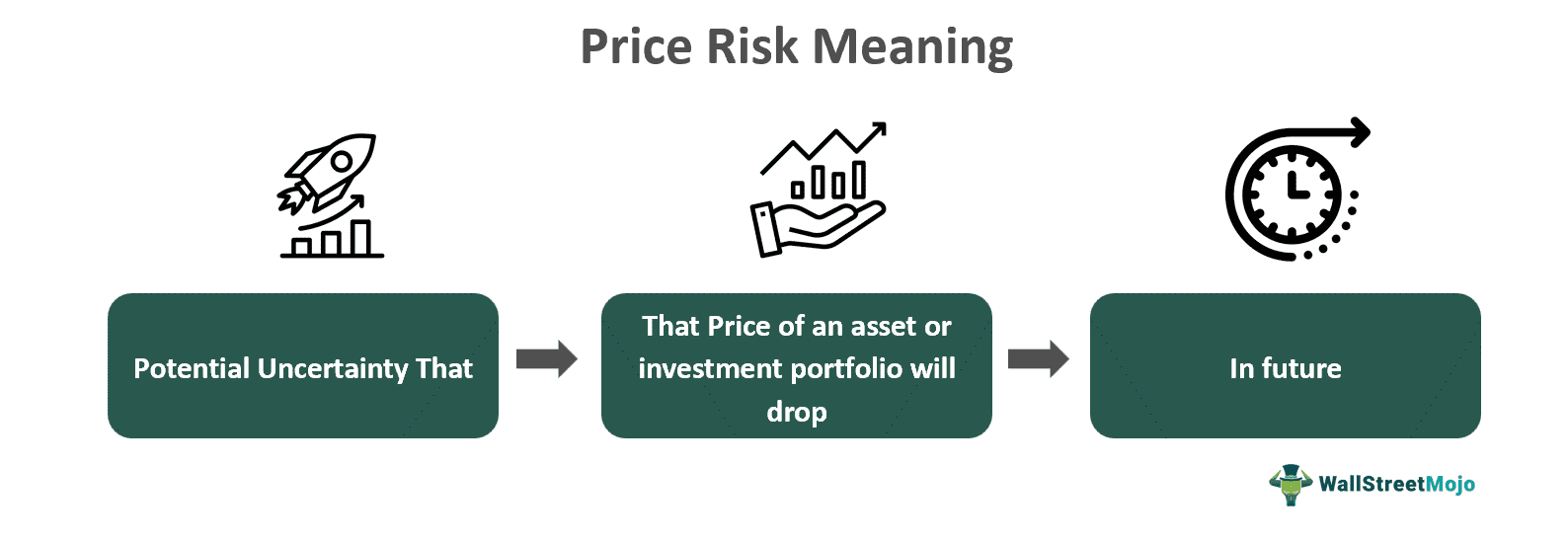
Moreover, this type of risk can result from inefficient asset management, extreme price volatility, uncertain earnings, misrepresentation of financial statements, weak business models, poor business management, etc. While the startups hold a higher risk, the large established firms show greater stability. Further, investors often use diversification and hedging (through futures, options, or short selling) for price risk management.
Key Takeaways
- Price risk is the possibility that the investors may experience loss if the future price of a security, asset, or investment portfolio declines.
- Such a potential loss may not occur due to the economic downturn but because of various other factors like ineffective business models, colossal price fluctuation, negative earnings, misrepresentation of financial statements, weak asset management, etc.
- The most effective way of minimizing such a risk is through proper diversification of the investment portfolio across different asset classes, geographical locations, and industries.
- Also, it can be hedged through strategies like futures, options, and short-selling.
Price Risk Explained
Price risk refers to the potential loss that the investors may incur if the price of a commodity, foreign exchange position, financial instrument, or investment portfolio drops in the near future. Such uncertainty may arise due to any other factors except an economic downfall. The possible causes of such a risk can be significant price fluctuations, low earnings, inefficient business models, misrepresentation of financial statements, poor asset management, ineffective business management, etc.
We often witness equity price risk in the stock markets when a particular security price goes down due to certain negative news about the company or the relevant stocks. Thus, such uncertainties are prevalent in every financial market. Similarly, commodities like gold, silver, oil, lithium gas, etc., are the most volatile commodities in the international markets. Therefore, they are highly vulnerable to the global market price risk when traded over the futures market.
Indeed, large organizations that have high market capitalization, strong financial position, and strong management hold less risk. On the contrary, small firms that are in the startup or growth stage have a high-risk exposure. Therefore, the investors must be informed about the company’s overall performance and background before investing.
How To Hedge?
Investors and traders usually hedge the price risk involved in different assets or overall investment portfolios by adopting the following strategies:
- Short-Selling: In a short-selling strategy, the investors can sell those stocks that they never owned. Thus, when interpreting a potential price fall in the stocks, they borrow a certain number of these stocks and promise to sell them at a certain rate after a specific period. If the stock prices fall, then the investor can sell these stocks at the predetermined price while keeping the difference amount (i.e., between the sales price and prevailing stock price).
- Futures and Options: The financial derivatives provide a certain level of protection from the market price risks. Through a futures contract, the investors are bound to execute a particular security transaction at a specific future date and a stated price. Conversely, an options contract is an arrangement where the buyer has a choice to execute the contract, i.e., buy or sell the underlying asset at the predefined price on a specific date. However, they are not obligated to do so. Thus, these strategies help consumers shield themselves from price hikes, producers from price falls, and investors from price movements opposite to their positions.
How To Minimize?
Effective price risk management is required to protect the invested amount and ensure profitability and wealth creation over the period. One of the best ways is to diversify the investment portfolio to spread the risk across different asset classes, geographical locations, industries, and investment products.
Suppose an investor has two choices: whether to invest all of his $25,000 in the insurance sector or diversify their portfolio by allocating $5,000 each across the stocks of five different industries, i.e., finance, insurance, FMCG, IT, and automobile sectors. Thus, considering a pandemic like COVID-19, where the significant sufferers were the insurance companies, the second option is more favorable for investment.
Examples
Investments are often sensitive to various market risks, including these risks. Let us understand more about it through the following examples:
Example #1
Suppose XYZ Co. Ltd. Issues ten 10-year fixed-income bonds with a 6% coupon rate. Now, the market interest rate will reach 7% in the next 5 years. However, the investors who blocked their money in these bonds experienced a higher risk due to the more significant interest income offered by the newly issued bonds. Therefore, in this case, the investors can disinvest from such a bond and reinvest in the new bonds that are offering better interest rates.
Example #2 – Commodity Price Risk
ASX lithium stock prices have witnessed an exceptional two-day rally despite a 30-month low record of lithium carbonate prices. This price surge is likely influenced by a prior rise in US lithium stocks and the restocking demand of the Chinese battery manufacturers, which have resulted in a rise in investor expectations after the Chinese New Year.
However, Morgan Stanley has warned investors about the risk resulting from a potential decline in the stock prices due to high inventories and falling demand from Chinese cathode makers, whose production has dropped by 28% since August 2023. While Morgan Stanley’s base case price for lithium carbonate is $13,500/t, the current spot price is under $12,000/t, with a potential bear target of $8,000/t. Hence, the firm suggests avoiding the purchase of ASX lithium stocks, rating all within its coverage as “equal-weight.” Moreover, existing investors may use various methods of commodity price risk management to protect their investments.
Price Risk Vs Reinvestment Risk
The price and reinvestment risks are the two different kinds of uncertainties that the investors may encounter while investing in the different kinds of assets and securities. The significant points of distinction include:
Frequently Asked Questions (FAQs)
How to calculate price risk?
The commodity price risk can be determined using different approaches like sensitivity analysis and Value at Risk (VaR). The VaR ascertains the chances of incurring a loss in a given period due to the price fluctuation of the commodities.
The sensitivity analysis gauges the various financial metrics, including cost of goods sold, profit margins, and revenue.
Do repurchase agreements have price risk?
The repurchase agreements have a limited price risk. Since the repos ensure that the issuer will buy back the security on a future date, it serves as insurance against price volatility.
What is flat price risk?
The flat price risk is the uncertainty that arises from the potential price fluctuation in the physical commodity when a trading company takes a log position by investing in such assets. Hence, if the price of the relevant commodity increases, the investor will make a profit; however, a decline in the price of this commodity can result in a loss to the trading company.