


What Is A Risk Asset?
A risk asset is a term used to denote a financial instrument or asset that experiences considerable price volatility, I.e., a sharp rise or fall due to various reasons. These assets or securities include real estate, equities, high-yield bonds, commodities, and currencies.
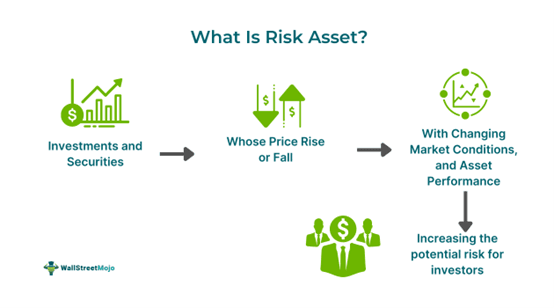
Financial institutions’ assets are more susceptible to sudden price fluctuations because of supply and demand issues, interest rate changes, default risk, prepayment risk, credit quality, etc. Such securities can elevate the possibility of a price crash to the extent of eroding the total asset value; however, investors can even expect huge returns on their investments.
Key Takeaways
- A risk asset is a category of investment products whose prices are highly susceptible to changes in market conditions and asset performance.
- These assets include high-yield bonds, equities, commodities, cryptocurrencies, real estate, and currencies.
- Changes in market dynamics, prepayment risk, interest rate changes, default risk, credit quality, economic conditions, and other factors are key factors resulting in the rise or fall of these securities’ prices.
- Investors should wisely select such assets since, while these securities have the potential to offer high returns, the subsequent losses can be as high as losing the total asset value.
Risk Asset Explained
Risk assets refer to a class of securities that is highly exposed to market changes. I.e., their prices tend to fall or rise significantly with changing market scenarios or asset performance. Some of the critical risk asset criteria that investors need to be careful of are changes in supply and demand, asset credit quality, repayment risk, default risk, interest rate changes, etc. These investment products include equities, high-yield bonds, commodities, currencies, real estate, and cryptocurrencies.
To have a more comprehensive understanding of these securities, let us explore their prominent features:
- High and unstable returns: These assets provide a considerable short-run return; however, such profits are not guaranteed.
- High risk: Such securities involve considerable risk since their value changes with market volatility, interest rate changes, and asset performance, extending the loss to the whole capital invested.
- Greater liquidity: They are more easily convertible to cash than risk-free assets like treasury bonds.
- Timing the market: Investors can benefit from favorable market performance through such investments.
- Constant monitoring: Further, they need regular tracking and assessment to avoid sudden losses.
List Of The Riskiest Assets
The inclusion of assets with a high-risk profile is essential to enhance the overall investment profits. However, investors need to track these securities to avoid potential losses closely. Some of the investment products to consider while risk asset allocation are listed below:
- Equities: Stock prices are susceptible to market fluctuations, and while they draw immense potential for making short-term profits, there is an equal risk of losing all the capital invested.
- High-yield bonds: These are corporate bonds that offer better interest rates than treasury bonds but have high default risk.
- Real estate: The risk of investing in properties can extend to massive capital loss in case of default.
- Commodities: The prices of commodities, like gases, metals, grains, etc., fluctuate constantly, thus raising future market value concerns for investors.
- Currencies: The currencies in the foreign exchange market are susceptible to exchange rate risk, political instability, international market volatility, and other uncertainties while providing a substantial profit-making avenue to the investors.
- Cryptocurrencies: The prices of unregulated cryptocurrencies are considerably volatile and can drop to their lowest value in no time. Moreover, such investments are kept in digital wallets, which don’t come under the regime of the Federal Reserves, raising security concerns.
Risk Asset Management Strategies
Risk asset management is an essential part of portfolio management for both institutional and individual investors to avoid losses and optimize returns. Let us now learn about some of the ways to effectively manage the risk involved in investing:
- Risk Identification and Assessment: Investors should review their portfolios to identify the risk level of the various assets and ensure that there is a proper blend of high- and low-risk assets.
- Risk Monitoring and Portfolio Adjustment: Moreover, they should review the portfolio in a timely manner for any changes in the risk profile of the securities and make relevant adjustments to the asset holding if the overall portfolio risk surges beyond the risk appetite of the investors.
- Anticipating Future Consequences: Investors should be cautious about the long-term influence of their asset decisions by efficiently analyzing future trends and returns.
- Market Crisis Preparedness: It is essential to have a proper risk mitigation strategy to deal with the market crash or downtrend by making the necessary changes to the portfolio.
- Historical Analysis: Organizations should use historical data to identify patterns of asset performance and failure and develop a better risk management strategy.
- Involving Senior Management: Risk asset decisions should always be made based on the suggestions and advice of top executives with years of market experience.
- Having a Safety Net: The inclusion of risk assets in banking requires these institutions to have proper protection through tier 1 and tier 2 capital.
Examples
Let us consider the following examples to understand the relevance and consequences of holding high-risk securities:
Example #1
Suppose the ABC Bank has around $37 billion (I.e., 35% of its overall assets) worth of short-term assets invested in the equities, real estate, and currencies market. These are the risky assets for the bank, which is more vulnerable to market fluctuations, default risk, and credit quality. Therefore, the asset managers constantly monitor the asset performance and market conditions to avoid losses. Also, the bank intends to derive a higher return on risk assets than risk-free asset holdings, such as treasury bonds and money market deposits.
Example #2
According to a report, investors are liquidating risk assets and moving towards safer investment options after observing a downtrend in major US equity benchmarks. Falling interest rates are benefiting real estate stocks, while higher oil prices have boosted confidence in the energy sector. Additionally, investors are purchasing more utilities and healthcare stocks as part of their defensive strategies.
Despite the S&P 500 trading at nearly 22 times earnings and gaining 15% year-to-date, Interactive Brokers’ senior economist José Torres warns of a 10-15% market correction during the current quarter. He attributes this expected correction to valuation concerns, early gains, high earnings estimates, and potential disruptions from the upcoming Presidential election.
A 16 basis point yield spread between 2-year and 10-year bonds historically signals a market correction. Meanwhile, David Miller from Catalyst Funds noted that Trump’s previous tax cuts positively impacted the market, and his victory could improve market performance. However, inflation and interest rates remain persistent concerns. Furthermore, Rania Gule of XS.com emphasized that the anticipated US Fed rate cuts of approximately 0.25 points in September 2024 could be beneficial for small-cap companies.
Impact On Portfolio
Risk assets can involve assets with a high short-run return potential. However, investors need to be cautious about the weightage of such assets (like unregulated cryptocurrencies) in their investment portfolio since their prices are highly volatile. A sharp rise in the value of such securities can maximize the value of the overall portfolio. However, a subsequent fall in their prices can cause substantial losses, sometimes devaluing the asset to zero and thereby declining the value of the overall portfolio.
Therefore, investors should often balance high-risk assets with risk-free assets like treasury inflation-protected securities and savings accounts to ensure optimal diversification and long-term portfolio growth. Indeed, a portfolio with more risky assets can fail to survive market shocks or vulnerabilities.
Risk Asset Vs. Risk-Free Asset
Risk and risk-free assets are two different classes of investments based on risk exposure to market volatility and asset performance. Let us have an overview of the various dissimilarities between these two assets:
Frequently Asked Questions (FAQs)
Frequently Asked Questions
Is gold a risk asset?
Gold is often considered a low-risk asset because of its supply constraints. This allows investors to use this nearly safe investment as a hedge against inflation.
What is the formula of risk assets?
The risk asset can be evaluated by multiplying the proportion of the total sum put into it and the asset’s standard deviation. Investors often allocate their funds across assets with different risk profiles (high, low, or risk-free) to ensure diversification.
What is risk asset ratio?
The risk asset ratio (RAR) is a financial metric used in banking to determine a bank’s total regulatory or permanent capital maintained against the level of risk it takes.
What is the highest-risk asset?
So far, cryptocurrencies and equities involve the maximum risk. In equities, the investors’ money is directly exposed to the risk associated with a company’s performance; there are equal chances of profit or loss for the investors.