


What Is Secured Debt?
A secured debt refers to a loan or advance offered with the pledge of a collateral. Hence, these types of debts are acknowledged as less risky since, in case of default by the borrower, the lender can recover their money by selling off the asset mortgaged by the former.
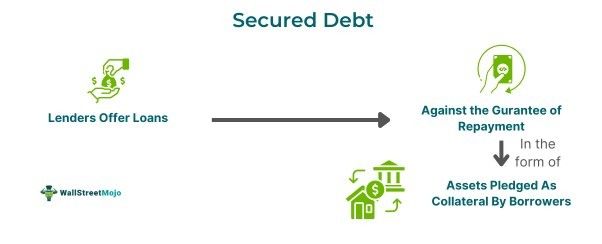
Also, due to their secured nature, borrowers must pay a low interest rate on these debts. These collateral may comprise machinery, real estate, intellectual property, etc. Moreover, at the time of a company’s dilution or bankruptcy, secured creditors or lenders have the right to recover their debts before the unsecured ones.
Key Takeaways
- A secured debt is a type of credit offering that is pledged or guaranteed against a collateralized asset, hence shielding the lenders from potential default risk while offering a low interest rate to the borrowers.
- Some of the common examples of such loans include mortgages, auto loans, gold loans, HELOCs, home equity loans, pawnshop loans, secured credit cards, bridging loans, and secured business loans.
- Borrowers with low credit ratings are also eligible for such credit facilities. These facilities provide an extended repayment period and more considerable loan sanctions than unsecured debts.
Secured Debt Explained
A secured debt is a loan facility whereby the lender provides a specific loan amount to the creditor who pledges their asset like real estate, machinery, intellectual property, or other valuables as collateral with the former. While these loans have a low interest rate for the borrowers, they include minimal default risk for the banks and other lending institutions. Some of the common examples of such debt products are mortgages, home equity loans, car loans, and gold loans.
In a senior secured debt, when a debtor fails to pay a few or multiple E.M.I.s (easy monthly installments), files for Chapter 7 Bankruptcy, dies, or dilutes the business, the creditor can liquidate the asset kept as collateral to retrieve their loss. Hence, through this arrangement, the lender can be assured of loan recovery even when the borrower is in a state of default.
Now let us have an overview of the prominent features possessed by a secured loan:
- These loans offer a low interest rate to the debtors.
- They are even available to borrowers with poor credit ratings.
- Such debts ensure the priority of repayment if the borrowers go bankrupt.
- The loan repayment tenure is usually high for such kinds of credit offerings.
- The allowed credit or loan is limited to the value of the asset kept as collateral; however, it can be increased if one has good credit scores.
Nevertheless, borrowers should be careful about their financial capacity to repay such loans since defaulting on such debts may result in losing the collateralized asset.
Types
The debts that are conditioned upon keeping something as collateral can save the lenders from loss if the borrowers fail to repay the due. Given below are the different kinds of secured loan products offered by the banks and other lenders:
- Auto Loans: All debts offered for the purchase of vehicles, such as two-wheeler loans and car loans, are secured by the respective asset.
- Home Equity Loans: In this kind of loan, the borrower keeps a share of their home’s equity as collateral with the lender.
- Mortgages: Such debts are evident in real estate purchases and are collateralized by that respective property.
- Home Equity Lines of Credit (HELOCs): These provide flexibility to the borrower through a revolving credit line to meet significant financial obligations or consolidate other loans or credit, such as credit cards.
- Secured Credit Cards: Such forms of credit cards are guaranteed by a cash deposit.
- Gold Loans: Banks and other micro-lending institutions offer gold loan facilities, in which the borrowers pledge their gold jewelry or valuables as collateral to the lender.
- Bridging Loans: A bridging loan serves as a short-term loan for buying a new property while selling an old one. Thus, it facilitates the availability of quick funds between selling and buying. The respective real estate often pledges it.
- Pawnshop Loans: Pawnshops initiate such short-term loans, accepting any asset that has some value (like a collectible item, ornament, musical instrument, etc.) as collateral from the borrower.
- Secured Business Loans: These types of debt are specifically extended to business entities that collateralize their assets with lenders.
Examples
Secured loans are a win-win situation for the borrowers and lenders if the former is assured of timely repayment and the latter wants to take a little risk. Following are some of the examples of such debts:
Example #1
Suppose Mrs Palm has gold jewelry worth $25,000. She approaches X.Y.Z. bank for a gold loan of $2,000. The bank has a policy of sanctioning 75% of the collateralized gold value as a loan. Therefore, she was eligible for a maximum secured debt of $18,750. However, her excellent credit rating of 790 made her eligible for a higher loan amount, I.e., for $20,000. Also, the bank offered a repayment tenure of 7 years at an interest of 11% p.a.
Example #2
White & Case L.L.P. provided legal counsel to Terminal Química Puerto México, S.A.P.I. (T.Q.P.M.) for a US$440 million senior secured debt financing, which will be used for the construction of an ethane import terminal and pipeline in Veracruz, Mexico. This infrastructure will streamline the delivery of ethane to Braskem Idesa’s petrochemical facility. Notably, T.Q.P.M. is a joint venture between Braskem Idesa and Advario. The project began in July 2022 and is expected to finish by the end of 2024. Its significance can be gauged by the capacity of the terminal and pipeline to move 80,000 barrels per day, which accounts for Braskem Idesa’s full feedstock supply.
How To Get Out?
While secured debts can increase the blood pressure of a borrower who struggles with paying off these liabilities, specific measures can bring them out of it. These are:
- Talking Directly to the Lender: The foremost way is to discuss the current financial distress with the lender and see if they can extend the loan tenure, reduce the periodic repayment amount, or make some other adjustment.
- Approaching a Credit Counsellor: Borrowers can seek expert advice on debt management, finances, and repayment from a credit counselor.
- Requesting a Breathing Space: The Debt Respite Scheme, introduced in May 2021, allows borrowers to apply for a relaxation or breathing period of up to 60 days, during which they are relieved from interest charges on their accumulated loans.
- Selling Off the Asset: If nothing works, the borrower can sell the collateralized asset and use the proceeds to close the loan.
- Surrendering the Asset: Another way is to surrender the mortgaged asset to the lender and ask them to recover their debts by selling it off.
- Consolidating Debt: If the borrowers have multiple ongoing loans, they can apply for a secured debt consolidation loan, which provides more significant financing for closing all of these debts and providing credit at better terms and conditions.
Secured Vs. Unsecured Debt
Secured and unsecured debts are the two different kinds of loan categories based on their default risk profiles. Let us now understand the differences between options:
| Basis | Secured Debt | Unsecured Debt |
| Definition | It includes loans that require the borrowers to keep their assets as collateral or guarantee. | It refers to loans that don’t need any collateral or mortgage from the borrowers. |
| Collateral | These loans involve mortgages on assets like real estate, intellectual property, fixed deposits, or machinery. | No guarantee is required. |
| Default Risk | Minimal risk of default by the borrower, in which case the lender can sell off the collateral to recover their sum. | It has a significant default risk. |
| Interest Rate | These types of debts usually have a low interest rate due to their less risky nature. | The interest rate is comparatively high. |
| Repayment Tenure | The borrower can seek a long repayment tenure, more than 5 years, for secured loans. | The repayment period is comparatively short for unsecured loans. |
| Sanctioned Loan Amount | The debt amount is subject to the value of the collateral or sometimes even higher, based on the borrowers’ credit ratings. | The loan amount offered by the lender is comparatively low. |
| Eligibility Criteria | These types of loans are also available to individuals or firms with low credit scores. | Borrowers with low credit ratings are not considered eligible for unsecured debts. |
| Priority | In case of borrower’s bankruptcy, the secured lenders are prioritized for repayment. | The unsecured lenders are paid at the second number after the secured creditors if the borrower becomes bankrupt. |
| Example | Home Equity Line Of Credit (HELOC), auto loans | Personal loans and student loans |
Frequently Asked Questions (FAQs)
Frequently Asked Questions
Are credit cards secured debt?
No, not all types of credit cards are backed by collateral, except secured credit cards. Indeed, most credit cards belong to the category of unsecured debt products.
Can secured debt be discharged?
Although a secured loan cannot be written off, in specific conditions, such a discharge is possible. Such circumstances include negotiation between a borrower and lender, bankruptcy of a sole trader, or unfair contract terms that can be legally proved by the borrower.
Can a secured debt be statute-barred?
A secured debt that remains unpaid for more than 12 years can be statute-barred, which means that such an obligation is still open. However, it cannot be subjected to a legal proceeding or court order to pay. Nevertheless, the lender has the right to take subsequent actions.
Is an interim charging order a secured debt?
An interim charging order is issued by the court for secured, unsecured debt when the debtor files for Chapter 7 Bankruptcy and the lender appeals to the court for repayment. Thus, in this case, the debt is collateralized by the creditor’s assets, such as their home or vehicle.