


Introduction
Recruiters at boutique advisory firms and Big Four valuation teams increasingly hire based on demonstrated modeling ability rather than academic pedigree. This shift matters because the traditional gatekeeping around finance roles has loosened considerably over the past decade. A valuation analyst without a finance degree is now a realistic career outcome for accountants, engineers, MBA generalists, and career switchers. However, candidates must be able to build a defensible discounted cash flow model and defend its assumptions in an interview.
This article breaks down what separates candidates who succeed from those who stall out. It covers the core technical skills valuation teams actually test for and how self-taught candidates compare with traditional finance graduates. It also examines compensation in India and the US and provides a step-by-step roadmap that does not require going back to business school. Readers will also see where a structured financial modeling and valuation course fits into this path.
Key Takeaways
- A finance degree is not essential to become a valuation analyst if you can demonstrate practical modeling and valuation skills.
- Individuals wondering how to become a valuation analyst without a finance degree can start with accounting, Excel modeling, and core valuation techniques.
- DCF, trading comparables, and precedent transactions form the core valuation methods tested in analyst interviews.
- Building three to five independent valuation case studies creates tangible evidence of your modeling and analytical abilities.
- Certifications such as the CFA Program can strengthen credibility but do not replace hands-on modeling practice.
- Valuation analyst salaries vary by experience, employer, location, and other key factors.
What Does A Valuation Analyst Actually Do?
A valuation analyst estimates the fair value of businesses, securities, or intangible assets using techniques such as discounted cash flow analysis, trading comparables, precedent transactions, and option-pricing models. The role exists across investment banks, Big Four advisory firms, boutique valuation firms, private equity funds, and corporate finance teams. Valuation analysts may support M&A transactions, financial reporting, and litigation-related assignments.
Day-to-day work involves pulling 10-K and 10-Q filings from SEC EDGAR and building three-statement models in Excel. Analysts also cross-check assumptions against comparable public companies and present valuation ranges, often using a “football field” format, to senior bankers or clients. None of this requires a finance degree specifically. It requires fluency in accounting logic, Excel formula discipline, and the ability to defend a set of assumptions under scrutiny.
Finance Degree vs. Skills-First Path: A Direct Comparison
Employers care less about the credential on paper than they once did, provided the candidate can prove competence through a portfolio or a certification with real modeling output. The table below compares the two most common entry paths:
| Factor | Traditional Finance Degree Path | Skills-First Path (No Finance Degree) |
| Time to entry-level readiness | 3-4 years | 4-9 months of focused, structured practice |
| Upfront cost | High (tuition, opportunity cost) | Low to moderate (course fees, self-study) |
| Core credibility signal | University brand, GPA | Portfolio models, certifications |
| Typical entry roles | Analyst, associate (campus hiring) | Analyst, valuation associate, FP&A analyst (lateral hiring) |
| Biggest risk | Underexposure to practical Excel work | Being screened out without a portfolio to prove skill |
| Best suited for | Recent graduates, campus recruiting | Career switchers, accountants, engineers, MBAs |
This comparison shows why a skills-first candidate needs to over-index on demonstrable output. A finished McDonald’s-style three-statement model or a completed DCF on a real public company carries more weight in an interview than a listed coursework title.
How To Become A Valuation Analyst Without A Finance Degree: Step-by-Step
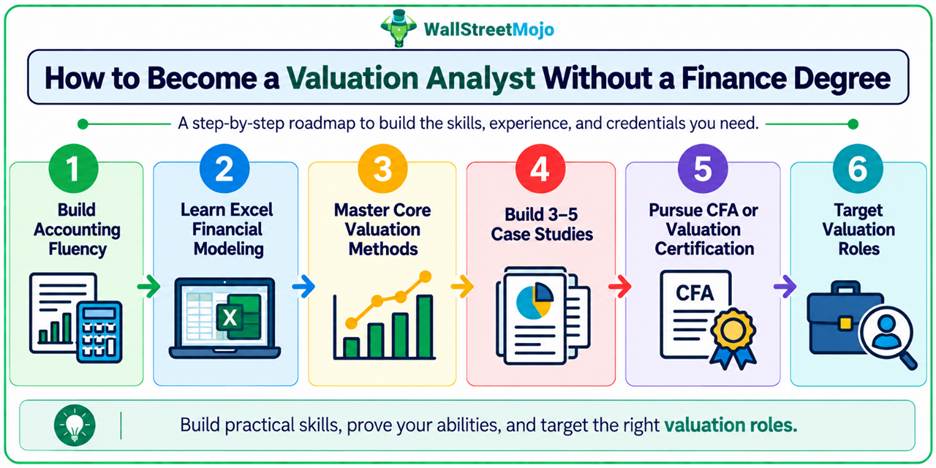
Follow these six steps to build the skills, experience, and credentials needed to become a valuation analyst without a finance degree.
1. Build Accounting Fluency First
Valuation is downstream of accounting. A candidate who cannot read a cash flow statement will not build a credible DCF, regardless of how polished the Excel formatting looks.
2. Learn Excel-Based Financial Modeling Formally
This is where most self-taught candidates plateau, because YouTube tutorials rarely cover circular references, sensitivity tables, or model auditing. A structured financial modeling and valuation course closes this gap faster than trial and error.
3. Master The Three Core Valuation Methods
Discounted cash flow, trading comparables, and precedent transaction analysis form the baseline vocabulary of every valuation interview.
4. Build Three To Five Independent Case Studies
Pick real, publicly traded companies, pull their filings, and build full models. This portfolio becomes the proof point a finance degree would otherwise provide.
5. Pursue The CFA Program Or A Recognized Valuation Certification In Parallel
The CFA Institute’s curriculum directly overlaps with equity valuation and is respected regardless of undergraduate major.
6. Target Roles And Firms That Hire On Skill
Boutique valuation shops, corporate FP&A teams, and mid-market advisory practices are generally more open to non-traditional backgrounds than bulge-bracket investment banks.
Choosing A Course: Comparing Financial Modeling and Valuation Providers
Choosing the right course matters if you want to become a valuation analyst without a finance degree. After all, unstructured learning can slow your progress and leave important skill gaps. The table below compares four widely used programs based on the factors most relevant to valuation training and interview readiness.
| Provider | Approx. Hours | Core Coverage | Case Study Depth | Access Model |
| WallStreetMojo Financial Modeling and Valuation Course | 27+ hours | Three-statement modeling, DCF, dividend discount, relative valuation, AI-in-Excel workflows | Full McDonald’s three-statement case study with Excel templates | 3-year access, 3 certificates |
| Wall Street Prep Premium Package | 70-90 hours | Three-statement modeling, DCF, M&A, LBO, trading and transaction comps | Case-study-based modeling using financial reports, Excel templates, and company examples | Self-paced, lifetime-style access |
| Breaking Into Wall Street (BIWS) Premium | 90 hours | Excel, accounting, DCF, M&A, LBO modeling | Get templates, plus additional examples | 5 years of support, updates, and video access |
| Corporate Finance Institute (CFI) FMVA | Varies by module (44-course catalog) | Financial modeling, valuation, accounting, Excel, and related finance skills | Modular courses, exercises, and case studies | Annual subscription |
For candidates specifically building toward a valuation analyst without a finance degree career path, the sequencing matters more than raw hour count. WallStreetMojo’s Financial Modeling and Valuation Course structures its curriculum around a foundation-to-modeling-to-valuation progression. All concepts and techniques in the program are taught by Dheeraj Vaidya, CFA, FRM, a former JPMorgan and CLSA analyst. His experience ensures that the curriculum mirrors the actual workflow a valuation team expects on day one rather than covering topics in isolation.
Pricing for any of the above courses changes frequently with promotional cycles. So, checking the live course page before enrolling is the more reliable approach than depending on a quoted figure in an article.
Valuation Analyst Without A Finance Degree Salary: India And US Benchmarks
In India or any other country like the USA, valuation analyst salaries vary considerably by experience, employer, and location. According to AmbitionBox’s data, the typical annual salary range for Valuation Analysts with 0 to 5 years of experience is ₹7.6 lakh to ₹8.4 lakh. In the United States, Salary.com reports an average Valuation Analyst salary of $69,331 per year as of September 1, 2026.
These figures provide useful salary benchmarks, but actual compensation can vary based on the hiring firm, city, experience level, and scope of the role.
Mistakes That Keep Non-Finance Candidates Out Of Valuation Roles
Most rejections trace back to a handful of avoidable errors rather than a lack of raw intelligence. Let us look at the common mistakes that you should avoid if you are looking to become a valuation analyst without a finance degree in India.
- Treating certifications as substitutes for practice: A completed course without independently built models signals passive learning, not job readiness.
- Ignoring accounting fundamentals: Interviewers routinely probe how an increase in depreciation flows through all three financial statements. Shaky answers here disqualify otherwise strong candidates.
- Overbuilding models with no clear investment thesis: A technically complex DCF with no articulated view on the company’s value drivers reads as busywork, not analysis.
- Skipping industry-specific valuation nuance: Valuing a bank or an insurer requires different multiples and adjustments than valuing an industrial company, and generic templates do not transfer cleanly.
Conclusion
The objective of becoming a valuation analyst without a finance degree is achievable. However, it demands more deliberate proof of competence than the traditional campus-hire path provides automatically. Accounting fluency, structured modeling training, and a portfolio of independently built valuations together form a credible substitute for the credential most firms once required by default.
Candidates who want a sequenced, practitioner-built starting point can explore WallStreetMojo’s Financial Modeling and Valuation Course to build the same modeling foundation valuation teams expect from any new hire, degree or not.
Frequently Asked Questions
Can someone really become a valuation analyst without a finance degree?
Yes, one can become a valuation analyst without a finance degree. People often get hired for this role even if they come from accounting, engineering, or general business backgrounds. They prove their competence through modeling portfolios, certifications like the CFA Program, and structured financial modeling and valuation course completion rather than a finance-specific undergraduate degree.
What skills matter most for valuation analyst jobs without a finance degree?
For valuation analyst roles, the most important skills are accounting fluency, advanced Excel modeling, DCF analysis, trading and transaction comparables, and the ability to clearly defend assumptions during interviews. These practical skills can often matter more than having a specific undergraduate finance degree.
Is the CFA charter necessary to work in valuation?
It is not strictly necessary for entry-level roles. However, progress through the CFA Program signals credibility to hiring managers, particularly for candidates without a finance degree. This is because the CFA curriculum directly covers equity valuation, financial statement analysis, and corporate finance.
How long does it take to become job-ready for a valuation analyst role without a degree?
Most focused candidates need four to nine months of structured modeling practice, including course completion and independent case study work, before they are competitive for entry-level or associate-level valuation roles.
Do valuation analysts need to know coding or AI tools?
Increasingly, yes, at a basic level. AI-assisted Excel workflows for formula auditing, model review, and output summarization are becoming common in modern valuation and financial modeling training. That said, core modeling logic still needs to be understood manually first.
What is a realistic valuation analyst without a finance degree salary expectation in India?
A valuation analyst in India with 0 to 5 years of work experience typically earns in the range of ₹7.6 lakh/yr to ₹8.4 lakh/yr. That said, besides experience, the compensation varies based on other factors, like location, hiring company, and more.