


What Are Pricing Models?
Pricing Models refer to the methods companies employ to ascertain the prices of their products and services based on business type, industry, market position, economic conditions, and customer perception. It is a format used to implement a pricing strategy and present goods or services to customers as a package or unit in a consolidated manner.
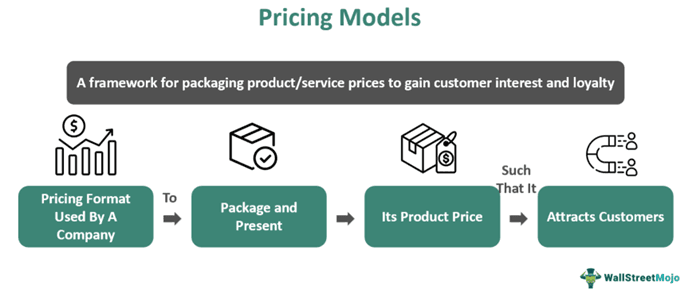
One of the most challenging aspects of any business is setting a competitive yet profitable price point for its goods or services. Thus, selecting a suitable pricing model helps a company communicate its optimal selling point, ensuring customer engagement and loyalty. Companies in different industries and sectors widely adopt these methods to achieve sustainability and growth.
Key Takeaways
- Pricing models refer to the packaging and presentation of product/service prices in ways that increase their appeal to customers.
- Different pricing models include freemium, market, product, digital product, bulk, sliding scale, flat rate subscription, tiered subscription, and pay-as-you-feel.
- The primary purpose of these models is to acquire customers and ensure sustainable business growth while building customer loyalty and engagement.
- It is different from pricing strategy, which refers to fixing the best or optimal price for a company’s goods or services.
Pricing Models Explained
Pricing models offer companies a structure that enables them to package and present their product prices in a way that appeals to customers. To justify their pricing decisions and arrive at appropriate prices, companies use various external factors as the core determinants of the prices of the products and services they sell. These determinants include the nature and type of business a company engages in, consumer preferences seen in the specific industry, competitor’s product pricing strategies, etc.
These models are critical, and the process of package pricing to make it attractive is challenging. It requires utmost care since setting a significantly or comparatively higher price than one’s competitors or not adhering to the general trends in the industry could affect sales volumes and sales revenue. This is because customers may prefer a more competitively priced alternative if they believe that the price of a specific product or service is too high. On the other hand, fixing a low price could result in low profitability despite high sales volume.
A pricing model should justify a company’s pricing strategy. Business entities often use competent pricing models to penetrate new or existing markets, especially startups that focus on building a strong customer base rather than profitability. Thus, these models serve as the key to sustainable business growth and strengthening customer relationships in the long run. It enables firms to define a competitive but favorable price for their products and services, which portrays substantial brand value and market standing.
These models impact a company’s financial performance, competitive positioning, and customer relationships. They should be adjusted from time to time to adapt to changing market conditions, economic factors, and customer preferences. Additionally, data plays a key role in shaping these models. Many pricing models rely heavily on data related to customer behavior, market trends, competitor movements, etc. Companies leverage psychological aspects of consumer behavior to design, present, and package the prices of products and services. For instance, scarcity tactics can boost sales.
Pricing models in finance help determine the value of stocks, options, derivatives, bonds, and other financial instruments. These models enable investors, traders, and financial institutions to buy, sell, or hold financial assets based on their financial goals.
Types
Pricing models serve as a framework for setting and presenting product prices in a manner that clearly outlines the corresponding pricing strategies. Given below are some prominent models companies use.
- Freemium: Per this method, companies give basic products or services free of cost. For any additional features, premium services, and superior versions of products or services, customers are required to pay higher prices. For instance, YouTube is available to every user with a Google account. However, YouTube Premium requires a special paid subscription.
- Product Pricing: Under this method, the cost of manufacturing a product, along with its packaging, storage, shipping, and other expenses, are considered while determining its selling price.
- Digital Product Pricing: Intangible products like software, ebooks, magazines, journals, and online courses are priced based on the brand value and the value these offerings create for customers.
- Market Pricing: It is a price point determined by market dynamics, i.e., the supply and demand of goods or services in a given market.
- Bulk Pricing: Per this pricing model, the volume of goods or services purchased plays a crucial role in determining its price and discount. Thus, the price drops when the purchase quantity increases.
- Sliding Scale Pricing: This method sets a product’s price based on the paying capacity of buyers. It enables sellers to accommodate buyers with varied financial capacities.
- Flat Rate Subscription: It is a popular Software as a Service (SaaS) pricing model that charges customers a consistent price at regular intervals.
- Tiered Subscription: Another prominent SaaS pricing method is the tiered subscription, where companies have different pricing levels with more and/or upgraded features at every level. However, the middle tier is strategically priced as the one that offers the best price.
- Pay As You Feel: Such pricing methods are standard in charity or fundraising events where customers can decide whether to pay at all or what amount to pay for the goods or services they have used or purchased.
Examples
Companies carefully plan their pricing models to attract customers and grow their business. Software pricing models like flat or tiered subscription models have gained immense popularity nowadays. To understand how companies finalize their pricing models, let us study some examples in this section.
Example #1
Suppose FirstPrint Ltd. is a company that designs digital visiting cards. It adopts a bulk pricing model where it lowers the price with the increasing volume of purchases. Mandy, the operations manager for the Texas region, uses the following plan to acquire customers.
| Quantity | Price |
|---|---|
| 100 visiting cards | $40 |
| 500 visiting cards | $150 |
| 1000 visiting cards | $250 |
| 5000 visiting cards | $1000 |
From this table, we can see that for 100 visiting cards, a customer would be charged $0.4 per piece, while on ordering 5000 visiting cards, the price is reduced by 50%, i.e., $0.2 per piece.
In 2024, Mandy needed more graphic designers due to the increased number of orders. However, she noticed that the asking price quoted by these professionals seemed to be higher than usual. To understand the change, she studied certain publicly available economic studies and reports pertaining to the human resource trends in designing, printing, digital marketing, and other allied industries.
Mandy saw that there was a general rise in the salary ranges of graphic designers working in each of these industries due to a high demand for their skills. Due to this change seen in the economy’s skills and employment statistics, she had to hire graphic designers at salaries higher than she normally would. To accommodate this additional expenditure, she proposed the following changes:
- Mandy asked the cost accounting team to revisit their cost structure.
- She worked with the marketing department to revise the prices for the bulk purchasing plan.
- Mandy proposed to introduce new designs and more customization options to customers to justify the price rise.
- She also approached senior management to check if a different pricing model could be selected and implemented for better pricing outcomes.
This is an illustration of how pricing models can be used to fix, restructure, or modify prices and, subsequently, acquire and retain customers.
Example #2
In March 2022, Netflix experimented with charging fees to subscribers who shared accounts outside their households. This trial involved a monthly fee ranging from $2 to $3, allowing the addition of up to two people as sub-accounts. Initially, this trial took place in Chile, Costa Rica, and Peru.
The change in the company’s pricing model and the corresponding increase in prices was driven by falling stock prices due to lower-than-expected subscriber numbers. Also, as competitors began gaining a foothold in the industry, Netflix’s popularity and market position were under threat from other well-known players.
At the end of 2023, Netflix had 221.8 million subscribers, a notch below its target. In the first quarter of 2024, the platform was expected to add only 2.5 million subscribers. In the United States, Netflix recently implemented subscription price increases, with the primary option priced at $9.99, and the most expensive option costing $19.99.
This is a classic example of the use of pricing models in business.
Advantages And Disadvantages
The selection of a suitable pricing model is a critical decision in any organization since it determines its success or failure in the long run. Let us study the various pros and cons of these models in business.
Advantages
- Customer focus: Pricing models are customer-centric. They enable a company to target the right audience to build a customer base.
- Business growth: Such methods help businesses grow and become sustainable in the long run.
- Applicability: These models are universally applicable to all types of product- and service-based industries and businesses.
- Custom solutions: Companies can opt for different pricing models based on the type of business and customer category.
- Customer engagement: It primarily aims at delivering value to customers, thus securing their trust, loyalty, and engagement.
- Brand value: Optimal pricing presents and nurtures the brand value of a firm in the right manner.
Disadvantages
- Heavy initial costs: Some pricing models, like freemium, typically require companies to fund the basic products or services they offer customers without receiving any monetary gains in return. This raises their initial cost. Only when customers choose an upgraded version or a premium product or service do these companies receive fees for the product or service they provide.
- Limited view: Such models sometimes overlook internal factors like product cost and profit margin.
- Incorrect model selection: Selecting the wrong pricing model can adversely affect a company’s reputation and even result in them losing customers to competitors.
- Implementation issues: The implementation of such models is highly challenging in today’s dynamic business environment.
Pricing Models Vs. Pricing Strategy
While both are critical aspects of product pricing, a pricing strategy is different from a pricing model. Let us discuss the differences.
| Basis | Pricing Models | Pricing Strategy |
| Definition | These models refer to the formats companies use to package the prices of their goods or services and present them as optimal to their customers. | A pricing strategy is a method used to determine the best price point for goods or services based on internal factors. |
| Focus | It focuses on optimal packaging and effective presentation of a product’s price to customers. | It focuses on setting the right price for goods or services. |
| Types | Freemium, market pricing, product pricing, digital product pricing, sliding scale pricing, bulk pricing, flat rate subscription, tiered subscription, and pay-as-you-feel are popular types. | Value-based pricing, competitive pricing, cost-plus pricing, price skimming, penetration pricing, dynamic pricing, economy pricing, geographic pricing, premium pricing, and bundle pricing are well-known pricing strategies in the industry. |
| Formulated | It is externally determined based on the type of business, sector, and industry. | It is developed internally considering factors like product cost, features, value, and competition. |
Frequently Asked Questions (FAQs)
Frequently Asked Questions
What is a dynamic pricing model in e-business?
A dynamic pricing model in e-business refers to the method of using real-time algorithms and information to revise the prices of goods or services based on factors like inventory levels, supply and demand, competitor’s strategy, customer persona, location, time, and seasonality.
How to develop a pricing model?
Companies can adopt the following steps to create an effective pricing model for their products or services: – Determine business goals – Estimate the product cost – Evaluate the value a product offers customers; – Anticipate the demand for goods or services; – Analyze the competitor’s product pricing – Test and monitor the product pricing implemented.
What are the 3 pricing models of Azure?
The prominent Azure VM pricing models include: – Free Azure options – Pay-as-you-go – Reserved VM instances
What are the 3 pricing models of AWS?
There are various AWS pricing models available to customers. They are: – On-demand – Spot instances – Dedicated hosts – Reserved instances – Savings plan