


Introduction
Anyone researching how to break into finance eventually runs into the same two names: WallStreetMojo and Wall Street Oasis. Both platforms show up repeatedly in Reddit threads, LinkedIn discussions, and campus finance club recommendations, which makes the choice confusing for someone who has never taken a structured finance course before.
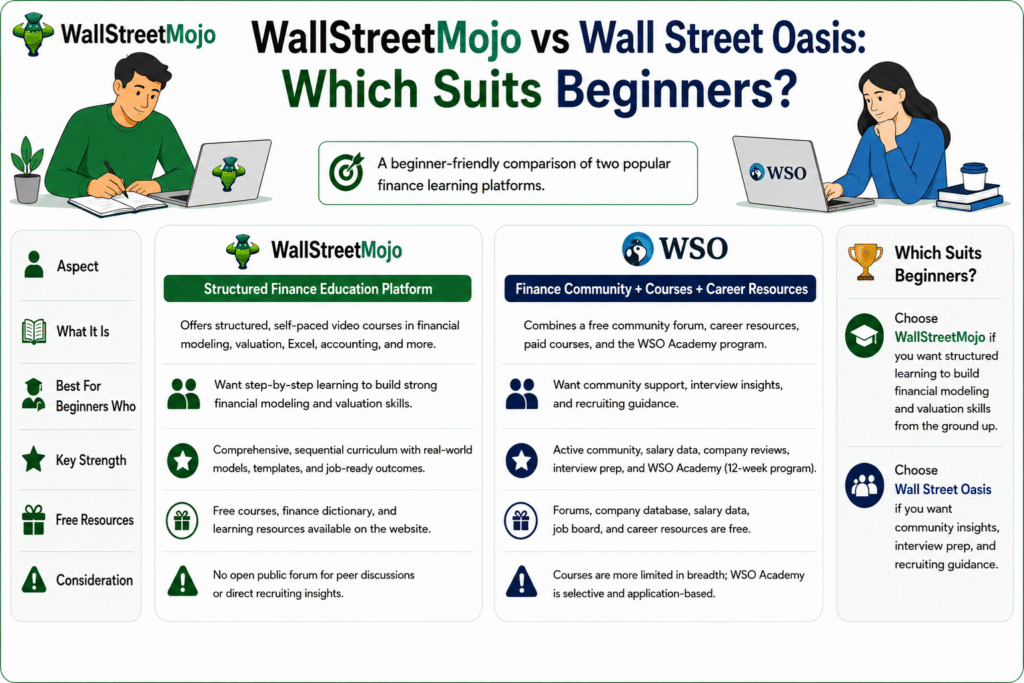
WallStreetMojo vs Wall Street Oasis is not a simple better-or-worse comparison, because the two platforms were built around different core purposes. WallStreetMojo is a structured course provider focused on financial modeling, valuation, and investment banking skill-building. Meanwhile, Wall Street Oasis began as a career community and forum before layering paid courses and a cohort-based recruiting program on top of it.
This WallStreetMojo vs Wall Street Oasis comparison looks at how the two platforms differ in their course structure, learning approach, pricing, and suitability for beginners. It helps beginners choose the right resource based on their goals, whether they want financial modeling skills or interview preparation and job-search strategy.
Key Takeaways
- WallStreetMojo offers structured, self-paced courses focused on financial modeling, valuation, Excel, and investment banking.
- Wall Street Oasis combines self-paced courses with community discussions, career resources, and WSO Academy.
- WallStreetMojo provides sequential learning paths for beginners building foundational finance and modeling skills.
- WSO provides community discussions, salary data, company information, and interview-focused career resources.
- WallStreetMojo suits beginners seeking structured finance education, while WSO suits learners seeking career and interview insights.
What Is WallStreetMojo?
In the WallStreetMojo vs Wall Street Oasis comparison, WallStreetMojo is an online finance education platform that offers structured, self-paced video courses. The course provider offers programs focusing on financial modeling, valuation, investment banking, Excel, accounting, and AI-driven finance workflows. The platform was co-founded by Dheeraj Vaidya, a CFA charterholder who previously worked as an analyst JPMorgan and CLSA, and this practitioner background shapes how the courses are built. Each program tends to walk through a real-world model or workflow rather than staying purely theoretical.
The platform reports serving 500,000+ learners across students, working analysts, career switchers, and corporate teams. Moreover, it’s course catalog is organized around specific job-ready outcomes such as the Financial Modeling & Valuation Core + AI Bundle, the Investment Banking Mastery Program (IBMP), and the Equity Research Course. Beginners typically start with the Elite Membership, which bundles access to the full course library, templates, and certificates rather than requiring a separate purchase for every skill area.
What Is Wall Street Oasis?
Wall Street Oasis (WSO) is a finance-focused online community covering careers in investment banking, private equity, hedge funds, and consulting. Founded in 2006, WSO combines a free discussion forum and career resources with paid courses and its WSO Academy program.
Unlike WallStreetMojo, WSO combines community discussions, career-related information, company reviews, and paid learning resources. Its free forums provide access to discussions and career insights and the paid offerings include self-paced financial modeling and interview preparation courses. In addition, WSO Academy offers a structured twelve-week program focused on investment banking, private equity, and consulting careers.
WallStreetMojo vs Wall Street Oasis: Head-To-Head Comparison
The table below compares WallStreetMojo and Wall Street Oasis across key factors, including their core models and founder backgrounds:
| Factor | WallStreetMojo | Wall Street Oasis |
| Core model | Structured, self-paced video courses | Free community forum + paid courses and cohort program |
| Founder background | Dheeraj Vaidya, CFA, FRM, ex JPMorgan and CLSA analyst | Patrick Curtis, former investment banking and private equity professional |
| Primary strength | Financial modeling, valuation, and Excel skill-building | Career discussions, recruiting information, and finance-related resources |
| Beginner course examples | Financial Modeling and Valuation Course, Basic Excel Course, Financial Analyst Fast Track Program | Financial Statement Modeling Course, WSO Free Modeling Series, IB Interview Course |
| Community access | Course-based learner community, no open public forum | Open public forum |
| Free resources | Free courses, dictionary, and resources on the main site | Forums, company database, salary data, and job board are free |
| Access model | Bundled Elite Membership covering the full course library plus individual course purchases | Individual course purchases, plus WSO Academy, a separate application-based program |
| Best suited for | Learners who want structured learning across core finance skills, including financial modeling, valuation, and equity research | Learners who want community discussions, job-search resources, and interview insights |
This table is built for quick scanning because that is exactly what someone in the research phase needs before deciding where to invest their time. Neither platform wins outright across every row, and that is the point. The right pick depends on whether the immediate need is skill acquisition or career navigation.
Curriculum Depth: Where Each Platform Actually Teaches Skills
For beginners comparing WallStreetMojo vs Wall Street Oasis, curriculum depth is often more important than brand recognition. WallStreetMojo structures its curriculum around outcome-specific bundles. The Financial Analyst Fast Track Program, for example, layers Excel, accounting, financial modeling, and valuation into a single sequential track. This matters for someone who has never built a three-statement model before and needs the prerequisite skills taught in order instead of having to learn them separately first.
When comparing WallStreetMojo vs Wall Street Oasis courses, one must note that Wall Street Oasis also offers self-paced programs covering areas such as financial statement modeling. These courses cover finance concepts, modeling techniques, and related skills.
Reviewers of the WSO Academy track note its strong focus on investment banking, while also covering private equity, hedge funds, and consulting. The program is designed around these specific finance career paths.
Credentials, Instructors, And Credibility
Trust matters more in finance education than in most other content categories, because a bad model habit or a misunderstood valuation concept can follow someone into an actual interview. WallStreetMojo leans on Dheeraj Vaidya’s CFA charter and analyst background at JPMorgan and CLSA as its primary authority signal. Moreover, the course pages typically attribute lessons to his professional experience in financial modeling and investment banking.
Wall Street Oasis takes a community-driven approach, drawing on discussions and insights from finance professionals and other community members. Patrick Curtis holds a bachelor’s degree in economics from Williams College and an MBA in entrepreneurial management from the Wharton School. Beyond his academic background, the platform’s broader credibility comes from its scale.
Practitioners across investment banks, private equity firms, and consulting firms contribute reviews, salary data, and forum answers over time. Neither model is inherently superior. The two platforms use different approaches to delivering finance education, with structured courses on one side and community-based resources on the other.
Pricing Structure: What Beginners Should Expect
For anyone comparing WallStreetMojo vs Wall Street Oasis, pricing can be an important consideration because institutional pricing changes often and promotional pricing varies by region. So, this section focuses on structure rather than committing to figures that may change.
WallStreetMojo generally uses a bundled subscription model, where a single Elite Membership unlocks its course library rather than requiring learners to buy each skill area separately. Individual standalone courses are also sold for those who want a narrower purchase.
That said, Wall Street Oasis (WSO) structures its pricing across multiple tiers covering different types of learning resources. Live public bootcamps are priced per event based on the topic and included study materials. For self-paced learning, individual modeling courses and multi-course bundles carry separate flat fees. The WSO Academy program operates under a separate tuition structure. Students enrolling in the Academy can choose an upfront payment or distribute the cost across multi-month installment plans.
WallStreetMojo vs Wall Street Oasis: Strengths And Limitations
The differences between the two platforms become clearer when considering their respective strengths and limitations.
WallStreetMojo’s course-first structure gives beginners a clear, sequenced path through core finance skills, including modeling and valuation. Its structured courses help learners build foundational knowledge before progressing to more advanced topics. Its primary focus is structured finance education rather than community-based career discussions, salary data, or peer-shared interview experiences.
Wall Street Oasis combines self-paced courses with community discussions and career-focused resources. Its forums provide access to discussions about interviews, companies, salaries, and finance careers. WSO Academy adds a structured, application-based program for learners seeking a more mentorship-focused format. Its community-oriented model, however, may be less suitable for learners who primarily want a structured course sequence across core finance skills.
Which One Should A Beginner Choose?
The answer to the WallStreetMojo vs Wall Street Oasis question depends on what “beginner” means in context. A beginner with zero modeling experience who wants a guided, sequential curriculum in Excel, financial modeling, and valuation generally gets more immediate value from a course-first platform like WallStreetMojo, since the content is designed to be followed from start to finish without needing to filter through forum threads to find a coherent path.
A beginner with some technical grounding who wants interview insights, recruiting resources, and access to a peer network may find Wall Street Oasis useful. Many learners in the commercial investigation phase end up using both: a structured course to build the modeling foundation, then WSO’s community to stress-test interview readiness against real recruiting outcomes. WallStreetMojo’s own course paths, including the Financial Modeling and Valuation Course and the Investment Banking Mastery Program, are built for exactly that first stage, giving beginners a structured curriculum developed under CFA-qualified expertise before they move into the networking and interview-prep phase.
Conclusion
The WallStreetMojo vs Wall Street Oasis choice comes down to matching the platform to the immediate goal. Beginners chasing a structured, instructor-led path into financial modeling, valuation, equity research, etc., tend to progress faster on WallStreetMojo’s course tracks. That said, learners seeking recruiting insights and peer-shared career information may find Wall Street Oasis’s community beneficial. Reviewing WallStreetMojo’s Financial Modeling and Valuation Course or its Elite Membership is a reasonable next step for anyone who wants a credentialed, sequential curriculum before entering the recruiting process.
Frequently Asked Questions
Is WallStreetMojo better than Wall Street Oasis for beginners?
Neither platform is universally better. WallStreetMojo vs Wall Street Oasis for beginners ultimately depends on the learner’s goals. WallStreetMojo works better for beginners who want a structured, sequential curriculum in modeling, valuation, FP&A, etc. Meanwhile, Wall Street Oasis works better for beginners who want community-sourced recruiting advice and salary data.
Is Wall Street Oasis free to use?
Wall Street Oasis’s forums, company database, and salary data are free to join and browse for all site visitors. That said, its structured courses and the WSO Academy program require separate payment.
Who teaches the courses on WallStreetMojo?
WallStreetMojo’s courses are taught or directed Dheeraj Vaidya, a CFA and FRM charterholder with prior analyst experience at JPMorgan and CLSA.
Is WSO Academy worth it for someone new to finance?
WSO Academy is a selective, application-based, twelve-week program aimed at candidates actively preparing for investment banking, private equity, or consulting roles. So, it suits beginners who already have some technical grounding and are focused on landing an offer, rather than those starting from zero.
Which platform is better for learning financial modeling specifically?
WallStreetMojo’s course library is built specifically around modeling and valuation as a core curriculum, while Wall Street Oasis offers modeling courses as part of a broader job- preparation-focused catalog. So, the better fit depends on whether the goal is deep skill-building or interview preparation.