


What Is Payment Tracking?
Payment tracking is a systematic process through which business entities monitor the status of their overall expenses, whether small or large, during a particular accounting year. It helps organizations record, gauge status, receive reminders, and reconcile all inbound and outbound cash flows.
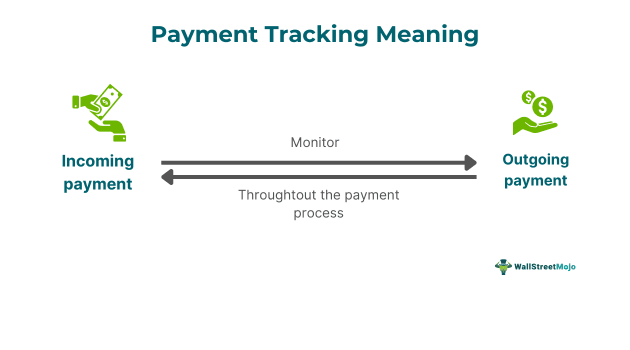
It is challenging for small and budding firms to trace all their payments and invoices over a given fiscal year. However, it facilitates budgeting, cash flow management, planned spending, financial forecasting, and tax planning and preparation. Moreover, proper accounting and record-keeping of all these expenses can help the management identify any payment discrepancies or frauds.
Key Takeaways
- Payment tracking is a method of monitoring all incoming and outgoing payments throughout a payment process.
- A robust payment tracking system provides for payment records, status, reminders, security, integration, reporting, and analysis.
- It helps business entities to effectively manage their cash flows, plan their budget, forecast future financial needs,
- prepare for tax season, strengthen their customer relationships, build investors’ confidence, utilize resources efficiently, and reduce operating costs.
- The companies can use different accounting and payment tracking software like QuickBooks, PayPal, or Google Sheets for this purpose.
Payment Tracking in Business Explained
Payment tracking is an approach where business entities keep an eye on all their incoming and outgoing cash flows or payments. Thus, it aims to follow the status of all small and big monetary transactions at every stage of the payment cycle. Every organization needs to have a robust and effective payment tracking system to ensure efficient cash flow management, budgeting, and financial reconciliation. On the one hand, it helps the firms to complete all due dates of payment. On the other hand, it aids these businesses in monitoring customer payments, updating status, and providing reminders at every stage of the payment process.
Some of the prominent features of a well-structured payment tracking system are security, integration with the various financial systems, and systematic record-keeping. Moreover, the firms can gauge the following critical metrics to determine the efficiency of such a system:
- Processing Time is the overall time it takes for a particular payment to move from the initiation stage to the receipt stage.
- Dispute Rate: It determines the percentage of disputed payments that require refunds or other actions.
- Error Rate: This is an efficiency measure of transactions that gauges the percentage of payments initiated with mistakes.
- Approval Rate: The payment approval rate is the percentage of payments that received approval on the first attempt.
Tracking payments has been improving with evolving customer expectations and technological advancements. Some recent developments in this field are blockchain technology, real-time tracking, mobile payment tracking, and integration of the system with accounting software.
Examples
There are various online payment tracking software. Businesses or individuals can also use the payment tracking template to hold command over their inbound and outbound payments. Let us discuss some relevant examples:
Example #1
Suppose M/s XYZ Ltd. is a small business entity that doesn’t have any payment tracking software. Instead, it uses remittance letters to monitor its expenses, record keeping, reconciliation of accounts, and proof of payment. Mrs. Chisel purchases a refrigerator from the company and agrees to make the whole payment upon delivery. M/s XYZ Ltd. Issues an invoice along with a remittance slip to Mrs. Chisel, mentioning the due date, amount, and invoice number. Now, Mrs. Chisel has made the payment by check, and the company has recorded the payment completion status and reconciled the remittance letter for record keeping.
Example #2
Swift payment tracking has taken a robust step in strengthening its cross-border payments for businesses. The provider considered the ISO 20022 standard throughout its payment chain to help the banks with white-labeled, ready-to-use tracking services. The purpose of such improvement is to ensure simplicity, ease of use, and the availability of clear payment status. This strategy was supported by 25 prominent banks and 20 top-notch corporates of different sectors, like Roche and Saudi Aramco.
Moreover, the initiative focuses on standardizing payment data to enhance automation and lower costs. Other benefits of the Swift initiative include better payment analysis and a unified tracking experience. Further, Swift’s efforts support the G20’s aim for faster cross-border payments, with 89% of transactions currently reaching the beneficiary bank within an hour. The app will be adding new features in 2024.
Benefits
The tracking of payments is essential for all kinds of businesses to achieve sustainability and transparency in their payment process. Given below are the various advantages of having a solid payment tracking system:
- Cash Flow Management: Small businesses have limited resources. Therefore, a powerful payment tracking system allows them to plan their future endeavors and spending carefully to ensure that they have enough cash. Hence, it helps budget future cash flows and maintain sufficient liquidity in the short run.
- Financial Forecasting: It facilitates businesses’ determination of their future financial needs for settling upcoming dues or meeting potential operating expenses.
- Proper Resource Allocation: Tracking invoices and expenses in real-time saves employees time and eliminates adverse consequences like excessive administration expenses and late payment penalties.
- Tax Planning and Preparation: The companies use such practices to effectively plan their taxes by segregating the tax-deductible expenses, thus preparing beforehand for the tax season.
- Real-Time Tracking of Expenses: Organizations can follow up on the payment status throughout an expense’s lifespan to get the real-time status.
- Financial Reporting and Analysis: This further aids the accounting team and management in properly reporting the business’s cash flows and analyzing the company’s liquidity position.
- Better Relations With Stakeholders: Moreover, a clear payment tracking system can help the business obtain accurate information on customers’ payments and resolve their payment issues. Thus, it even aids in securing the trust of investors and creditors.
- Employee Reimbursements and Rewards: When businesses know how much money they will have left at the end of the year after making all the payments, they can effectively plan to use this money to ensure employee satisfaction through rewards and reimbursements.
- Credit Risk Mitigation: The firms can curtail the possibility of credit risk pertaining to potential payment defaults through timely reminders. Also, they can effectively plan the credit and payment terms based on the data so collected.
Frequently Asked Questions (FAQs)
Frequently Asked Questions
What is compensation payment tracking?
Compensation tracking is a specific feature of the tracking software that helps the company’s human resource department monitor employees’ pay, benefits, and bonuses. It is also included in the respective employee’s records.
Does the payment tracking software allow for multiple users?
Businesses use different accounting software to track their invoices and bills. Still, the most effective ones allow multiple employees to use the software at the same time to enter expenses, bill details, and record invoices. Some of these software are QuickBooks, Google Sheets, Xero, and PayPal.
What is the best way of payment tracking?
The best way to track expenses and other payments is to automate the whole process using payment-tracking software. Moreover, immediately recording the payments is essential for limiting errors or missing transactions. Another way is to create a payment tracking template that would help businesses know their real-time expenses.