


Introduction
Anyone researching how to break into finance eventually lands on the same question: WallStreetMojo vs Udemy vs Coursera, which platform actually delivers the skills employers pay for? All three show up in the same search results, all three claim strong ratings, and all three look similar on the surface. The difference shows up only once a beginner examines what each platform is actually built for.
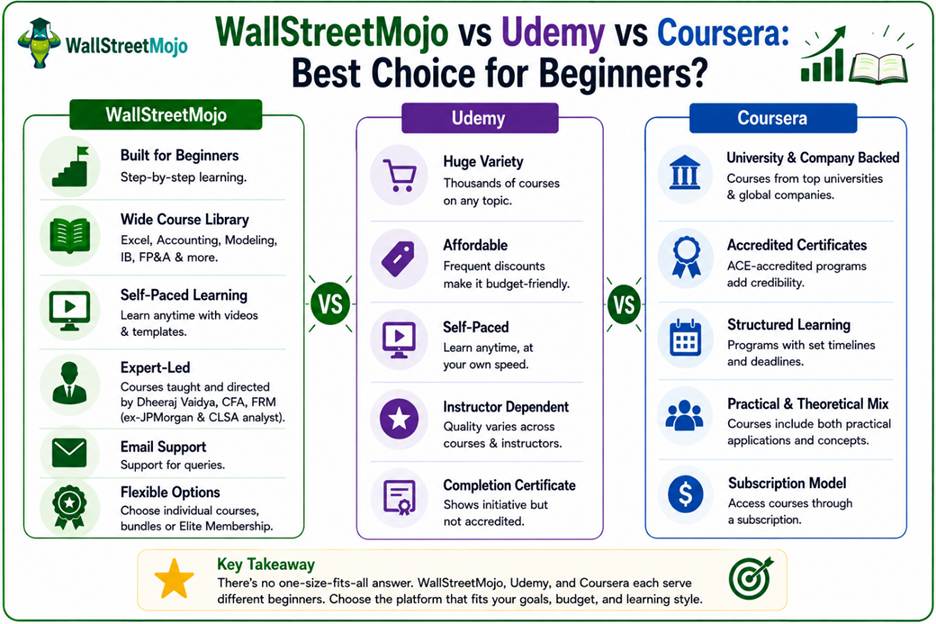
WallStreetMojo is a finance-specific training provider built around structured, career-focused programs in financial modeling, valuation, and investment banking. Udemy is a general-purpose course marketplace where instructor quality varies widely by listing. Coursera is a university- and company-backed learning platform built around accredited certificates and academic rigor.
This comparison breaks down course quality, instructor credibility, certification value, pricing structure, and the type of beginner each platform actually suits, so the decision comes down to fit rather than guesswork.
Key Takeaways
- WallStreetMojo offers flexible learning options, from individual finance courses and bundles to Elite Membership for broader skill development.
- Certificates alone rarely secure jobs; employers also assess practical skills such as financial modeling, valuation, and analysis.
- The platform offering the best online finance course for beginners depends on career goals, preferred learning format, budget, and desired level of structure.
- Course quality varies by platform, so beginners should compare instructor experience, curriculum structure, reviews, and content freshness before enrolling.
WallStreetMojo vs Udemy vs Coursera: Quick Comparison
The table below compares WallStreetMojo, Udemy, and Coursera across the factors that matter most when choosing a finance learning platform.
| Factor | WallStreetMojo | Udemy | Coursera |
| Course focus | Finance-specific (modeling, valuation, IB, FP&A, Excel, AI in finance) | General marketplace, any subject | Academic and corporate-partner subjects |
| Instructor model | Industry-expert-created courses, directed by Dheeraj Vaidya, CFA, FRM; select bestsellers created by him | Open marketplace, anyone can publish | University faculty and corporate partners |
| Accreditation | Not a university-accredited body | Not accredited | ACE-accredited pathways for select certificates |
| Best for | Career-track finance skill building | Cheap, narrow skill refreshers | Partner-backed certificates |
| Learning style | Structured, sequential finance curriculum | Self-paced, instructor-dependent | Structured, academic pacing |
| Community trust signal | 500,000+ learners, led by a CFA and FRM charterholder with vast experience in investment banking | Review count and instructor rating per course | Partner brands include reputed companies |
This WallStreetMojo vs Udemy vs Coursera for beginners comparison highlights the main differences in course quality, credentials, pricing, and learning structure.
How The Three Platforms Differ In Course Quality And Instruction
The WallStreetMojo vs Udemy vs Coursera comparison becomes clearer when you examine how each platform approaches course quality and instruction.
Course quality depends entirely on who is allowed to teach and how tightly the curriculum is controlled.
Udemy operates as an open marketplace. Anyone can publish a course, which keeps the barrier to entry low and the catalog enormous, but it also means quality swings sharply between listings on the same topic. Learners evaluating a finance course on Udemy need to look beyond the headline rating. Instructor credentials, review volume, and the date of the latest update all provide important context when assessing course quality.
By contrast, Coursera controls quality through its partners. Courses come from universities and companies, so consistency is higher, and instructors are typically professors or subject-matter leads rather than independent creators. This makes Coursera stronger for structured, academically rigorous learning. That said, finance-specific, practitioner-led content (the kind built around real deal experience) is less common than on a specialist platform.
Meanwhile, WallStreetMojobuilds its finance library around practitioner-led instruction. Several of its bestselling programs, including the Financial Modeling and Valuation Course, are led by course director Dheeraj Vaidya, CFA, FRM, a former J.P. Morgan and CLSA equity analyst who has trained more than 100,000 learners. The entire catalog is focused on finance, Excel, valuation, and AI-for-finance workflows. This gives beginners a sequential learning path rather than requiring them to piece together isolated courses from a broader catalog.
Certification And Credential Value Compared
The WallStreetMojo vs Udemy vs Coursera comparison also reveals important differences in how each platform approaches certificates and credentials.
Coursera’s professional certificates carry the strongest resume recognition of the three because they are ACE-accredited and university-or company-branded. That said, Udemy’s completion certificates signal initiative but are not accredited. Meanwhile, WallStreetMojo’s certificates function as skills-based, finance-specific proof of competency rather than an academic credential.
This distinction matters because employer perception has shifted meaningfully. Many employers now emphasize skills-based hiring practices over degree-first screening. Moreover, a Western Governors University workforce survey found that 86% of employers view non-degree certificates as a valid signal of job readiness, even as most still weigh degrees for finance and professional-services roles.
In practice, this means a beginner’s certificate rarely gets hired on its own. Hiring managers look past the logo and check whether the candidate can actually build a three-statement model, defend a DCF assumption, or perform a comparable company analysis. These practical skills are what a finance-specific curriculum is designed to develop.
Pricing And Access Models
Pricing is another important factor in the WallStreetMojo vs Udemy vs Coursera comparison, particularly for beginners comparing single courses with broader learning plans.
Each platform uses a different pricing and access model, so the most cost-effective option depends on how many courses a beginner plans to take and how long they need access. Here is how the three platforms structure their pricing and course access:
- Udemy sells courses individually, typically discounted to a low one-time price, and access is generally kept for the life of the course. This favors learners who want one narrow skill without ongoing cost.
- Coursera offers individual course subscriptions as well as Coursera Plus, which provides broader access to its course catalog for a recurring fee. This suits learners who want flexibility to take one course or work through multiple courses and certificates.
- WallStreetMojo sells individual finance courses and structured bundles, plus an Elite Membership that unlocks its full library of finance, Excel, and AI courses under one plan. This is ideal especially for a beginner who is planning to progress from fundamentals into a specialized track like investment banking or equity research rather than buying one course at a time.
Beginners should look beyond the upfront price and consider the total cost of completing their learning path. A low-cost Udemy course may offer limited value if it is never completed, while an ongoing Coursera subscription can add costs over time. A structured finance program may be more practical for learners who plan to complete several related courses.
Which Platform Fits Which Type of Beginner
Each platform is better suited to a different type of beginner. Ultimately, the WallStreetMojo vs Udemy vs Coursera choice depends on factors like what the beginner wants to accomplish and how they prefer to learn.
- Choose Udemy if you need to develop a specific skill or topic quickly and prefer a low one-time cost over a structured learning path or formal credential.
- Choose Coursera if you want a credential backed by a university or company partner and prefer a structured, subscription-based learning experience, particularly when pursuing a broader certificate or degree pathway.
- Choose WallStreetMojo if you want to build career-focused finance skills and are exploring financial modeling courses online and a structured sequence covering valuation, investment banking, or FP&A. It is particularly suited to learners who want one finance-focused platform they can progress with from beginner to job-ready, rather than piecing together unrelated courses.
Many serious finance beginners end up combining platforms: Coursera can provide university-or company-backed certificates, while WallStreetMojo offers finance-specific programs, for example, the Investment Banking Mastery Program, focused on applied modeling, valuation, and investment banking skills.
Mistakes Beginners Make When Choosing a Finance Course
Let us look at some common mistakes made by beginners when choosing a finance program.
- Picking a course purely on price without checking whether the instructor has real practitioner experience in finance
- Assuming any certificate carries equal weight, when accreditation and brand recognition vary sharply across platforms
- Buying a broad, generic course instead of a finance-specific curriculum that builds Excel, modeling, and valuation skills in order
- Ignoring how up-to-date the content is, as finance training that has not been refreshed in a few years often misses current AI-driven workflows and tools
- Underestimating the time commitment, as a self-paced Udemy course still requires the same discipline as a structured program
Conclusion
There is no single winner in the WallStreetMojo vs Udemy vs Coursera for beginners comparison. The right choice depends on the learner’s goals, preferred learning format, and desired level of structure. Udemy is well suited to learners seeking focused, low-cost skill development, while Coursera works well for those looking for university- or company-backed certificate options.WallStreetMojo is a strong fit for beginners who want a structured, practitioner-led path covering financial modeling, valuation, investment banking, and other finance skills.
For learners who want to build finance skills through a sequential, career-focused curriculum, exploring the full WallStreetMojo course catalog is a practical next step.
Frequently Asked Questions
Is WallStreetMojo better than Udemy for finance courses?
WallStreetMojo can be a stronger choice for beginners seeking structured, finance-specific learning. Its courses are developed by industry professionals and directed by a CFA and FRM charterholder with years of experience as an investment banking analyst. Udemy, by contrast, offers a much broader marketplace where course quality depends more heavily on the individual instructor and course.
Do Coursera certificates carry more weight than Udemy certificates?
Yes, Coursera certificates are typically more recognized because they are backed by university or corporate partners. Moreover, in some cases, the certificates are accredited by the American Council on Education, while Udemy issues non-accredited completion certificates.
Which platform is cheapest for a finance beginner?
Udemy is typically the cheapest option for a beginner taking a single finance course, with courses available at a low one-time price. Coursera generally offers individual course subscriptions or Coursera Plus, while WallStreetMojo offers individual courses, bundles, and Elite Membership, giving learners more flexibility when building broader finance skill development.
Can a beginner use more than one platform at the same time?
Yes, many learners combine a broad, accredited Coursera certificate with a finance-specific program certificate from a platform like WallStreetMojo to pair resume recognition with applied modeling and valuation skills.
Does an online finance certificate actually help with hiring?
A certificate is best viewed as supporting evidence rather than a standalone qualification. While employers increasingly value practical evidence of skills, hiring managers still expect candidates to demonstrate the underlying competency, for example, by building and explaining a working financial model.
What should a beginner check before choosing any online finance course?
When choosing the best online finance course for beginners, learners should check the following before enrolling: – Instructor background and real industry experience – How recently the content was updated – Review volume and rating consistency – Whether the curriculum builds skills sequentially rather than covering topics in isolation