


Introduction
Choosing among the best financial analyst courses for beginners is harder than it looks. This is mainly because most course pages describe outcomes rather than curriculum sequencing. A beginner rarely fails because the material was too advanced. They fail because they picked a course that assumed prior accounting knowledge, skipped Excel fundamentals, or never connected ratio analysis to real modeling work.
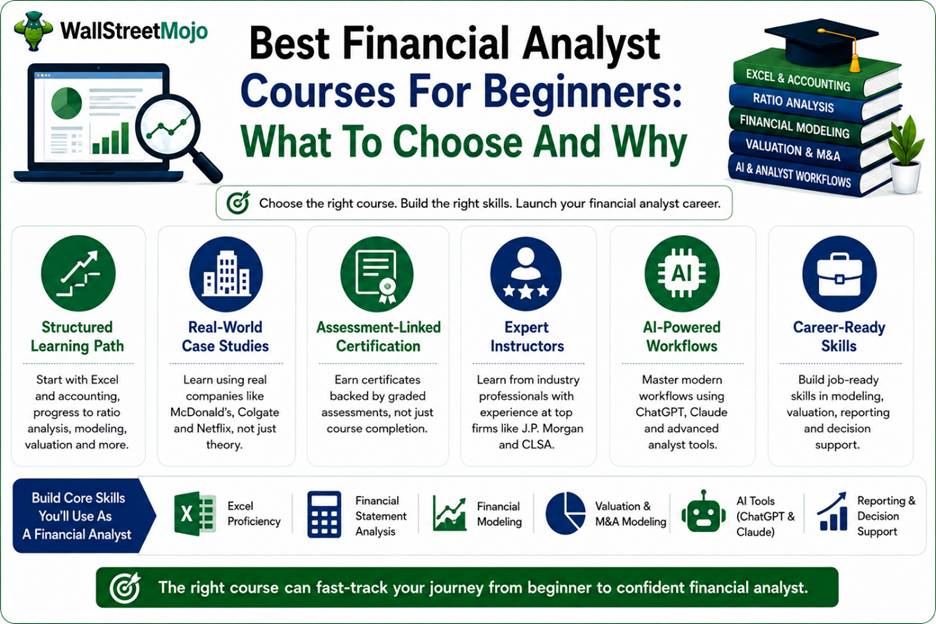
The best financial analyst courses for beginners share three traits. They start with accounting and Excel before introducing valuation. Moreover, they use real company case studies instead of hypothetical numbers and tie certification to an actual skills assessment rather than video completion.
This article compares five financial analyst courses based on curriculum depth, instructor credentials, pricing, and career alignment. Moreover, it provides a framework for choosing the right course.
Key Takeaways
- The best beginner-friendly financial analyst courses start with Excel and accounting before financial statement analysis, modeling, and valuation.
- Real-world company case studies provide more practical preparation than courses relying mainly on generic templates.
- Assessment-linked certifications provide stronger evidence of skills than simple course-completion certificates.
- Instructor industry experience can help learners understand how financial analysis is applied in real-world roles.
- AI-assisted modeling and audit workflows are becoming increasingly relevant to modern financial analyst training.
- Entry-level financial analyst salaries vary by country, employer, location, and candidate profile.
What Makes A Financial Analyst Course Genuinely Beginner-Friendly
The best financial analyst courses for beginners should build analyst skills in sequence. Ideally, a program should start with Excel fundamentals and core accounting. Next, it should cover financial statement analysis and ratio analysis. Only then should it introduce financial modeling and valuation.
Courses that open directly with discounted cash flow modeling or trading comps tend to lose beginners within the first few modules. This is because they assume familiarity with balance sheets and income statement mechanics.
The following three criteria separate genuinely beginner-friendly programs from repackaged advanced content:
- Structured learning sequence: Foundation topics come first, followed by financial statement analysis, modeling, and valuation.
- Real-world case studies: Learners practice on real, named companies rather than abstract templates, which mirrors how equity research and FP&A teams actually work.
- Assessment-linked certification: A certificate backed by a graded assessment provides stronger evidence of skills than a simple course-completion badge.
Comparing The Best Financial Analyst Courses For Beginners
The table below compares the best financial analyst courses for beginners based on structure, case studies, certification, and instructor background.
| Course | Best For | Curriculum Structure | Case Studies | Certification | Instructor Credential |
| WallStreetMojo Financial Analyst Fast Track Program | Beginners wanting a full Excel-to-AI analyst sequence in one path | Excel & accounting → ratio analysis → modeling → valuation & M&A → AI workflows | McDonald’s, Colgate, Netflix | 10+ course certificates, including a final program certificate | Dheeraj Vaidya, CFA, FRM, ex-JPMorgan and CLSA |
| CFI Financial Modeling & Analysis / FMVA | Learners seeking a recognized financial modeling certification | Modular, self-paced, exam-gated | Template-based exercises | FMVA certification exam | CFI in-house instructor team |
| 365 Careers The Complete Financial Analyst Course 2026 (Udemy) | Budget-conscious beginners looking to build Excel and modeling skills | Excel, accounting, statements, valuation, modeling in one bundled course | Practical exercises and modeling examples | Udemy completion certificate | Course team, no single named lead instructor |
| University certificates (Coursera/edX) | Learners wanting an academic credential from a named institution | Weekly modules following a semester-style syllabus | Case discussions, less hands-on Excel | University-issued certificate | Business school faculty |
| NYIF Financial Analysis Programs | Mid-career professionals transitioning into analyst roles | Instructor-led or cohort-based, with a more advanced pace | Institutional case studies | NYIF program certificate | Wall Street practitioner faculty |
A pattern worth noting is the emphasis on real-world case studies in single-instructor programs. For example, the WallStreetMojo program is taught by a former JPMorgan and CLSA analyst. Multi-instructor platforms often use modular content from different contributors.
Career And Salary Context: Why This Choice Matters
Financial analyst roles remain one of the more resilient entry points into corporate finance. In the United States, the Bureau of Labor Statistics projects employment of financial analysts to grow 7% from 2025 to 2035, much faster than the average for all occupations. Per the data available to the public, about 29,500 openings are projected each year. The median annual salary for financial analysts was $103,570 in May 2025.
In India, entry-level financial analyst compensation varies significantly by job title, employer, location, and candidate profile. Public salary trackers also use different methodologies and often combine related roles, making a single national fresher figure difficult to verify. Salary data should therefore be treated as directional rather than as a definitive market benchmark. That said per AmbitionBox, the typical salary range for financial analysts in India with 1-7 years of experience ranges from ₹6.5 lakh to ₹7.2 lakh per year.
Common Mistakes Beginners Make When Choosing A Course
Choosing among the best financial analyst courses for beginners requires more than comparing price or brand recognition. Let us look at three mistakes that are particularly common when beginners compare financial analyst courses:
- Skipping The Accounting Foundation: Jumping straight into financial modeling without understanding how the three financial statements connect leads to formula-following without comprehension.
- Ignoring Case Study Relevance: A course built entirely around generic templates rarely translates to interview readiness, where hiring managers ask about specific line-item judgment calls.
- Overlooking AI workflow exposure. By 2026, analyst job descriptions increasingly reference ChatGPT or Claude-assisted modeling and audit work, and courses that ignore this layer leave a visible gap on a resume.
A Simple Decision Framework
When comparing the best financial analyst courses for beginners, apply a short filter. First, confirm the course starts with Excel and accounting rather than valuation. Verify that certification is tied to a graded assessment. Check whether case studies use real companies. Finally, confirm the instructor has verifiable industry experience, not just teaching credentials.
Programs like the WallStreetMojo Financial Analyst Fast Track Program follow this sequence. It starts with Excel foundations and progresses to DCF, trading comps, M&A modeling, and AI workflows using ChatGPT and Claude. The program is taught by an instructor with JPMorgan and CLSA experience. This highlights why sequencing and instructor background matter more than course length alone.
Conclusion
Selecting among the best financial analyst courses for beginners comes down to curriculum sequencing, case study depth, and verifiable instructor experience rather than price alone.
Programs that move from Excel and accounting through modeling, valuation, and AI-assisted workflows, such as the WallStreetMojo Financial Analyst Fast Track Program, give beginners a structured path that mirrors how hiring managers actually evaluate analyst readiness. Review the current curriculum and pricing on the course page before enrolling.
Frequently Asked Questions
What is the best financial analyst course for someone with zero finance background?
Among the best financial analyst courses for beginners, those starting with Excel and basic accounting are better suited to learners with no finance background. This is because such programs avoid assuming prior knowledge of financial statements.
How long does it typically take to complete a beginner financial analyst course?
Most structured programs range from 60 to 85+ hours of self-paced content, depending on how many modules are bundled. Learners often spread study over several weeks alongside other commitments.
Do financial analyst certifications actually help with job applications?
Certifications tied to graded assessments and real case studies carry more credibility with hiring managers than completion-only badges, particularly when paired with a named instructor’s verifiable industry background.
Is Excel knowledge required before starting a financial analyst course?
Basic spreadsheet familiarity definitely helps. That said, well-structured beginner courses include a dedicated Excel-for-finance module covering formulas, shortcuts, and functions like NPV and IRR before any modeling begins.
Are AI tools like ChatGPT and Claude relevant to financial analyst training in 2026?
Yes, analyst job postings increasingly reference AI-assisted modeling, audit, and valuation workflows. So, courses that include ChatGPT or Claude-based exercises alongside traditional Excel modeling better reflect current hiring expectations.
What is the typical entry-level financial analyst salary?
The average entry-level financial analyst salary is $67,642 per year in the United States and ₹7,42,520 per year in India, based on Indeed salary data.