


What Is Multilateral Trading Facility (MTF)?
A Multilateral Trading Facility (MTF) is a trading system that serves as an alternate market or trading venue for a traditional exchange. It is a European regulatory term that defines a computerized system that connects buyers and sellers of securities and assets. Chi-X Europe in London is the largest operating MTF.
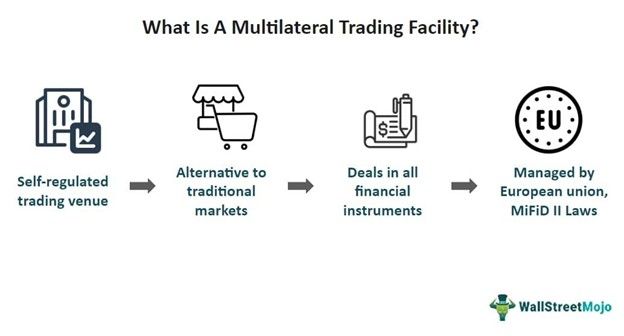
The MTF abides by the rules of Europe’s Markets in Financial Instruments Directive II (MiFID II) and is controlled by investment banks and firms. It has no listing requirements and works as a software program to match parties involved in trading practices. It has fewer trading barriers and simple contract rules for the buyers and sellers to follow.
Key Takeaways
- Multilateral trading facilities (MTF) are computerized trading venues in European markets that are an alternative to traditional exchanges.
- The platform connects multiple buyers and sellers, who are electronically matched with each other based on the matching set prices for assets/securities.
- Establishing such multilateral trading systems makes trading more competitive and more accessible to many investors.
- Headquartered in London, Chi-X Europe, regulated by the Financial Conduct Authority, is the largest operating MTF and one of the largest trading venues worldwide.
Multilateral Trading Facility Explained
The multilateral trading facility is a trading venue used for the exchange of financial instruments. This platform is called multilateral as it involves a number of buyers and sellers who connect with each other based on the matching set prices. Besides facilitating traditional exchanges, it provides opportunities for brokers, hedge funds, investment banks, asset managers, and other financial firms to connect for undertaking trade practices. These entities, however, must become members first to leverage the benefits of the platform. Retail investors, on the other hand, have limited options to access the markets. Hence, they have to have a provider of their choice for the same.
MTFs comprise multiple members who can interact with each other to negotiate asset prices. One of the critical regulations of an MTF is that trade exchanges must be initiated on a non-discretionary basis, the contracts must abide by all the rules regarding price and information transparency, and no discrimination among the members and clients should be observed.
The multilateral trading facility works as an alternative to the regular traditional markets and exchanges. It is formulated by a computerized system and software programs for pairing and matching buyers and sellers via a well-established contract. Primarily, the MTFs were started as alternative computerized trading venues. Still, with time and expansion, they started covering operations like trading precious metals, currencies, futures contracts, and exchange-traded funds.
The system is based on simple pre and post-trading transparency rules and a written rulebook. It allows investors to trade at lower costs by increasing liquidity, decreasing bid-ask spreads, and offering access to over-the-counter (OTC) products. The facility induces high-speed trading due to computerized programs without conflict among traders since they earn only through commissions. The MTFs are known for competitive pricing and secured transactions.
Examples
Let us consider the following scenarios to understand the multilateral trading facility definition better:
Example #1
In March 2022, Yoshi Markets, previously known as Arabian Bourse Limited (ABX), a well-known MTF in UAE, received permission to operate as custodians for virtual assets. They were willing to offer a fully regulated trading ecosystem and transparency in trading activities.
The MTF received permissions from the Abu Dhabi Global Market (ADGM) and Financial Services Regulatory Authority (FSRA). It is a good example to cite, as Yoshi markets are among the few platforms in the GCC region that can work with virtual assets MTFs. It has its order book and liquidity parameters, benefiting its customers with less commission and tight spreads.
Example #2
In February 2023, the European Securities and Markets Authority (ESMA) specified a new supervision rule and guidance authority for the MTFs. The EU’s financial markets regulator published a report on Opinion on the trading venue parameter, elaborating the concerns about the limitations under which the system should qualify as MTF and should seek proper permission and authority to become a trading venue.
The report was based on the MiFiD’s definition of MTFs, which lists down certain elements that do not match the criteria or proper structure that an MTF must have. ESMA, in the report, mentioned how it planned to collaborate with National Competent Authorities (NCAs) to check that firms working in coordination with the ESMA opinion are under proper monitoring. It also indicated its expectations from NCAs to take appropriate actions against any breach of authority.
Multilateral Trading Facility vs Regulated Market vs Organized Trading Facility
When it comes to trading assets and securities, there are various platforms where buyers and sellers connect. There are traditional and automated systems that help individuals and entities take trades. MTFs, organized trading facilities (OTF), and regulated markets are the most common platforms, to name a few.
Let us check out some significant differences between MTF, regulated market, and organized trading facility (OTF) below:
- A multilateral trading facility offers equities and non-equities, but an organized trading facility only offers non-equities. On the contrary, regulated markets are strictly regulated platforms that set specific rules for traders to follow while dealing with any asset/security in the market.
- MTFs can be controlled by market operators and investment firms, but OTFs can only be run by investment firms. In contrast, regulated markets are strictly controlled by government bodies or industry/ labor groups.
- MTFs are controlled by MiFID II laws and the European Securities and Market Authority (ESMA). In contrast, OTFs were earlier managed by the Financial Conduct Authority (FCA) when it emerged and later by the Dutch Authority for the Financial Markets (AFM) since 2019 but also followed MiFiD II. Again, the FDA and the Securities and Exchange Commission (SEC) are examples of regulated markets.
- There is a requirement to trade in MTFs and OTFs or become members, but in regulated markets, the government decides who can enter the market and how much they should be charged.
Frequently Asked Questions (FAQs)
Frequently Asked Questions
What are the advantages of multilateral trading facilities?
The advantages of MTFs are – – The trading system is secure under MiFiD rules. – It offers transparency in pricing both pre and post-trade. – Details of all orders are available, including volume, time, and other trading factors. – Non-discretionary rules and order book interactions are available.
What is a multilateral trading facility in international business?
When multiple parties match for trade in MTFs, they are involved in a contract, which induces stability and long-term relationships in international businesses. When there are alternative trading venues, it becomes easy for an investor to access various financial vehicles with minimum restrictions and costs.
What are the principles of the multilateral trading facility?
The main principles of multilateral trading facilities set by the World Trade Organization (WTO) are as follows: – Nondiscrimination trading, where each party is treated equally, whether local or foreign – Encouragement of free trade and room for negotiation by lowering trade barriers – Promoting fair competition and inducing price transparency and information exchange – Working together to build an economic reform.