


Introduction
Global M&A value is on pace to hit roughly $4 trillion in 2026, and the deals driving that number above $5 billion now account for nearly half of total value. That shift matters for anyone planning a career in dealmaking. Larger and more complex transactions require analysts who can build a defensible model from day one, not learners who need months of additional training.
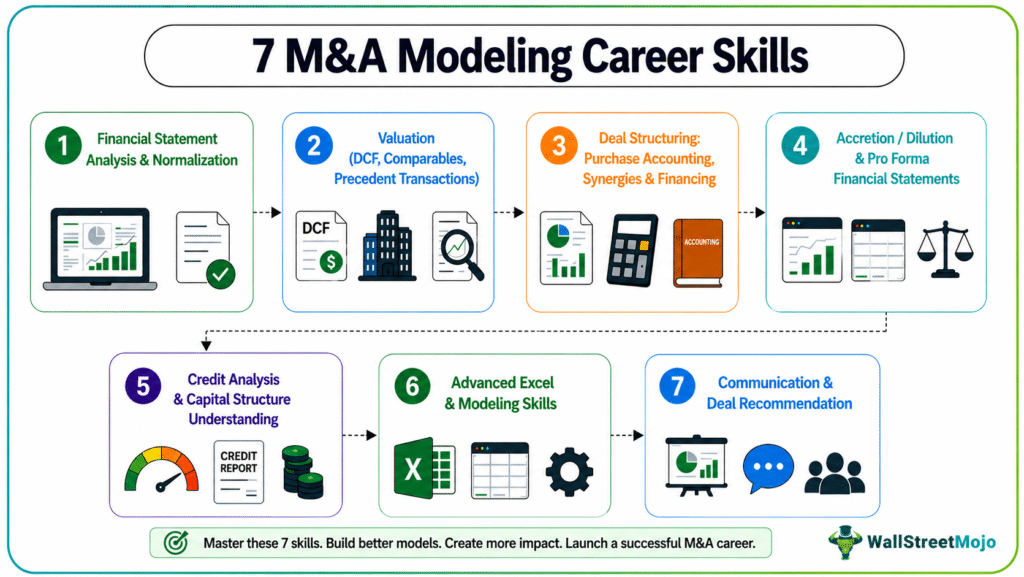
Mergers and acquisitions or M&A modeling is the process of building a financial model for an acquisition or merger. The model combines the financials of the acquirer and the target company to evaluate valuation, financing structure, synergies, and post-deal earnings. Analysts who master the process work across investment banking, private equity, equity research, and corporate development.
This article breaks down the seven core M&A modeling career skills every aspiring M&A analyst needs and compares the main paths to acquiring them. Moreover, it shows where a structured course closes gaps that self-study alone typically leaves open.
Key Takeaways
- Reading and normalizing financial statements is the foundation of every successful M&A model.
- Valuation, purchase accounting, and synergy modeling drive accurate acquisition pricing and analysis.
- Strong Excel skills are essential for building dynamic, review-ready M&A models.
- Credit analysis helps determine sustainable financing and protects investment-grade status.
- Communicating a clear deal recommendation is as important as building the financial model.
- Mastering the skills needed for M&A modeling prepares analysts for investment banking, private equity, equity research, and corporate development roles.
1. Reading And Normalizing Financial Statements
The first of the essential M&A modeling career skills is reading and normalizing financial statements. Before any deal work begins, an analyst has to pull clean historical financials for both companies and adjust them for one-time items, accounting changes, and non-operating noise. This step, often called financial statement normalization, determines the accuracy of every downstream calculation, from EBITDA multiples to pro forma EPS.
A common mistake among new analysts is treating reported net income as the correct starting point for a model. Experienced practitioners instead trace figures back to 10-K and 10-Q filings, flag restructuring charges or asset write-downs, and rebuild a normalized income statement before touching valuation. Getting these wrong compounds through every later stage of an M&A model.
2. Valuation Methodology (DCF, Comparable Companies, Precedent Transactions)
What is valuation in M&A modeling? It is the process of estimating what a target company is worth using multiple techniques so that an acquirer can defend a purchase price and negotiate terms.
Understanding M&A valuation methods is one of the most important M&A modeling career skills. M&A analysts typically rely on three complementary valuation methods to estimate a target company’s value. The table below summarizes what each method measures and when it is most useful.
| Method | What It Measures | Best Used For |
| Discounted Cash Flow (DCF) | Intrinsic value based on projected free cash flows discounted to present value | Companies with predictable cash flows |
| Comparable Company Analysis | Relative value using trading multiples (EV/EBITDA, P/E) of similar public companies | Quick market-based sanity checks |
| Precedent Transaction Analysis | Relative value using multiples paid in past M&A deals in the same sector | Capturing control premiums in the offer price |
None of these methods works in isolation. Practitioners typically build a “football field” chart that overlays the valuation ranges from all three, then anchor the offer price within that range while accounting for synergies and competitive dynamics in the bidding process.
3. Deal Structuring: Purchase Accounting, Synergies, And Financing
Deal structuring is another of the core M&A modeling career skills. It separates an analyst who can model a transaction from one who can only model a standalone company. To build a realistic acquisition model, analysts must understand three closely connected areas: purchase accounting, synergy modeling, and financing structure.
Purchase accounting requires calculating goodwill, allocating the purchase price to identifiable assets, and recording any resulting deferred tax liability.
Synergy modeling involves estimating and phasing in both revenue and cost synergies over a realistic timeline. Revenue synergies include cross-selling opportunities and pricing power, while cost synergies include headcount overlap and procurement savings. Overstating synergies is one of the most common reasons M&A deals fail to deliver their expected value.
Financing structure involves deciding the mix of cash, stock, and debt used to fund the deal and modeling the resulting sources and uses of funds.
The Kraft Heinz merger is a well-known real-world example of these concepts in action. It required purchase accounting, brand-related goodwill, and post-merger integration assumptions to be reconciled into a single combined entity model.
4. Accretion/Dilution and Pro Forma Financial Statements
Accretion/dilution analysis measures whether an acquisition increases or decreases the acquirer’s earnings per share after the deal closes. It is often one of the first metrics boards and management teams review when evaluating a transaction.
Building this analysis requires constructing a full pro forma balance sheet and income statement that combines both companies’ financials, layers in the purchase accounting adjustments, and calculates post-deal EPS. Analysts also run a breakeven synergies calculation, which shows the minimum synergy value needed for a deal to avoid being dilutive, and a sensitivity analysis across different synergy and financing assumptions.
Common mistakes at this stage include forgetting to adjust share count for stock-financed deals and ignoring the tax effect of incremental interest expense on new acquisition debt.
5. Credit Analysis And Investment-Grade Considerations
Financing an acquisition with debt changes the combined company’s leverage profile, and that has direct implications for its credit rating and borrowing costs going forward. Analysts need to model the post-deal Debt/EBITDA ratio, compare it against rating agency thresholds, and assess whether the transaction risks a downgrade.
This skill is frequently underweighted in self-taught modeling because free tutorials rarely cover the interaction between capital structure and credit ratings. In real deal teams, maintaining investment-grade status is often a key constraint when structuring a transaction. It influences how much debt can be used and, in turn, affects the accretion/dilution outcome.
6. Advanced Excel Modeling and Deal Structures
Advanced Excel proficiency is among the most valuable M&A modeling career skills. Excel remains the working tool of choice on M&A desks, and fluency goes well beyond basic formulas. Analysts need to build dynamic models with linked worksheets, create sensitivity analyses using data tables and scenario manager, manage circular references for interest expense calculations, and present the model in a clear, review-ready format.
Beyond core mechanics, understanding alternative deal structures adds real differentiation. Asset purchases, for instance, carry different tax and GAAP reporting treatment than stock purchases, and a Section 338 election can change how a deal is taxed even when it is legally structured as a stock purchase. Analysts who understand when each structure applies bring more to a deal team than those who can only model a standard stock-for-stock merger.
7. Communicating a Deal Recommendation
A model is only useful if it leads to a clear recommendation. The final skill is synthesizing valuation output, synergy assumptions, accretion/dilution results, and credit impact into a concise recommendation that a client or investment committee can act on. This typically means condensing a multi-tab model into a one-page summary. The summary presents the key assumptions, analysis, and recommendation upfront in a client-ready format.
Analysts who skip this step, treating the model as the finished product rather than a decision-support tool, tend to stall at the analyst level regardless of how technically sound their spreadsheets are.
Self-Study vs. Structured Course: Comparing the Two Paths
Choosing the right learning path is essential for developing strong M&A modeling career skills. The table below compares self-study and structured courses across the factors that matter most:
| Factor | Self-Study (YouTube, Free Blogs) | Structured M&A Course |
| Curriculum sequence | Scattered, requires piecing together topics | Follows the analyst workflow: data gathering → valuation → modeling → recommendation |
| Case study continuity | Rare; most tutorials use isolated examples | Single case study carried through synergies, purchase accounting, and recommendation |
| Excel templates | Inconsistent quality, often outdated | Industry-standard templates built for reuse on real deals |
| Feedback and support | None | Instructor-backed guidance |
| Certification | Not available | Certificate of completion for resumes and LinkedIn |
| Time to competency | Weeks to months of trial and error | Structured hours with a defined endpoint |
Self-study works for learners who already understand financial statements and simply need to fill specific gaps. For someone looking to develop M&A modeling career skills for beginners and starting from scratch, however, the lack of sequencing and the absence of a continuous case study make it harder to connect isolated Excel tricks to an actual deal workflow.
The Mergers and Acquisitions Modeling Course by WallStreetMojo addresses this gap directly. The course is taught by Dheeraj Vaidya, CFA, FRM, a former J.P. Morgan and CLSA analyst. It guides learners through a comprehensive case study covering valuation fundamentals, synergies, purchase accounting, pro forma financial statements, accretion/dilution analysis, and sensitivity analysis. The curriculum concludes with advanced topics such as asset purchases and Section 338 elections.
Learners who want the full sequence in one place, rather than assembling it from scattered sources, can review the M&A modeling course curriculum to see how each module maps to the seven skills above.
Career Paths and Compensation Context
Strong M&A modeling career skills open opportunities across investment banking, private equity, equity research, and corporate development.
Analysts entering M&A-focused roles in the United States typically see a wide compensation band depending on employer type, location, and experience. On average, an M&A analyst in the US earns $94,230 annually as of August 1, 2026. That said, in India, the salary range for the same position is typically ₹8.6-11.5 lakh per year.
Broader financial analyst employment, which includes many entry points into M&A-adjacent roles, is projected by the U.S. Bureau of Labor Statistics to rise by 6 percent from 2024 to 2034. This growth rate is faster than the average for all occupations, with roughly 29,900 openings estimated each year during the period. That combination of steady headcount demand and a rebounding deal market makes M&A modeling one of the more durable technical skillsets a finance professional can build in 2026.
Conclusion
Building strong M&A modeling career skills comes down to mastering a repeatable workflow, not memorizing formulas in isolation. These M&A analyst skills help professionals contribute confidently to live transactions and long-term finance careers.
Analysts who can normalize financials, value a target from multiple angles, structure the deal correctly, and communicate a clear recommendation stand out in a hiring market that increasingly rewards deal-ready skills over theoretical knowledge.
For those ready to build that workflow through a single guided case study rather than scattered tutorials, the Mergers and Acquisitions Modeling Course offers a practical next step.
Frequently Asked Questions
What skills do I need to become an M&A analyst?
The essential M&A modeling career skills include financial statement analysis, valuation (DCF, comparables, and precedent transactions), deal structuring and purchase accounting, accretion/dilution modeling, credit analysis, and advanced Excel skills. Furthermore, they need to have the ability to communicate a clear deal recommendation.
Is M&A modeling the same as financial modeling?
No, financial modeling forecasts a single company’s standalone performance, while M&A modeling combines two companies, applies purchase accounting adjustments, and analyzes the deal’s impact on the combined entity’s earnings and credit profile.
Do I need to know Excel before learning M&A modeling?
Yes, M&A modeling is built almost entirely in Excel, so a working knowledge of formulas, linked worksheets, and basic financial functions is expected before starting deal-specific modeling.
How long does it take to learn M&A modeling?
Most structured courses cover the full workflow in six to eight hours of instruction, though building genuine proficiency through practice on additional case studies typically takes several weeks of consistent application.
What is accretion/dilution analysis used for?
It determines whether a proposed acquisition will increase or decrease the acquirer’s earnings per share after the deal closes, making it one of the first metrics evaluated when assessing a transaction.
Can someone with no finance background learn M&A modeling?
Yes, provided they first build a foundation in reading financial statements and basic valuation concepts.