


What Is Settlement Risk?
Settlement risk, Herstatt risk, or delivery risk refers to the uncertainties associated with the timely fulfillment of contractual terms and conditions by one or multiple parties to the contract. Thus, it is the default or counterparty risk that the parties may not meet their obligations within the agreed timeframe.
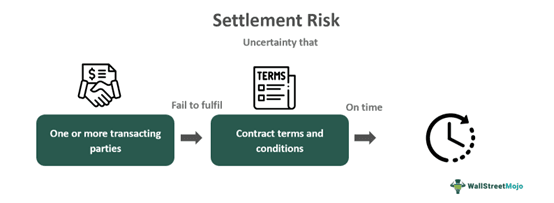
The finance, forex, securities market, and insurance sectors often struggle with settlement risk. The management and mitigation of such uncertainties are crucial for boosting the investors’ confidence and market faith since the potential risk may further result in liquidity issues and financial crises. Moreover, it makes the system more efficient for facilitating financial transactions and securities transfer or exchange.
Key Takeaways
- The settlement risk is a counterparty or credit uncertainty that flares when one or more contracting parties are expected to fail to fulfill their part of obligations to the contract on time.
- Such risk is commonly seen in banking, foreign exchange, insurance, financial markets, and other types of transactions or contracts.
- Some of the prominent ways of managing the Herstatt risk include netting, central counterparties, delivery vs. payment, and real-time gross settlement.
- The various settlement issues include liquidity, temporal, operational, and systemic risks.
Settlement Risk Explained
The settlement risk is a form of credit risk whereby there is a possibility that one or multiple contracting parties will not deliver their promise, I.e., will not meet the agreed-upon terms and conditions on time. Say the seller promises to deliver the consignment within 3 days of order placement and payment, but the same took 5 days, which potentially results in the settlement risk. Such uncertainties are non-prevalent in the securities market but often lead to liquidity and financial issues.
For instance, in financial transactions, the settlement risk in banking and foreign exchange transactions can be curtailed through Continuously Linked Settlement (CLS). The earliest case of delivery risk was witnessed in the 1970s when the Herstatt Bank shocked the financial industry worldwide. It was on June 26, 1974, that the German regulatory authorities ceased all the operations of the German bank Herstatt Bank. While the Deutsche Bank disbursed the payment to Herstatt Bank, the latter failed to make the subsequent dollar payment to the former. This disrupted the settlement process amidst the FX settlement risk.
Types
The risk of settlement arising from the potential non-fulfillment of the contractual obligations by the parties to the contract can be categorized into the following different kinds:
- Default Risk: If any of the parties is expected not to meet the entire contract terms and conditions, then it is known as default risk.
- Settlement Timing Risk: Such uncertainty persists in the timing of the exchange of securities, I.e., delayed settlement of contract obligations.
- Systemic Risk: The possibility that a prominent financial institution defaults, failing obligation fulfillment by the other institutions.
- Temporal Risk: The chances of settlement risk pertaining to the different time zones between which the transaction occurs, like in the forex market.
- Liquidity Risk: These uncertainties persist when one party to the contract fails to fulfill their obligations, because of which the other party faces a shortage of assets or funds.
- Operational Risk: Sometimes, technical or operational glitches such as system failure, processing errors, etc. This results in the parties’ non-settlement of the obligations.
Examples
The settlement risk can extend from insurance to foreign exchange sectors. Let us discuss the following examples:
Example #1
Suppose a supplier, ABC Ltd., is to receive $10,000 as payment from a customer, PRS Corp. The latter processes the payment through a Real Time Gross Settlement (RTGS) via Federal Reserve’s Fedwire through its bank, XYZ Bank. The XYZ bank processes the payment in favor of ABC Ltd. The supplier’s bank, STU Bank, receives the amount the same day, mitigating the settlement risk involved in the contract between ABC Ltd. And PRS Corp.
Example #2
EFAMA’s research revealed that due to the US transition to T+1, more than a third of Foreign Exchange (FX) trades from European asset managers would have to settle outside CLS, impacting 40% of the daily FX flows. In this context, CLS reported that 40-50% of the 1% of CLS settlement average daily settlement value could be affected. Moreover, more than 50% of respondents believe CLS can still mitigate most of their settlement risk, while 35% are undecided on their response.
The shortened settlement cycles in North America will limit European asset managers’ access to CLS for USD trades, potentially leading to costlier and riskier alternatives such as funding. In the meanwhile, EFAMA urged regulators to mandate mitigating measures such as extending CLS cut-off times and enhancing alignment among custodians. Also, CLS emphasized the need for regulatory engagement and thorough risk assessment to address challenges. Additionally, CLSNet, an automated netting calculation service, can reduce funding requirements for same-day instructions to limit settlement risk.
Example #3
In July 2026, the European Central Bank’s T2 payment system experienced a technical outage following a software update, delaying some euro and Danish krone payments. Such disruptions can create settlement risk when banks cannot transfer funds within the agreed settlement timeframe. If one party has already fulfilled its obligation but the corresponding payment remains pending, it faces exposure until the transaction is completed.
How To Mitigate?
The financial sector is often prone to settlement risk, which results in breach of contract. Given below are some of the measures to reduce such uncertainties:
- Netting: This method of risk mitigation totals the various payments, financial obligations, or positions between two or more parties to ascertain a net payment amount.
- Central Counterparties (CCPs): The central counterparties serve as mediators or intermediaries between the parties to the contract, affirming the fulfillment of contractual terms and conditions by all the parties.
- Delivery vs. Payment (DvP): It is a widely used mechanism in financial markets where the delivery of stocks or securities follows a successful payment by the obliged party.
- Real-Time Gross Settlement Systems (RTGS): The RTGS system allows the seamless settlement of each transaction or transfer of securities 24×7.
Settlement Risk vs Pre-Settlement Risk vs Credit Risk
Settlement, pre-settlement, and credit risks are the three different forms of risk associated with contract fulfillment. They differ as follows:
| Basis | Settlement Risk | Pre Settlement Risk | Credit Risk |
|---|---|---|---|
| Definition | It is the possibility that one or multiple parties fail to execute their obligations in a contract on time. | It is the chance of default from any of the parties to the contract in fulfillment of their obligations before the expiration date. | It is uncertain whether a borrower will be able to fulfill their debt or meet the contract’s terms and conditions. |
| Default Timing | Delay in the fulfillment of contract terms and conditions during the settlement period | Prior to the contract’s settlement date | One party fails to meet the terms and conditions during the settlement cycle. |
| Interrelationship | It is a part of credit risk. | It is a part of credit risk. | It comprises both settlement and pre-settlement risks. |
| Occurs In | It often takes place in financial transactions and forex and is rarely seen in the securities market. | Rare but often seen in bond and equity markets | Common in financial markets, transactions, forex, securities market, bond market, etc. |
Frequently Asked Questions (FAQs)
Frequently Asked Questions
What is ACH settlement risk?
The Automated Clearing House (ACH) settlement risk arises when one or more of the parties to the credit contract can’t pay the agreed sum to the other party due to bankruptcy or another financial issue, resulting in non-settlement of the transaction.
What is settlement risk in FX?
The FX settlement risk arises due to different timezones whereby the party that sells the currency transfers the same to the buyer. Still, the latter fails to transfer the subsequent currency or make payment against the receipt on time.
Why is it essential for financial institutions to manage settlement risk effectively?
The settlement risk can be perceived as fraud at times. However, it may result from potential lags or other issues. However, it may result in a financial crisis or liquidity risk for the parties. Therefore, management of such risk becomes critical for making the financial markets more efficient by surging investors’ confidence and improving market mechanisms.