


Part of our Accounting Concepts guide
Marketable Securities Examples – Meaning
Marketable securities, also called short-term investments, are favored by major corporations. It is impossible to provide a complete set of examples that address every variation in every situation since there are thousands of such securities. The following marketable securities examples outline the most common Marketable Securities.
Examples of Marketable Securities Include –
- Common Stock
- Commercial Papers
- Banker’s Acceptance
- Treasury Bills
- Certificate of Deposit
- Other money market instruments
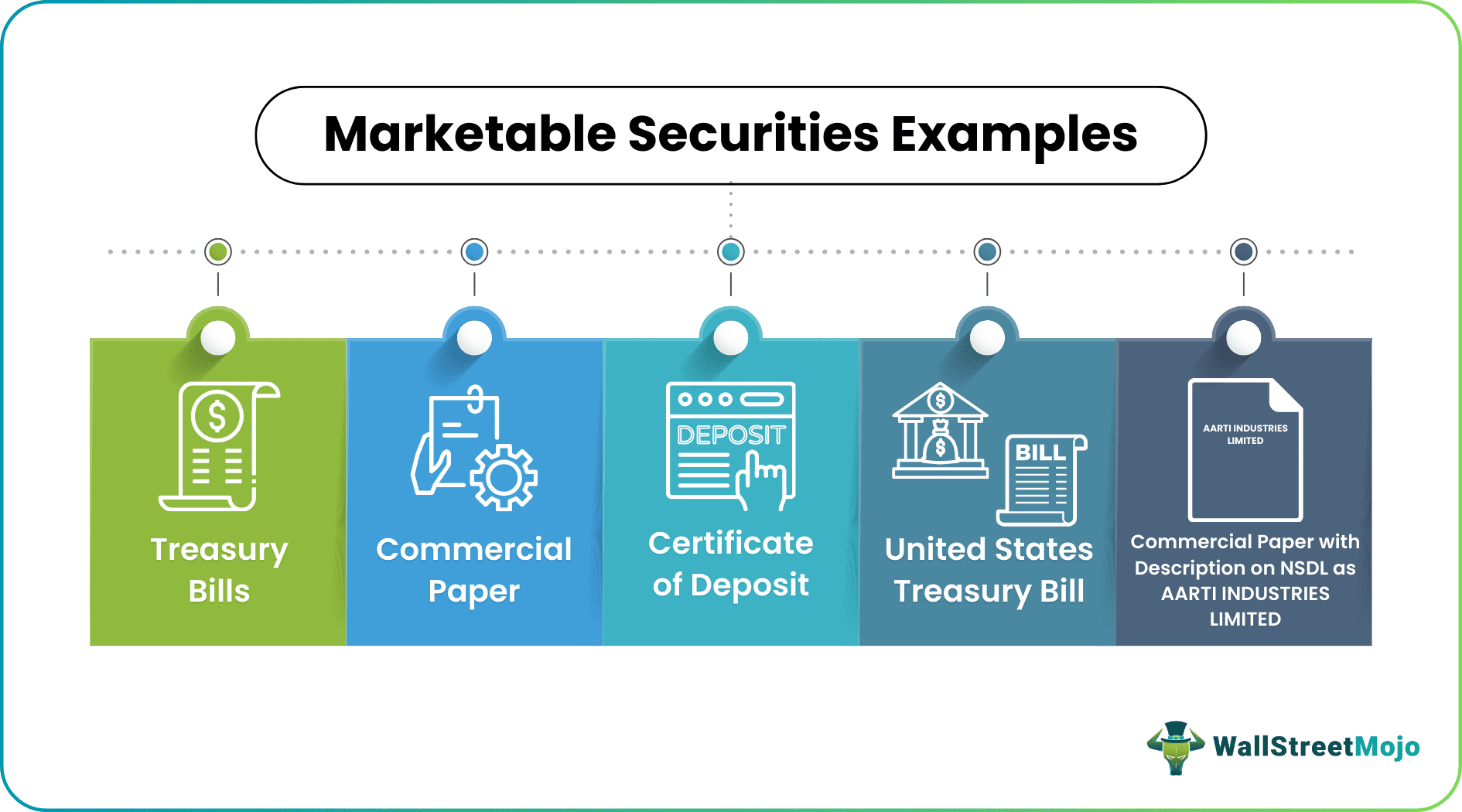
List of Most Common Examples of Marketable Securities
Example #1 – Treasury Bills
Calculate the current price and the Bond equivalent yield (Using simple compounding) of money market instruments with a face value of Rs100 and discount yield of 8% in 90 Days.
Solution:
Take year = 360 days.
Discount Yield uses 360 Days in a year, and it is calculated on fair value that is face value here.
DY = [ ( FV – P)/FV) ] × ( 360/n)× 100
Here,
FV = Rs 100, n = 90 days, DY = 8, P = current price
Calculation of Current Price –
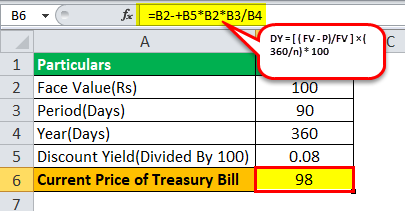
So, putting the above figures In the formula will get the current price.
8 = [(100-P)/100] × (360/90) × 100
Current Price = Rs 98
Calculation of Bond Equivalent Yield –
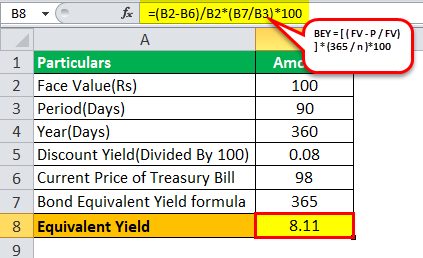
Bond Equivalent Yield uses 365 Days in a year and is calculated on actual investment.
BEY = [ ( FV – P)/FV) ] × ( 365/n)× 100
=[(100-98)/100] × (365/90) × 100
BEY = 8.11%
Video Explanation of Marketable Securities

Example #2 – Commercial Paper
ABC public limited company initiated a Commercial Paper in the market details mentioned below.
- Date of initiate – 17th May 2018
- Date of Maturity – 15th August 2018
- Number of Days – 90
- Coupon Rate – 11.35%
What is ABC limited’s net amount after initiating 90 days of commercial paper?
Solution
The company has to provide a yield of 11.35% to investors on its investment over one year. Therefore, we will use 365 days and calculate the difference between the price and face value of his investment. The formula is as follows,
Yield = [( FV – A)/A) ] × ( 365/Maturity)× 100
Here,
- A – Net Amount received from investors
- FV – It is assumed to be Rs 100
Maturity – 90 Days
Yield (interest) – 11.35%
So by putting the figures mentioned above in the formula will get the Net Amount for 100Rs face value commercial paper.
Calculation of Net Amount –
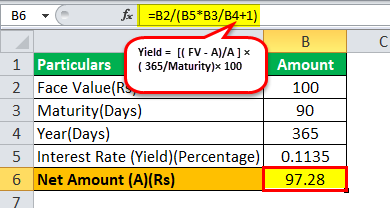
11.35% = [(100-A)/A] × (365/90)×100
Solving the above equation will get A = 97.28 Rs
So if a company-issued commercial paper is worth Rs 10 Crores, the Company would receive only 97,277,560.87 Crores.
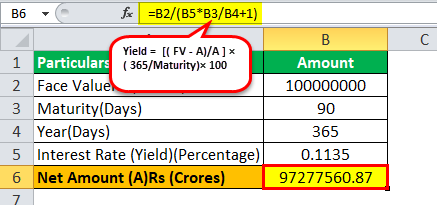
Net Amount = 97277560.87
Example #3 – Certificate of Deposit
XYZ Company has a due payment of Rs3 Crores on 15th September 2018. The company has extra cash today, 15th June 2018. After considering all facts and figures, it decided to put surplus cash in the Certificate of Deposit of one of the Government Banks at 8.25% per annum. Calculate the Amount of Money that needs to be invested in a certificate of deposit today to make the due payment? Here year is to be taken as 365 days.
Solution:
CDs are issued at a discount price, and the discount amount is paid at issue itself.
Formula For CDs
D = 1×(r/100)×(n/365)
Here,
- D – Discount
- r– the rate of discounting
- n– Month/ Days
Calculation of CD-
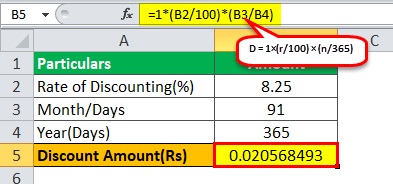
D= 1×(8.25/100)×(91/365)
D= Rs 0.020568493
The amount to be received on Face Value Rs 1 will be –
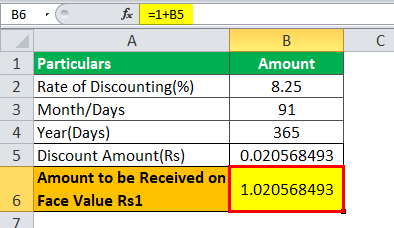
Amount to be received on Face Value Rs 1 = Rs 1 + Rs 0.020568493
=Rs 1.020568493
The amount to be Invested will be –
If the amount to be received is Rs 3 crore, then,
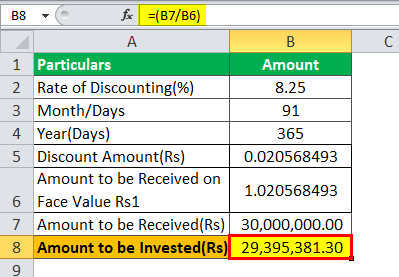
Amount to be Invested Is = (3 Crores/1.020568493) = Rs29,395,381.30
Amount to be Invested = Rs29,395,381.30
Example #4 – (Commercial Paper with Description on NSDL as AARTI INDUSTRIES LIMITED)
Aarti industries limited issued a Commercial Paper with a Description of NSDL as AARTI INDUSTRIES LIMITED 90D CP 20FEB19 and the below details.
- Face Value – Rs5,00,000
- Issue Price – Rs4,80,000
- Issue Date – 22/11/2018
- Maturity Date – 20/02/2019
- Credit Rating A1+
What is the cost or yield of Commercial Paper?
Solution:
We know that
Yield = (Face Value – Issue Price/Issue Price)× (360/Days of Maturity)
So Here, Maturity Days is 90 Days,
Calculation of Yield –
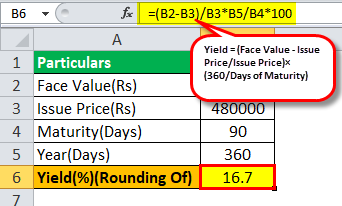
Yield = (5,00,000 – 4,80,000/4,800,000)×(360/90)
Yield = (20,000/4,80,000)×4
Yield = 0.042×4
Yield = 0.167 or 16.7%
So yield or cost of commercial paper is 16.7%
Example #5 (United States Treasury Bill)
The United States Treasury Bill was issued for cusip 912796UM9 with the principal amount of 25,000,000 with a maturity period of 90 Days and a coupon rate or discount yield of 2.37%. Calculate the current price of the Treasury Bill? Take the year as 360 Days.
Solution:
Here,
- Face Value – 25,000,000
- Maturity – 90 Days
- Discount Yield – 2.37%
- P( Current Price)-?
Discount Yield uses 360 Days in a year, and it is calculated on fair value that is face value here.
Calculation of Current Price –
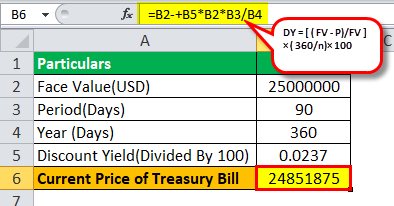
DY = [ ( FV – P)/FV) ] × ( 360/n)× 100
2.37 = [(25,000,000 – P)/25,000,000] × (360/90) × 100
Current Price = 24851875
So Solving the above equation will get the current price of the United States Treasury Bill, which is 24,851,875.
Conclusion
Cash and Marketable Securities are companies’ liquid assets, and sufficient cash and Marketable Securities management are very important for the companies. Many companies invest in marketable securities because it is a Substitute for hard Cash, Repayment of short-term liabilities, and Regulatory requirements. These features and advantages of marketable securities make them popular. Holding Marketable Securities for a company depends on the solvency and financial condition of a company. Marketable Securities have some limitations, like low returns, default risk, and inflation risk associated with marketable securities. In short Marketable Securities is an investment option for the organization to earn returns on existing cash while maintaining cash flow due to high liquidity.
Recommended Articles
This has been a guide to Marketable Securities Examples. Here we provide the list of top examples of marketable securities along with calculations and explanations. You may learn more about accounting from the following articles –