


What Is An Offshore Trust?
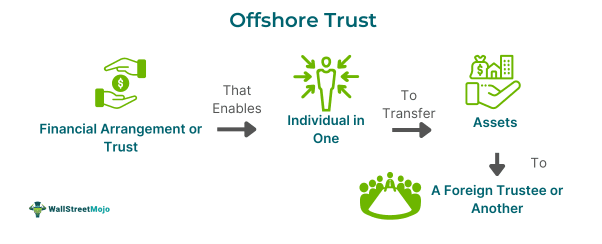
An offshore trust refers to a legal arrangement that facilitates asset protection and estate planning by initiating the cross-border management of an individual’s assets. This management is carried out by trustees who are tax residents, financial institutions, or offshore trust companies in a foreign nation.
The most significant advantage of offshore trust asset protection is the ability to ensure tax avoidance by the trustor in their native country. This is achieved by transferring the trust funds to a country with an offshore trust jurisdiction, which provides tax relaxation on the income or capital gains from such assets. Further, the creditors cannot claim over these assets during lawsuits.
Key Takeaways
- An offshore trust refers to a critical financial arrangement whereby an individual can transfer their assets, property, investments, or money to be managed or controlled by a foreign trustee. This trustee can be an individual, financial institution, or offshore trust company residing in another country.
- It involves a settlor, beneficiaries, trustee, and protector. Setting up this trust requires the selection of jurisdiction, considering an offshore trust company, and deciding on a trust structure.
- Such a tool facilitates tax planning, estate planning, succession planning, wealth management, asset security, and confidentiality.
Offshore Trust Explained
An offshore trust is a versatile financial tool that allows individuals to pass on their assets (trust funds) to an offshore trust account. A trustee who is a taxpayer or financial institution situated in another country as that of the settlor manages it. The various assets that can be transferred to such an account include stocks, bank deposits, real estate, intellectual property, life insurance policies, and investment portfolios.
There can be different foreign trust structures, as stated below:
- Discretionary Trust: This form of trust aims to facilitate tax planning and wealth management. The trustee has the right to include or eliminate beneficiaries from such a trust.
- Revocable and Irrevocable Trusts: A revocable trust allows the settlor to make changes in the trust deed. On the other hand, an irrevocable trust doesn’t have any scope for modification.
- Accumulation and Maintenance Trust: This trust is formed to allocate assets to the child’s future education and upkeep.
- Interest in Possession Trust: It is formed to distribute the interest from investment among the beneficiaries.
These trusts can be distinguished into the following four categories:
- Private Trust: It includes succession planning, wealth management, asset protection, life interest trust, and estate planning.
- Charitable Trust: This involves offshore management of assets meant for charities, donations, or specific social causes.
- Corporate Trust: The companies and business entities transferred into such a trust.
- Purpose Trust: A trust that holds assets assigned for a specific purpose without any beneficiaries.
How To Set Up?
First of all, let us understand the parties critical to the formation of such trusts:
- Settlor: This is the person who forms the trust by transferring the assets or executing the testamentary disposition to such trusts. This individual can also act as a trustee, protector, or even beneficiary.
- Trustee: A tax resident of another country who is responsible for managing or controlling the trust assets as per the wish of the settlor.
- Beneficiary: The individual, organization, or group of individuals who will inherit the trust assets upon distribution by the trustee.
- Protector: A firm or person who looks after the trustee’s asset control and management. A settlor appoints a protector.
Now, the following are the three basic steps in setting up such trusts:
- Selecting an Offshore Jurisdiction: The trustor must choose a jurisdiction that has favorable laws for these trusts, a similar legal structure, economic stability, etc.
- Finding an Offshore Trust Company: Next is appointing a foreign trustee in the respective jurisdiction.
- Framing the Trust Structure: Then comes selecting and forming a suitable trust structure by opening an offshore trust account in a foreign bank. A settlor can also undertake the services of an offshore limited liability company.
Examples
Let’s understand its fundamentals in a practical scenario with the help of the following examples:
Example #1
Suppose Mr. Raven is a wealthy businessman residing in Texas. He holds assets worth $17.23 million in foreign and domestic investments under an offshore trust in the Luxemburg jurisdiction. It is managed by Mrs. Peterson, who is a non-US citizen. Being a sole proprietor, Mr. Raven wants to protect his assets from any liability arising out of legal, financial, or criminal lawsuit claims if filed against him in the future. He wishes that the trust assets would be distributed among his son and daughter equally upon his death.
Example #2
According to the ICIJ’s investigation, Daim Zainuddin, Malaysia’s ex-finance minister, and his family are beneficiaries of an offshore trust that holds assets valued at $52.5 million. These assets include properties in the UK and US. Additionally, the trust received a $47 million loan from another entity.
The Malaysian Anti-Corruption Commission is investigating Daim and his associates over alleged offshore wealth linked to misappropriated state funds totaling $480 million. As part of the investigation, the MACC has frozen approximately $8 million in bank accounts and confiscated a skyscraper owned by the Daim family. Despite the allegations, Daim has denied any such misconduct.
Taxation
These trusts have different taxation structures in various jurisdictions, as discussed below:
- United States: These trusts offer a limited tax advantage. Indeed, the Internal Revenue Service (IRS) makes it compulsory to follow the reporting requirement. The trust owners and beneficiaries need to file information on trust distribution, including assets, property, or money, in Form 3520.
- United Kingdom: Such trusts usually decrease the tax burden of UK residents. However, non-UK residents are liable to taxes on such income and capital gains. The extent of tax savings relies upon the trust establishment, timing of formation, and beneficiary status. The taxation becomes due when the income is distributed. In some instances, the trust income and gains are tax-free.
Advantages And Disadvantages
These trusts have various benefits, along with certain drawbacks, as discussed below:
| Advantages | Disadvantages |
|---|---|
| The foremost benefit of such trusts is their asset protection ability to avoid any claims by creditors regarding domestic lawsuits or trials. | It is subjected to the laws of the nation in which it is created. Therefore, the creditors may be allowed by the court to claim over these assets in certain lawsuits (declared in favor of the creditors) pertaining to the settlor’s bankruptcy. |
| Like any other trust, it facilitates estate and succession planning by prioritizing the settlor’s conditions for asset distribution to the beneficiaries. | Some of these trusts are irrevocable, and the settlers can’t claim their assets once they are transferred to the offshore trust account. |
| It is a legal, financial arrangement ensuring the safety or security of the trust funds. | Such an arrangement is most often misunderstood as a potential tax evasion window, raising reputational and ethical concerns. |
| The jurisdictions mandate the maintenance of the trust assets’ confidentiality and privacy. | Setting up such trusts involves comparatively higher costs than setting up an onshore trust since it needs to comply with various administrative, tax reporting, and legal requirements. |
| Certain jurisdictions provide tax benefits such as exemptions or deferred taxes on the income or capital gain derived from such assets under management. | The trust creators find the formation of these trusts more complex as it requires the consideration of both national and foreign laws. |
| It provides an advantage to US residents by saving them from the special taxes that are usually charged on their income or capital gain from foreign investment. | In the US, the Internal Revenue Service often mandates the trust’s comprehensive regulatory compliance to refrain from potential fines and penalties. |
| The trust funds are invested in foreign and domestic assets to provide diversification benefits. | The IRS subjects the trust funds to the taxes as grantor or non-grantor trusts, which deprives the beneficiaries of such tax advantages. |
Frequently Asked Questions (FAQs)
Frequently Asked Questions
How much does an offshore trust cost?
Setting up such a trust costs somewhere between $10,000 to $100,000. It includes the professional and legal charges, which vary according to the jurisdiction, attorney, asset value, and estate complexity.
What is the 10-year charge on an offshore trust?
Every 10th year, on the completion or anniversary of these trusts, the government charges an inheritance tax over the net value of the assets under management. The maximum rate of taxation is 6% in the US, but it varies from asset to asset.
Do offshore trusts need to register with HMRC?
Previously, such a trust didn’t need to be registered with the Trust Registration Service (TRS). However, from 2023, HMRC has made this trust registration compulsory for the authorized trust that a UK taxpayer trustee controls. At the same time, an unauthorized trust must fulfill all the UK regulatory requirements to get registered with the TRS.