


What Is Residential Mortgage-Backed Securities (RMBS)?
Residential mortgage-backed securities (RMBS) refer to debt-based instruments that are secured by a pool of residential real estate and kept as collateral for loans, which are sold to investors. Moreover, the ultimate buyers generate a steady income through the cash flows of these underlying mortgages.
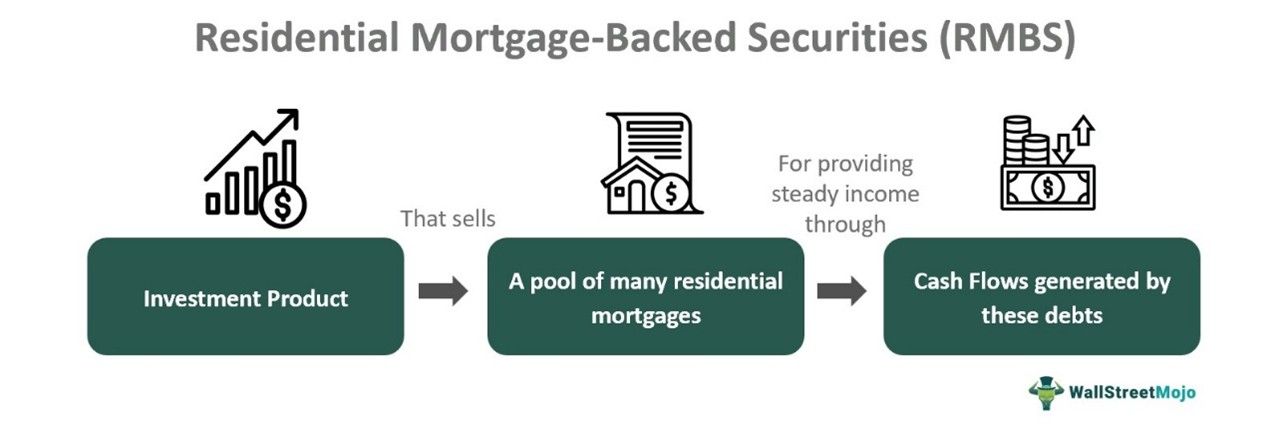
The RMBS are complex structured products with considerable liquidity and limited risk. Also, such bonds are made up of a multitude of residential mortgage loans, which are divided into various tranches, where each series of bonds has a different risk profile. These bonds are often purchased by the institutional investors like the life insurance corporations.
Key Takeaways
- Residential mortgage-backed securities (RMBS) are the assets that are made by bundling a large number of residential mortgages into a series of bonds that are sold to potential investors.
- These investors would reap a consistent income from the cash flows of these home loans.
- There are two types of RMBS: agency and non-agency.
- The RMBS issuers can be government sponsors like Freddie Mac and Fannie Mae or non-government agencies like private firms.
- The issuers earn through the asset management fees and also share the risk of defaulting on payment with the investors.
Residential Mortgage-Backed Securities Explained
Residential mortgage-backed securities are investment vehicles created by combining many residential real estate mortgage loans into a series of bonds that are then sold to investors who aim to generate a consistent return from the cash flow of these debts. Such assets are generally created by organizations such as non-agency investment firms, such as Fannie Mae and Freddie Mac.
Hence, the investors, especially the institutional investors, earn payments from these loans, often with interest rates superior to U.S. government-backed bonds. At the same time, the entities issuing Residential Mortgage-Backed Securities earn management fee and share the risk of mortgage defaults with investors.
In an RMBS transaction, a portfolio of residential mortgages is sold by the mortgage originator to a special purpose vehicle (SPV), which funds this acquisition by issuing RMBS bonds. These bonds are divided into tranches representing varied levels of risk. Cash flows from the underlying mortgages are transferred to the SPV, which then distributes them to the RMBS investors.
Notably, the senior noteholders are paid first, followed by mezzanine holders, and lastly, junior tranche holders. Thus, junior noteholders are at a higher risk of not being paid when there is an insufficient cash flow.
There are generally following two types of RMBS:
- Agency residential mortgage-backed securities: The RMBS formed by government-sponsored institutions such as Freddie Mac and Fannie Mae are categorized under agency RMBS. These are the lowest risk-bearing assets but provide minimal returns.
- Non-agency residential mortgage-backed securities: The non-agency RMBS are created by the private companies, providing greater liquidity and returns to the investors.
Investors in Residential Mortgage-Backed Securities can also choose between different types of collateralized loans based on their investment objectives and risk appetite. These include fixed-rate, floating-rate, interest-only, or adjustable-rate mortgages.
Examples
Residential Mortgage-Backed Securities offer institutional investors an opportunity to earn returns from pooled residential mortgage loans. Let us understand how these investment products work through the following examples:
Example #1
Suppose ABC Bank has issued home loans worth $7 million in 2023. Now, the mortgage originator, i.e., the ABC Bank, sells this portfolio to XYZ Financial Ltd., which is a special purpose vehicle (SPV) dealing with mortgages. XYZ Financial Ltd. segregates these residential mortgages into different tranches based on their risk profile to create 3 different series of bonds: senior, intermediate, and junior RMBS.
Thus, if the cash flows generated from the underlying mortgages were less than $11,000, then the investors of senior RMBS would be the first to receive the income, and the intermediate RMBS investors would be the next. At the same time, the last will be the junior RMBS investors, who will bear the maximum loss in this case.
Example #2
On August 14, 2023, UBS AG and its U.S. affiliates agreed to pay $1.435 billion in penalties to settle a civil lawsuit over their handling of residential mortgage-backed securities (RMBS) in 2006 and 2007. The lawsuit was filed in November 2018. This settlement concludes the final case by the Department of Justice’s RMBS Working Group, which targeted misconduct by financial institutions that resulted in the 2008 financial crisis. The lawsuit accused UBS of deceiving investors by providing false information about the mortgage loans backing the RMBS. This settlement raises the total penalties collected from 18 financial institutions, ratings agencies, and originators to over $36 billion.
Advantages And Disadvantages
Although the residential mortgage-backed securities market has great potential for investors, these assets are also prone to various challenges. Let us now have a glance at these benefits and limitations:
| Advantages | Disadvantages |
|---|---|
| RMBS is the most secure form of investment in the fixed-income securities category since the underlying collateral is real estate. | RMBS holds a certain level of credit risk arising from the potential default of payment by homeowners, as these assets are created by pooling many residential mortgage loans together. |
| The bond owners can expect a consistent income that comes from the cash flows of these mortgage loans, I.e., the interest payments by the borrowers. | Also, the rising interest rates may lead to a fall in the value of the underlying real estate collateral. |
| Moreover, these assets provide a diversification advantage, as the investment is spread across hundreds of thousands of residential mortgages. | Further, these assets are prone to adversities in the financial system and economy, which can broadly impact the overall housing market. |
| By selling these assets, the issuers of RMBS can generate enormous cash reserves for further lending, thus indirectly contributing to economic growth. | Such investments involve the possibility of a low-income generation when the homeowners prepay their loan amounts. |
| Also, since the RMBS are distributed into different tranches, each having a series of bonds with varying risk profiles, the investors can select these assets as per their risk-taking capacity. | Moreover, investors need to investigate whether the lenders have followed proper underwriting standards and conducted due diligence on the borrowers to reduce the chances of defaulting on payment. |
| These investment products have high liquidity since they can be traded in the market at a discounted dollar price, like any other security. | Such investments are only available to institutional investors since they require huge capital investment, which is not possible for retail investors. |
| Further, the performance and price of such bonds are independent of the stock market movements. | |
| Compared to government bonds, these securities are a win-win for institutional investors who invest colossal amounts in these high-interest-paying assets while taking limited risks. |
Difference Between Residential Mortgage-Backed Securities and Commercial Mortgage-Backed Securities
The mortgage-backed securities can be either RMBS or CMBS; however, both of these differ significantly in the following ways:
| Basis | Residential Mortgage-Backed Securities | Commercial Mortgage-Backed Securities |
| Definition | RMBS is an investment product that is secured by the underlying residential real estate mortgage. | CMBS is an asset formed by bundling various commercial real estate mortgage loans into an investment product. |
| Purpose | Favorable steady income with sufficient liquidity and limited risk | High income with a slightly higher risk involvement |
| Underlying Mortgage | Residential mortgage loans | Commercial mortgage loans |
| Types of Borrowers | Individual homeowners | Business entities, property developers, and other organizations |
| Risk Profile | Low potential default risk, however, involves prepayment, credit, and interest rate risks | Comparatively higher risk associated with the business performance, commercial properties and economic conditions |
| Influenced By | Financial market and housing market conditions; consumer behaviour | GDP, business investment scenario, economic cycles, commercial real estate market conditions |
| Metrics Used | Borrowers’ credit history, credit scores, delinquency rates, loan to value (LTV) ratios | Debt-to-equity ratio, debt-service coverage ratio, business cash flows |
Frequently Asked Questions (FAQs)
What asset class is RMBS?
Even after being one of the most secured assets of the fixed-income securities family, providing tremendous income opportunities at a desirable risk appetite, these investment products fall into an under-utilized asset class.
What is the yield of a non-agency RMBS?
Non-agency residential mortgage-backed securities provide higher investor protection and sufficient liquidity, as they are traded on a daily basis at a discounted price. Nevertheless, these investment products generally yield around 5.5 to 6% of interest.
What is the difference between covered bonds and RMBS?
A covered bond is an investment product that pools public sector mortgage loans to form an asset salable to the investors. However, the loans that are repaid can be replaced with new mortgages in this arrangement.
Conversely, the RMBS is a secured fixed-income asset that is formed by dividing various residential mortgage loans into tranches and clubbing them into a series of bonds based on their risk profile.
Is RMBS A CDO?
No, RMBS are not CDOs. A collateralized debt obligation (CDO) is an asset that comprises a group of performing and non-performing debts such as mortgage, corporate, and other kinds of loans.