


Introduction
Every commerce graduate, MBA aspirant, and finance professional eventually asks the same question: Is investment banking worth it? The profession promises steep compensation, fast-track career growth, and access to some of the world’s biggest corporate deals. That said, it also demands punishing hours and a steep early-career learning curve.
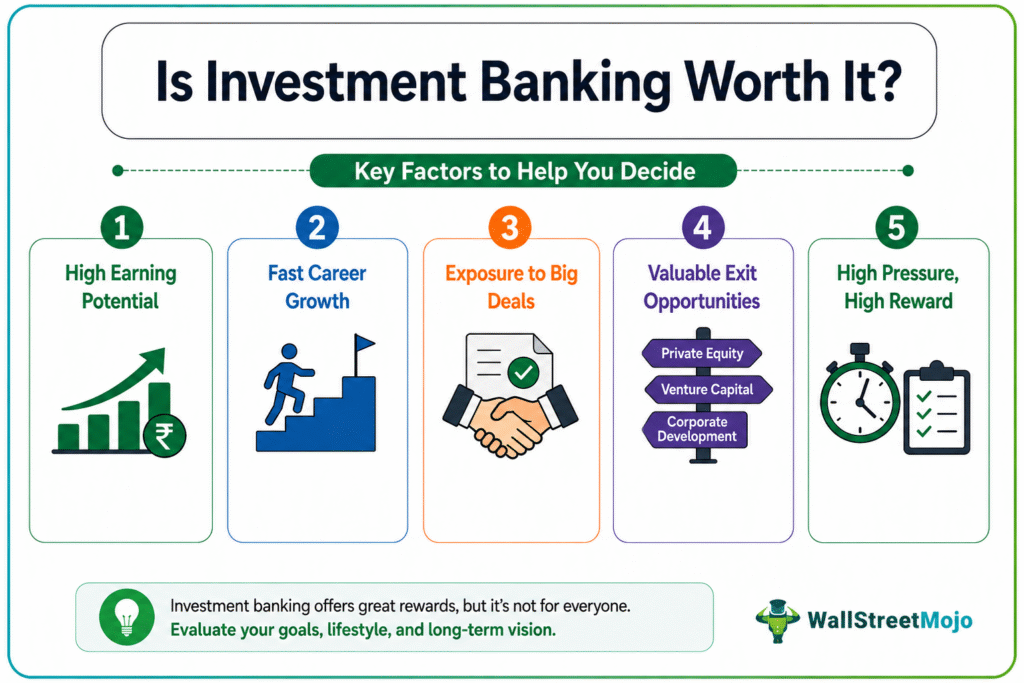
In 2026, global investment banking activity continues to be supported by mergers and acquisitions, capital raising, corporate restructuring, and cross-border transactions. While these trends continue to create opportunities across global financial markets, choosing this career requires looking beyond compensation and prestige to understand its long-term demands and rewards.
This article examines investment banking through the lens of salary, career progression, day-to-day realities, and the skills employers expect. By the end, you’ll understand what analysts, associates, and managing directors earn, how the investment banking career path evolves, and what it takes to break into and succeed in the industry.
Key Takeaways
- Investment banking offers high salaries, rapid career growth, and valuable exit opportunities across the broader finance industry.
- For people thinking, “Is investment banking a good career choice?” the answer actually depends on your career goals, work ethic, and tolerance for long hours.
- Success requires strong skills in financial modeling, valuation, accounting, Excel, and capital markets.
- Career progression typically follows analyst, associate, vice president, director, and managing director roles.
- Networking, internships, and hands-on training significantly improve your chances of breaking into investment banking.
- The profession rewards resilience, technical expertise, and consistent performance in fast-paced, high-pressure environments.
What Does “Is Investment Banking Worth It” Actually Mean?
Investment banking is worth it for individuals who prioritize rapid compensation growth, exposure to high-stakes corporate transactions, and long-term exit opportunities across private equity, venture capital, corporate development, or corporate strategy.
However, succeeding in the profession requires the ability to tolerate 70-100-hour work weeks during live deals, particularly in the first three to five years. Determining whether investment banking is worth it involves evaluating the trade-offs between financial rewards, career acceleration, work-life balance, and long-term professional goals.
While compensation is exceptional relative to most finance roles, it comes with demanding deadlines, long working hours, and significant client-facing responsibility.
Ultimately, the profession is best suited to individuals who thrive in high-pressure environments and view the analyst years as an investment in future opportunities. Those who prioritize predictable schedules or greater work-life balance may find alternative careers in corporate finance, equity research, or FP&A more aligned with their long-term objectives.
Investment Banking Salary in India and the US
For individuals wondering “is investment banking worth it for finance students,” it is important to evaluate the salary potential alongside the responsibilities and career progression. Compensation is one of the biggest reasons professionals pursue this career, and the latest 2026 salary data reinforces investment banking’s reputation as one of the highest-paying professions in finance.
| Role Level | Typical Yearly Salary in India (In Lakh) |
| Analyst | ₹14.2–15.7 |
| Associate | ₹16–17.7 |
| Vice President | ₹48.8–62.9 |
| Director | ₹80.1–88.5 |
| Managing Director | ₹1.26–1.57 Cr |
In the United States, the average annual salary for an investment banker is approximately $168,661 according to Salary.com. While the average salary for investment banking analysts is 119,964, investment banking managing directors earn $346,679 per year, on average.
The salary figures presented above are based on data published in July 2026. Actual compensation varies depending on factors such as employer, location, experience, qualifications, performance, and bonus structure.
Investment Banking Career Path: How Progression Works
The investment banking career path follows a well-defined hierarchy comprising analyst, associate, vice president, director, and managing director roles.
At most firms, professionals typically spend around two to three years at each junior level before progressing to the next position, although promotion timelines can vary by performance and employer.
The investment banking career path is structured around a series of progressively senior roles. The career path typically progresses through the following roles:
- Analyst (Years 0–3): Analysts build financial models, prepare pitch books, perform company valuations, and support transaction execution. This stage involves the longest working hours but offers the fastest learning curve and technical skill development.
- Associate (Years 3–6): Associates are typically promoted from the analyst role or hired with prior finance experience. They oversee analysts, review financial models and presentations, and assume greater responsibility for client communication and deal execution.
- Vice President (Years 6–9): Vice presidents lead transaction execution, coordinate deal teams, manage client relationships, and begin contributing to business development and new client acquisition.
- Director/Senior Vice President (Years 9–12): Directors oversee multiple transactions and mentor junior professionals. At the same time, they balance execution responsibilities, expand business development, ensure optimal client relationship management.
- Managing Director (12+ Years): Managing directors focus primarily on originating new business, maintaining senior client relationships, negotiating major transactions, and driving revenue generation for the firm.
Exit opportunities also influence how professionals evaluate the career. Analysts often transition to private equity, hedge funds, corporate development, or start-ups after two to three years. They use the technical skills and deal experience gained in investment banking to accelerate their careers. This exit-heavy structure is one reason candidates tolerate the demanding early years: the skill set transfers well across the broader finance industry.
Is Investment Banking a Good Career Choice? A Decision Framework
Whether investment banking is a good career choice depends on your career goals, work preferences, and long-term ambitions. The framework below can help you determine whether the profession aligns with your priorities.
| Decision Factor | When Investment Banking May Be The Right Option. | When To Consider Other Finance Careers |
| Compensation | You prioritize maximizing earning potential | You are comfortable with moderate but stable compensation |
| Working Hours | You are willing to work long and unpredictable hours | You value work-life balance and predictable schedules |
| Career Goals | You want rapid career progression and opportunities to transition into private equity, venture capital, or corporate development | You prefer long-term growth within a single organization or function |
| Nature of Work | You enjoy transactions, financial modeling, M&A, and client-facing work | You prefer analysis, planning, operations, or internal finance roles |
| Work Environment | You thrive in fast-paced, deadline-driven environments | You prefer a more predictable and less time-sensitive work environment |
How To Become An Investment Banker: Skills And Learning Path
Breaking into investment banking requires a combination of technical proficiency and practical skills. Core competencies include financial modeling, valuation methods such as discounted cash flow (DCF) and comparable company analysis, strong Excel skills, proficiency in PowerPoint, and a solid understanding of accounting principles and capital markets.
Most successful candidates build this foundation through a mix of academic coursework, self-study, professional certifications, and specialized training. Given how technical and interview-focused these skills are, many aspiring bankers supplement their degree with a dedicated investment banking program rather than relying solely on generic finance coursework. The Investment Banking Mastery Program (IBMP) by WallStreetMojo is one such pathway, covering financial modeling, valuation, mergers and acquisitions (M&A), and pitch book preparation through hands-on projects that mirror real analyst work, helping candidates develop portfolio-ready deliverables for interviews.
Beyond technical preparation, candidates should focus on building a professional network through informational interviews, industry events, and internships at boutique or bulge-bracket firms. These experiences provide practical exposure, strengthen industry connections, and improve the likelihood of securing interviews and full-time opportunities.
For professionals transitioning into investment banking from other careers, a comprehensive training program that condenses years of practical learning into a focused curriculum can significantly shorten the learning curve and improve job readiness compared with self-directed preparation alone.
Conclusion
So, is investment banking worth it in India, the USA, or elsewhere? For candidates who value rapid compensation growth, high-intensity deal exposure, and strong exit opportunities, the answer is often yes, provided they can manage the demanding hours that come with the profession.
However, long-term success depends on developing strong technical skills in financial modeling, valuation, accounting, and capital markets. Candidates who build these competencies through structured learning and hands-on practice are better positioned to stand out in a competitive hiring market.
For those seeking a guided learning path, the WallStreetMojo Investment Banking Mastery Program provides practical training in financial modeling, valuation, M&A, and pitch book preparation to help build interview-ready skills and real-world confidence.
Frequently Asked Questions
Is investment banking worth it for someone without a finance degree?
Yes, many successful investment bankers come from engineering, economics, or commerce backgrounds. What matters most is demonstrated proficiency in financial modeling, valuation, and accounting fundamentals. Candidates can gain the relevant skills through structured coursework and internships regardless of their original major.
How many hours do investment banking analysts actually work?
Analysts typically work 70 to 100 hours per week during active deal periods, with quieter stretches between transactions. Hours vary by group, with M&A and capital markets teams generally reporting the heaviest workloads.
What is the average investment banking salary in India for freshers?
The investment banking salary in India varies across different roles, location, company, and experience level. Typically, the salary ranges from 14.2 lakh to 1.57 crore per annum.
Is investment banking a good career choice compared to consulting?
Both offer strong exit opportunities and compensation, but investment banking generally pays more at junior levels and involves more technical, deal-specific work, while consulting offers broader industry exposure and comparatively more predictable hours.
How long does it take to become an investment banker?
Most candidates begin their careers as analysts after completing their undergraduate education, while experienced professionals may enter at the associate level after gaining relevant finance expertise. Structured preparation, including modeling coursework and internships, typically takes six months to two years before landing a first offer.
Is investment banking worth it in 2026?
Yes, strong M&A activity, capital raising, and corporate restructuring continue to create opportunities for investment bankers. However, the profession remains highly demanding and is most suitable for candidates seeking rapid career growth, high compensation, and long-term exit opportunities.