


Introduction
Most beginners who want to learn equity research fast make the same mistake: they start with a 500-page valuation textbook, stall out by chapter four, and never touch a real financial model. Equity research rewards a different kind of learner, one who moves in a structured sequence from accounting fundamentals to ratio analysis to full valuation, using real company filings instead of abstract theory.
In simple terms, Equity research is the process of analyzing a company’s financial statements, industry position, and growth drivers to form an investment view, typically expressed as a buy, sell, or hold recommendation. Analysts at firms like J.P. Morgan, Morgan Stanley, and CLSA build this view using three-statement models, discounted cash flow valuation, and comparable company analysis.
This article explains how to learn equity research fast, compares the most practical learning paths available in 2026, and highlights the mistakes that cost beginners months of wasted effort.
Key Takeaways
- Learn equity research fast by following a four-stage sequence: accounting, ratio analysis, valuation, and AI-assisted workflows.
- Skipping accounting fundamentals is the most common reason beginners struggle with financial modeling and valuation.
- University degrees and the CFA Program build deep finance knowledge but are not designed for rapid, hands-on skill development.
- Structured learning paths that combine case studies, Excel templates, and sequential coursework help beginners build practical equity research skills.
- Hands-on practice with real companies is essential for turning theoretical knowledge into job-ready analytical skills.
- AI-assisted Excel workflows improve efficiency, but every model still requires manual review of formulas, assumptions, and outputs.
What Slows Beginners Down When Learning Equity Research
Beginners rarely fail at equity research because the concepts are too hard. They fail because they learn concepts out of sequence. A person who jumps straight into DCF modeling without first understanding how the income statement, balance sheet, and cash flow statement connect is likely to build a model that appears correct. However, the model often breaks the moment an underlying assumption changes.
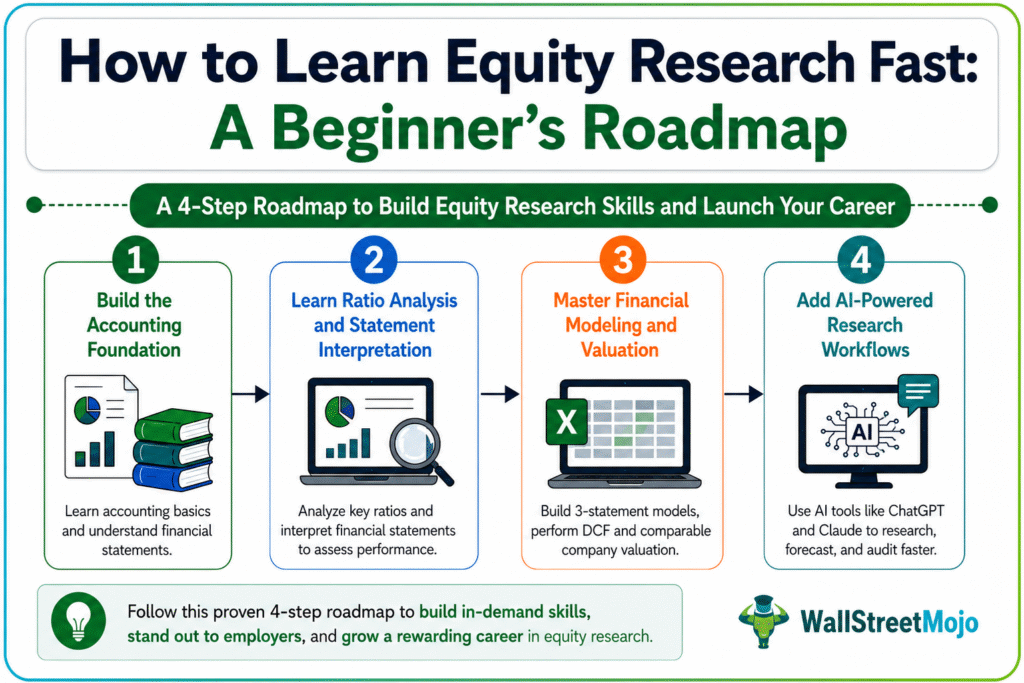
The fastest path to competence follows four stages in strict order: accounting fundamentals, ratio and financial statement analysis, financial modeling and valuation, and finally AI-assisted workflows that speed up execution. Skipping stage one to reach stage three faster is the single most common reason why beginners plateau.
The Four-Stage Roadmap
If you’re wondering about the best way to learn equity research fast, the four-stage roadmap below provides the recommended learning sequence.
| Stage | Focus Area | Core Skill Built | Typical Time Investment |
| 1. Foundation | Basic accounting and financial statements | Reading a 10-K or annual report | 15-20 hours |
| 2. Analysis | Ratio analysis and statement interpretation | Assessing liquidity, profitability, and leverage | 5-8 hours |
| 3. Modeling & Valuation | Three-statement models, DCF, and trading comps | Building and defending a valuation | 25-30 hours |
| 4. AI Layer | AI-assisted modeling and Excel workflows | Using ChatGPT and Claude to forecast and audit models faster | 10-15 hours |
Beginners who follow this order, rather than reversing it, typically reach a workable equity research skill level in six to eight weeks of consistent part-time study. The Equity Research Course from WallStreetMojo is structured around this exact four-phase sequence,taking learners from accounting fundamentals through valuation and AI-powered workflows in a structured progression.
Comparison: Equity Research Learning Paths for Beginners
Anyone looking for the best way to learn equity research fast should compare the available learning paths before investing significant time or money. They are a university finance degree, the CFA Program, self-directed study through YouTube and free resources, or a structured paid course. The table below compares the four most common ways to learn equity research across time, cost, suitability, and key limitations, helping beginners choose the path that best fits their goals.
| Learning Path | Time to Basic Competence | Cost Range | Best For | Limitation |
| University finance degree | 2-4 years | High (tuition-dependent) | Long-term career foundation | Slow; not equity-research specific |
| CFA Program | 2-4 years (3 levels) | $3,000–$5,000 total | Deep, credentialed finance knowledge | Not designed for fast, applied skill-building |
| Self-study (YouTube, blogs, free templates) | Variable, often 6+ months | Free to low cost | Testing interest before committing | Unstructured; no feedback or certification |
| Structured paid course (available online) | 6–10 weeks | ₹10,000–₹80,000+ | Beginners who want a fast, guided, job-ready path | Requires consistent self-discipline |
Among structured learning options, the key differentiator is not the platform itself but how the curriculum is organized. Programs that take learners from accounting fundamentals through ratio analysis, financial modeling, valuation, and AI-assisted research in a logical sequence are generally easier to follow than assembling individual courses from multiple sources.
The Equity Research Course offered by WallStreetMojo bundles 8+ courses into one sequenced learning path, covering accounting, financial modeling, valuation, and AI-powered workflows. Downloadable Excel templates are included, making it easier for learners to focus on building skills rather than assembling resources from different providers.
The Core Skills and Tools Every Equity Research Analyst Needs
To learn equity research fast, beginners should spend more time practicing these skills than simply watching tutorials. Successful equity research analysts combine technical knowledge with hands-on practice. The following skills and tools help transform theoretical knowledge into practical analytical ability.
- Building a three-statement model that correctly links the income statement, balance sheet, and cash flow statement
- Calculating and interpreting liquidity, profitability, and leverage ratios across at least two industries
- Constructing a discounted cash flow valuation, including WACC and terminal value assumptions
- Running a trading comparables analysis using EV/EBITDA and P/E multiples against real peer companies
- Using ChatGPT or Claude to draft a first-pass fundamental analysis, then correcting its assumptions manually
Case studies matter here. Practicing on a familiar, well-documented company, such as Netflix or McDonald’s, lets a beginner focus on mechanics instead of researching an unfamiliar business from zero. Courses built around such case studies, like the Netflix three-statement model included in the WallStreetMojo equity research bundle, remove that initial research burden so learners can concentrate on modeling technique.
Common Mistakes That Waste Beginners’ Time
Many beginners spend months correcting the same avoidable mistakes. The four below are the most common:
- Starting with valuation before accounting: DCF and comps mean little without understanding what drives the numbers underneath them.
- Relying only on passive video content: Watching a modeling tutorial without rebuilding the model independently creates false confidence.
- Ignoring industry-specific ratios: A retail company and a bank require different ratio frameworks; applying one template everywhere produces flawed analysis.
- Treating AI tools as a shortcut instead of a workflow: ChatGPT and Claude can accelerate model-building and auditing, but only once the underlying accounting and valuation logic is understood. If used earlier, they can mask gaps instead of closing them.
These mistakes can slow down skill development at a time when finance-related opportunities remain significant. According to the U.S. Bureau of Labor Statistics, business and financial operations occupations are projected to have approximately 942,500 openings annually from 2024 to 2034, with employment projected to grow 5.2% over the period. For beginners, that makes it even more important to build practical skills systematically rather than spending months learning without a clear direction.
How AI Is Changing How Fast Beginners Can Learn Equity Research
AI is helping beginners learn equity research fast, but only when it complements strong accounting and valuation fundamentals. Analysts increasingly use AI tools inside their day-to-day workflow rather than as a separate step. Beginners who learn to pair fundamental analysis with AI-assisted Excel workflows, including ChatGPT and Claude plugins for Excel, can significantly reduce the time required to build a first financial model.
That said, AI-generated formulas, assumptions, and outputs should always be reviewed before they are used in analysis. Beginners should also understand the difference between prompt-based AI, which works through a chat interface, and plugin-based AI, which integrates directly into Excel. Familiarity with both approaches helps them choose the workflow that best fits their needs.
Conclusion
If you’re wondering how to learn equity research fast, the answer is not to find a shortcut but to follow the right sequence: accounting first, ratio analysis second, valuation third, and AI-assisted workflows last. Beginners who compare their options carefully, whether a university path, the CFA Program, self-study, or a structured program, can avoid months of unnecessary trial and error.
For those who want a single, sequenced path built around real case studies, templates, and AI-powered workflows, the Equity Research Course by WallStreetMojo offers a practical starting point worth evaluating against the alternatives mentioned above.
Frequently Asked Questions
How long does it take to learn equity research as a beginner?
To learn equity research fast for beginners, following a structured learning plan is far more effective than jumping between unrelated topics. Most beginners can reach a workable, interview-ready level within six to ten weeks of consistent part-time study by following this approach rather than jumping straight into advanced topics.
Is the CFA necessary to learn equity research?
No, the CFA Program builds broad, credentialed finance knowledge over two to four years and is valuable for long-term credibility. That said, it is not designed as a fast, applied path into equity research. Many working analysts pursue the CFA alongside, not instead of, applied modeling training.
Can a complete beginner with no finance background learn equity research?
Yes, provided they start with basic accounting and financial statement literacy before moving to ratio analysis and valuation. Skipping this foundation is the primary reason non-finance beginners struggle with later modeling stages.
What is the fastest way to practice equity research skills without a job?
Building financial models for real, publicly listed companies using freely available annual reports is one of the fastest ways to develop practical equity research skills. Working through structured case studies on companies such as Netflix or McDonald’s helps beginners apply accounting, valuation, and financial modeling concepts without requiring access to expensive professional financial databases.
Do I need Bloomberg or FactSet to learn equity research?
No, beginners can learn every core skill, including ratio analysis, three-statement modeling, DCF valuation, and trading comps, using free public filings and Excel. Institutional terminals like Bloomberg and FactSet become relevant later, once working within a research team.
How is AI changing equity research training in 2026?
AI tools like ChatGPT and Claude are increasingly used inside Excel through plugin-based workflows to draft models and assist with fundamental analysis. That said, they supplement rather than replace the underlying accounting, ratio analysis, and valuation skills beginners must still learn directly.