


Financial modeling has long been a core skill that distinguishes career-focused analysts from those with basic spreadsheet proficiency. What has changed is the toolkit. Building strong financial modeling and valuation skills in 2026 no longer means mastering Excel formulas in isolation. Rather, it means pairing those formulas with AI tools like ChatGPT and Claude that can accelerate research, flag errors, and automate first-draft assumptions.
Employers across investment banking, equity research, and corporate finance now expect candidates to demonstrate strong financial modeling and valuation skills for analysts, alongside AI proficiency.
This article breaks down the financial modeling and valuation skills for beginners that can determine whether a beginner becomes job-ready or gets passed over and compares traditional modeling skills against their AI-augmented counterparts. Additionally, it outlines a practical sequence for developing them. Anyone looking to develop the best financial modeling and valuation skills, whether through self-study or a structured course, will find a clear benchmark here.
Key Takeaways
- Three-statement modeling and DCF valuation remain non-negotiable foundations, regardless of AI adoption.
- Prompt-based AI research and AI-Excel plugin fluency are now expected alongside traditional Excel skills.
- AI will not replace the financial analyst, but it will replace the analyst who does not use AI.
- Structured, sequenced learning paths that build core modeling before AI layers tend to produce more interview-ready candidates than AI-only shortcuts.
- AI can accelerate financial modeling, but analysts still need strong financial fundamentals to validate assumptions, formulas, and outputs.
What Skills Do You Need For A Financial Modeling And Valuation Career In The AI Era?
A career-ready analyst needs proficiency in three-statement modeling, DCF and comparable company valuation, Excel, and sensitivity analysis. Developing strong financial modeling and valuation skills for analysts also requires prompt-based AI research skills, AI-Excel plugin workflows, and the judgment to audit AI-generated output against financial logic. The skill mix has shifted from purely mechanical spreadsheet work toward a hybrid of technical financial modeling and AI-assisted analysis.
The 7 Core Skills For A Financial Modeling And Valuation Career Using AI
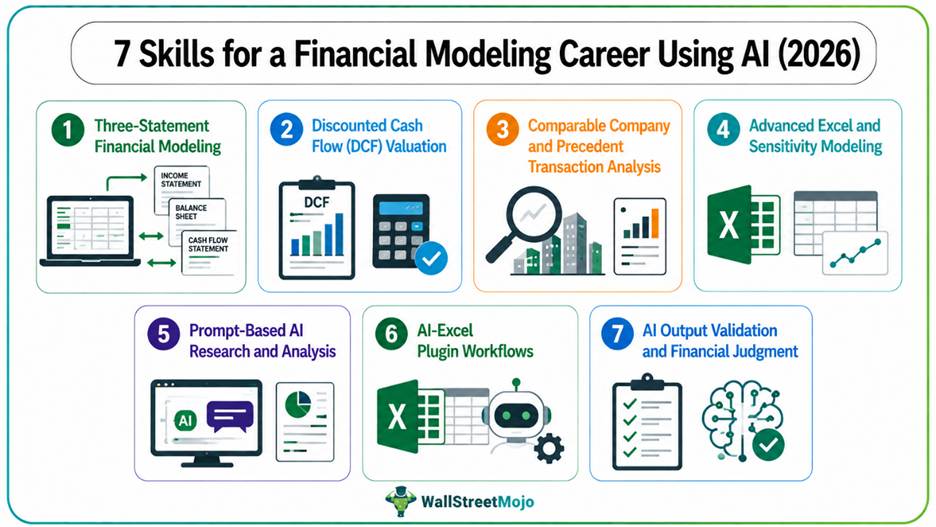
The seven financial modeling and valuation skills below combine core financial modeling expertise with AI-enabled workflows, giving analysts the technical foundation and judgment needed for modern finance roles:
1. Three-Statement Financial Modeling
Linking the income statement, balance sheet, and cash flow statement remains the foundation of every model built on Wall Street or in corporate FP&A. Analysts who cannot trace how a change in depreciation assumptions flows through to retained earnings may struggle regardless of how well they prompt an AI tool. This is why structured programs, including the Financial Modeling and Valuation Core AI + Bundle, start with statement linking before introducing any AI layer.
2. Discounted Cash Flow (DCF) Valuation
Calculating free cash flow to firm, weighted average cost of capital, and terminal value is a recurring test question in investment banking interviews. A specialized financial modeling and valuation course can build a strong foundation in valuation methods while incorporating AI-driven workflows. However, analysts still need to understand the underlying WACC and terminal value mechanics well enough to build, explain, and validate the valuation.
3. Comparable Company And Precedent Transaction Analysis
Relative valuation using EV/EBITDA, P/E, and PEG multiples requires judgment about peer selection that AI tools can accelerate but not fully replace. Analysts still need to defend why a chosen comp set is appropriate to a managing director or client.
4. Advanced Excel And Sensitivity Modeling
Data tables, scenario managers, circular reference handling for debt schedules, and dynamic sensitivity outputs remain core Excel skills. Strong financial modeling and valuation skills also require analysts to understand how these tools affect scenarios, assumptions, and valuation outcomes. For years, Excel has been considered the universal language of finance, and that hasn’t changed, even as AI tools are layered on top of it.
5. Prompt-Based AI Research And Analysis
This involves using ChatGPT or Claude in a browser to summarize 10-Ks, generate ratio analysis, identify peer companies, and draft assumption logic before the analyst refines it in Excel. Key AI skills required for finance careers include prompt engineering, data analytics, financial modeling, and AI-powered research techniques.
6. AI-Excel Plugin Workflows
The newest layer involves running ChatGPT or Claude directly inside Excel to audit formulas, generate functions, and flag inconsistencies in real time, rather than switching between a browser tab and a spreadsheet. This workflow is increasingly tested in analyst interviews as firms adopt Copilot-style plugins internally.
7. AI Output Validation And Financial Judgment
The single most underrated skill is knowing when to override an AI suggestion. Despite the impressive capabilities of these tools, many analysts have not fundamentally changed their day-to-day financial modeling workflows. They still rely on Excel to build and review models because unvalidated AI output can introduce model risk. Analysts who can catch a flawed AI-generated assumption before it reaches a client deck are the ones who get trusted with complex deals.
Traditional Financial Modeling Skills vs AI-Augmented Financial Modeling Skills
The table below compares traditional financial modeling workflows with AI-augmented approaches across key analyst tasks:
| Skill Area | Traditional Approach | AI-Augmented Approach (2026) |
| Statement linking | Manual formula building across tabs | Same manual base, AI flags broken links |
| DCF valuation | Manual WACC and FCFF calculation | AI drafts assumptions; analyst verifies WACC logic |
| Comps analysis | Manual peer screening | ChatGPT/Claude shortlist peers from filings |
| Excel proficiency | Formulas, VBA, sensitivity tables | Same formulas, plus AI-generated formula audits |
| Research | Manual 10-K reading | AI summarizes filings in minutes |
| Formula auditing | Manual trace precedents | AI-Excel plugins detect errors instantly |
| Communication | Static PowerPoint decks | AI-assisted dashboards and narrative summaries |
This table reflects why hiring managers increasingly ask candidates to demonstrate both columns rather than one. Candidates who rely only on traditional modeling skills may miss the productivity benefits of AI. Conversely, those who rely solely on AI may lack the modeling foundation needed to identify and correct AI-generated errors.
Common Mistakes Beginners Make When Learning Financial Modeling with AI
Beginners often skip the fundamentals required to develop financial modeling and valuation skills and jump straight to AI-generated models, which leaves them unable to explain their own output in an interview. Some people even treat AI-drafted DCF assumptions as final rather than as a first draft requiring validation. A third common mistake is learning AI prompting skills in isolation without ever building a model manually in Excel. This can leave gaps in fundamental modeling knowledge that recruiters may test through modeling case studies.
How to Build Financial Modeling And Valuation Skills: A Practical Roadmap
The most durable sequence or developing the best financial modeling and valuation skills moves from core modeling to core valuation, then into AI-assisted analysis, and finally into AI-Excel plugin mastery. This mirrors how structured bundles, such as the Financial Modeling and Valuation Core + AI Bundle taught by Dheeraj Vaidya, CFA, a former J.P. Morgan and CLSA analyst, organize their curriculum.
In the program designed by WallStreetMojo, Financial Modeling 101 comes first, which helps build basic knowledge of financial modeling. It is followed by the Financial Modeling course, which applies core modeling skills through a McDonald’s case study.
Next comes DCF and trading comps, and after that, Netflix-based AI modeling case studies follow. The sequence concludes with ChatGPT and Claude Excel plugin workflows.
Following this order helps learners understand the reasoning behind AI output rather than relying on AI-generated results without comprehending the underlying logic.
Conclusion
Building financial modeling and valuation skills in 2026 requires combining strong technical fundamentals with fluency in ChatGPT and Claude-based workflows. In other words, the current scenario requires durable technical fundamentals paired with fluency in ChatGPT and Claude-based workflows. Analysts who master both statement linking and AI output validation stand out in a hiring market that increasingly tests for exactly this combination.
For those looking to build these seven skills in a structured sequence rather than piecing together scattered tutorials, the Financial Modeling and Valuation Core + AI Bundle offers a phased path from core Excel modeling through AI-powered valuation and Excel plugin workflows.
Frequently Asked Questions
What is the most important skill for a financial modeling career in 2026?
Three-statement modeling remains the most important foundational skill. This is because it underlies every valuation method and every AI-assisted workflow built on top of it.
Do I need to learn Excel before learning AI tools for financial modeling?
Yes, AI tools like ChatGPT and Claude accelerate modeling tasks. That said, analysts still need Excel fluency to build, audit, and defend the underlying formulas.
Can ChatGPT or Claude replace financial modeling skills?
No. Understanding financial statements, building valuation models, and advising clients still require human expertise, even as AI tools speed up research and data collection.
What is the difference between prompt-based AI workflows and AI-Excel plugin workflows in financial modeling?
Prompt-based workflows involve using AI tools in a browser to generate outputs applied manually in Excel. In contrast, plugin-based workflows involve using AI directly inside Excel to audit models and generate formulas in real time.
Is a financial modeling and valuation course worth it for beginners?
A structured approach to developing financial modeling and valuation skills for beginners helps learners involves following a defined sequence, from core modeling through AI-assisted valuation, rather than guessing which skills to prioritize first.
How much do financial analysts with modeling skills earn?
The average annual salary for financial analysts in the United States is $85,604, while in India the annual salary range for the same position is ₹6.5 lakh to ₹7.2 lakh for 1 to 7 years of experience. Besides experience, other factors, for example, the employer and region, impact salary.