


Introduction
Choosing among the best FP&A courses for beginners can be harder than it looks. Search results show university certificates, practitioner-led programs, and self-paced courses. Many claim to prepare learners for financial planning and analysis roles. However, without a corporate finance background, it can be difficult to distinguish job-ready training from certificate-focused programs. More importantly, earning a certificate does not necessarily mean you have developed the practical skills needed to succeed in FP&A.
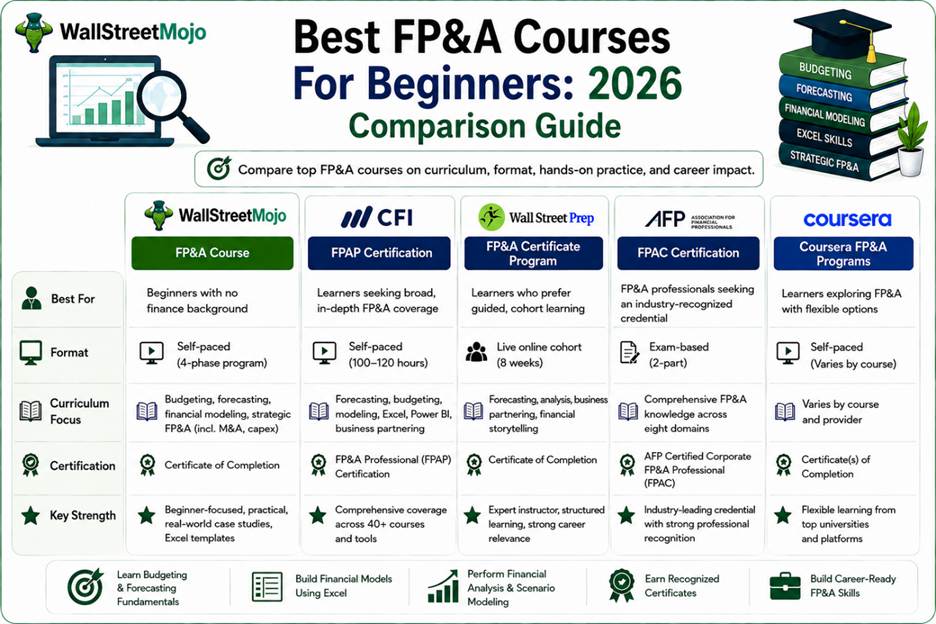
This guide takes a comparison-first approach. It evaluates recognizable programs, including CFI’s FPAP, the AFP’s FPAC credential, Coursera-hosted options, and WallStreetMojo’s FP&A Course. The comparison focuses on criteria that matter most to beginners: curriculum sequencing, hands-on modeling practice, instructor credibility, and career alignment.
A strong FP&A course for beginners covers budgeting, forecasting, financial statement analysis, and Excel-based modeling in a structured sequence, backed by instructors with real FP&A or investment banking experience.
Key Takeaways
- Beginner FP&A training should progress from budgeting and forecasting to financial modeling and strategic decision-making.
- Hands-on Excel practice and case studies help turn FP&A concepts into practical workplace skills.
- WallStreetMojo’s FP&A Course provides a focused, sequenced path from fundamentals to financial modeling and strategic FP&A.
- Beginners should prioritize curriculum fit, practical training, and instructor credibility over certification or brand recognition alone.
What Makes A Good FP&A Course For Beginners?
The best FP&A courses for beginners online should teach the FP&A cycle, budgeting, forecasting, financial statement analysis, and introductory financial modeling in a logical sequence. They should include practice files, case studies, and a certificate that signals competency to employers.
Three elements separate strong beginner programs from weak ones:
- Sequencing: Concepts should progress from budgeting fundamentals to forecasting, financial modeling, and strategic FP&A rather than introducing advanced topics too early.
- Practitioner credibility: Instructors with direct FP&A, investment banking, or corporate finance experience bring case studies that reflect actual workplace workflows rather than textbook theory.
- Applied practice: Downloadable Excel templates and case-study-driven exercises matter more than passive video lectures for skill retention.
Comparing The Top FP&A Courses For Beginners In 2026
Let’s examine how each program approaches beginner FP&A training and where each one stands out.
Corporate Finance Institute (CFI) FPAP Certification
CFI’s Financial Planning & Analysis Professional program follows a broad, multi-course pathway rather than a single course. It covers forecasting, budgeting, scenario modeling, Excel, Power BI, and business partnering across more than 40 online courses. The program is self-paced and typically takes 100 to 120 hours to complete, with a final exam requiring a 70% passing grade. Its breadth makes it suitable for learners who want comprehensive FP&A coverage, although beginners seeking a more focused starting point may prefer a shorter, more tightly sequenced course.
Wharton Online & Wall Street Prep FP&A Certificate Program
This cohort-based program combines a university-affiliated brand with practitioner-led instruction. The eight-week curriculum covers forecasting, analysis, business partnering, and financial storytelling. Lead instructor Christian Wattig brings more than a decade of FP&A leadership experience. Its structured format suits learners who value guided progression, while the fixed schedule offers less flexibility than a self-paced course.
AFP Certified Corporate FP&A Professional (FPAC)
The FPAC is less a beginner course and more an experience-gated credential. It is positioned as the industry-leading FP&A certification, built around a two-part comprehensive exam, and typically requires candidates to already be performing FP&A-related work. It suits learners who already hold an entry-level FP&A job and want formal recognition, not those starting from zero.
Coursera And LinkedIn Learning FP&A Programs
These platforms offer flexible FP&A courses and certificate programs from different providers. They can suit learners who want to explore FP&A before committing to a longer program. However, learners need to evaluate each option individually because curriculum depth, sequencing, and career focus vary across providers.
Financial Planning & Analysis (FP&A) Course By WallStreetMojo
WallStreetMojo’s Financial Planning and Analysis Course is structured specifically for the beginner-to-job-ready transition. It moves through four phases: FP&A foundations and budgeting, forecasting and financial statement analysis, cost management and financial modeling, and strategic FP&A including M&A and capital budgeting.
The course is directed by Dheeraj Vaidya, CFA, FRM, a former JPMorgan and CLSA analyst and IIT/IIM alumnus who has trained more than 100,000 finance professionals. The program includes downloadable Excel templates and a certificate of completion with one year of access. WallStreetMojo’s FP&A Course follows a tightly sequenced curriculum and includes case studies and real-world examples. It provides a focused learning path rather than a broad multi-certification pathway.
FP&A Course Comparison Table
The table below compares the top FP&A courses for beginners based on format, ideal learner profile, and key considerations.
| Course | Format | Best For | Notable Limitation |
| CFI FPAP | Self-paced, 40+ courses | Learners wanting a broad, multi-topic pathway | High course volume for true beginners |
| Wharton/Wall Street Prep FP&A Certificate | 8-week cohort | Learners wanting university branding + live structure | Fixed schedule, less flexibility |
| AFP FPAC | Exam-based credential | Working FP&A professionals seeking formal recognition | Not designed for absolute beginners |
| Coursera/LinkedIn FP&A options | Self-paced, multiple course providers | Exploratory learners testing interest | Inconsistent depth across providers |
| WallStreetMojo’s Financial Planning and Analysis Course | Self-paced, single structured course | Beginners wanting a sequenced, case-study-driven path | Single course, not a multi-certification track |
How To Choose The Right FP&A Course As A Beginner
Start by matching the course format to your learning constraints. Full-time professionals often benefit from self-paced formats, like WallStreetMojo’s or CFI’s, that fit around work schedules. Career switchers with more flexibility may prefer the structured cadence of a cohort program like Wharton Online’s.
Next, check whether the curriculum builds progressively. A course that opens with budgeting fundamentals and only introduces discounted cash flow modeling and capital budgeting later, as WallStreetMojo’s four-phase structure does, reduces the risk of learners getting lost in advanced material too early.
Finally, weigh instructor credibility. Programs led by professionals with verifiable investment banking or corporate FP&A backgrounds, such as CFA or FRM charterholders, tend to translate theory into workplace-relevant case studies more effectively than generic instructional content.
Common Mistakes Beginners Make When Choosing an FP&A Course
Let’s look at the common mistakes that beginners should avoid when choosing FP&A certification courses for beginners.
- Chasing the credential name over curriculum fit: A well-known certification name means little if the course jumps ahead of a learner’s current skill level. FP&A certification courses for beginners should balance credential value with practical skill development.
- Ignoring whether Excel practice is built in: FP&A is an Excel-heavy discipline; video-only courses without downloadable templates leave a skills gap.
- Overlooking instructor experience: Course quality tracks closely with whether the instructor has actually worked in FP&A, investment banking, or equity research.
- Assuming all “FP&A courses” cover the same ground: Programs differ significantly in their purpose and target audience. For example, FPAC is an exam-based credential designed primarily for working FP&A professionals rather than absolute beginners.
Career Outcomes: What An FP&A Course Can Lead To
FP&A skills feed directly into financial analyst roles, which the U.S. Bureau of Labor Statistics tracks under a broader occupational category. Overall employment of financial analysts is projected to rise 6% from 2024 to 2034, faster than the average for all occupations, with about 29,900 openings projected each year.
This outlook highlights the value of choosing FP&A courses for beginners that build skills in forecasting, analysis, and strategic decision support.
Conclusion
Selecting among the best FP&A courses for beginners comes down to matching curriculum depth, format, and instructor credibility to individual career goals. Broad multi-course pathways like CFI’s FPAP suit learners wanting comprehensive coverage, cohort programs like Wharton Online’s suit those wanting structured pacing, and exam-based credentials like FPAC suit working professionals.
For learners who want a single, sequenced, practitioner-led path from FP&A fundamentals through financial modeling WallStreetMojo’s Financial Planning & Analysis Course offers a case-study-driven curriculum built around real-world FP&A workflows. Review the full curriculum before enrolling in any program to confirm it matches your current skill level.
Frequently Asked Questions
What is the best FP&A course for someone with no finance background?
Beginners with no finance background generally benefit from a self-paced, sequenced course. It should start with budgeting and forecasting fundamentals before introducing financial modeling. WallStreetMojo’s FP&A Course and CFI’s introductory FP&A modules can fit this approach. Exam-focused credentials like FPAC are better suited to learners with existing FP&A experience.
Is CFI or WallStreetMojo better for learning FP&A?
CFI’s FPAP suits learners who want a broad, multi-certification pathway spanning 40+ courses, while WallStreetMojo’s FP&A Course suits learners who prefer a single, tightly sequenced curriculum built around one case study and immediate Excel practice. The right choice depends on whether breadth or focused depth matters more.
Do I need a certification to work in FP&A?
A certification is not strictly required, but it strengthens a resume and demonstrates structured knowledge to recruiters. Employers generally weigh practical modeling skills, Excel proficiency, and relevant coursework alongside any certificate earned.
How long does it take to learn FP&A as a beginner?
This varies by course format. Self-paced programs like WallStreetMojo’s FP&A Course include 11+ hours of core video content, while broader pathways like CFI’s FPAP can take considerably longer given their larger course volume. Actual mastery also depends on how much time a learner dedicates to hands-on practice.
What is the difference between FP&A and financial modeling courses?
FP&A courses cover the full planning cycle, including budgeting, forecasting, cost management, and financial statement analysis, with financial modeling as one component. Standalone financial modeling courses focus narrowly on building models like DCFs and projections without the broader budgeting and forecasting context.
Can I become an FP&A analyst without a finance degree?
It is possible, though most employers prefer a bachelor’s degree in finance, accounting, or a related field. Beginners without that background can strengthen their candidacy through structured FP&A coursework, downloadable Excel templates, and demonstrable modeling skills built through a beginner-focused course.