


Introduction
Financial modeling has become the single most requested skill in investment banking, equity research, corporate finance, and FP&A interviews. According to the CFA Institute, 51% of employers prioritize financial modeling skills, making it one of the most sought-after technical competencies for finance professionals, alongside market knowledge and communication skills.
That said, most beginners spend months on scattered YouTube tutorials without producing a model that would survive scrutiny from a hiring manager.
To learn financial modeling fast, you need more than endless tutorials. The key is following a structured learning sequence that starts with building Excel fluency, progresses to accounting logic, and culminates in practical financial modeling skills.
This guide breaks down what financial modeling actually requires and compares the realistic learning paths available today. Moreover, it lays out a 90-day plan to learn financial modeling fast without wasting time on redundant resources. Readers will also see where a structured program, such as the Financial Modeling and Valuation Course by WallStreetMojo, fits into an efficient learning path compared to free or fragmented alternatives.
Key Takeaways
- Build accounting knowledge before learning Excel-based financial modeling and valuation techniques.
- Practice with real company filings to develop practical, job-ready financial modeling skills.
- Structured learning paths reduce trial and error compared to fragmented free resources.
- Professional Excel formatting and formula transparency improve model quality and credibility.
- Understanding how beginners learn financial modeling fast helps you avoid common mistakes and build skills efficiently.
- Consistent hands-on practice is the fastest way to become confident in financial modeling.
What Financial Modeling Actually Involves
Financial modeling is the process of building a spreadsheet-based representation of a company’s historical and projected financial performance. It is typically used to support valuation, budgeting, and investment decisions.
A working model links the income statement, balance sheet, and cash flow statement into a single dynamic structure, often referred to as a three-statement model. It also incorporates valuation methods such as discounted cash flow (DCF) analysis, comparable company analysis, or leveraged buyout (LBO) modeling, depending on the use case.
Beginners frequently misunderstand the scope of the skill. Financial modeling is not simply “using Excel.” It requires a working knowledge of GAAP or IFRS accounting principles and an understanding of corporate finance concepts like weighted average cost of capital (WACC). Moreover, it requires the discipline to build transparent, auditable formulas rather than relying on hardcoded values.
For those exploring financial modeling for beginners, mastering these fundamentals is the first step toward building accurate, job-ready models.
Why Most Beginners Waste Time Learning Financial Modeling
The following three patterns consistently hold back self-taught learners who want to learn financial modeling fast:
- Many beginners jump straight to valuation before mastering the underlying accounting statements, resulting in models that appear correct but fail under scrutiny.
- Some learners focus on Excel shortcuts in isolation without applying them to real financial models, making it difficult to transfer those skills to practical work.
- Others rely on fragmented free resources, switching between unrelated YouTube channels and blog posts that teach inconsistent formatting conventions and formula structures.
A structured course compresses the trial-and-error phase by teaching accounting, Excel, and financial modeling in the sequence employers expect. This approach is far more effective than following the order in which a search algorithm surfaces content.
Comparing the Fastest Ways to Learn Financial Modeling
The table below compares the main financial modeling learning paths available to beginners in 2026, based on typical time investment, cost, and career readiness.
| Learning Path | Typical Time to Job-Ready | Cost Range | Structured Curriculum | Real Model Practice | Certification |
| Free YouTube tutorials | 6-12 months | Free | No | Limited | No |
| University finance coursework | 2-4 years | High (degree cost) | Yes, but theory-heavy | Minimal | Degree |
| Blogs and articles | 4-8 months | Free | No | Minimal | No |
| Structured online programs (for example: courses by WallStreetMojo) | 6-10 weeks | Moderate | Yes | High | Yes |
| Corporate training bootcamp | 3-6 weeks | High | Yes | High | Sometimes |
This comparison explains why people looking to learn financial modeling fast often choose structured courses over free resources. A financial modeling course online like the Financial Modeling and Valuation Course by WallStreetMojo condenses the accounting-to-valuation sequence into a guided curriculum with case studies. As a result, beginners spend less time on trial and error than those relying solely on free resources.
Excel And VBA Skills Beginners Must Prioritize First
Before touching valuation, beginners should be fluent in a defined set of Excel functions and formatting conventions that appear in nearly every professional model:
- Formula Logic: Learn functions such as INDEX-MATCH, OFFSET, IFERROR, and SUMIFS to create dynamic formulas and reference data efficiently.
- Formatting Discipline: Follow professional formatting conventions by using blue for hardcoded inputs, black for formulas, and green for links to other worksheets, as commonly practiced by investment banking teams.
- Sensitivity Tools: Use data tables and Scenario Manager to analyze how changes in assumptions affect financial model outputs.
- VBA Basics: Learn to create simple macros that automate repetitive formatting and data-related tasks, improving efficiency as financial models become larger and more complex.
Beginners often skip formatting conventions because they seem cosmetic, but recruiters and analysts reviewing a test model treat inconsistent formatting as a signal of weak attention to detail.
A 90-Day Roadmap to Learn Financial Modeling Fast
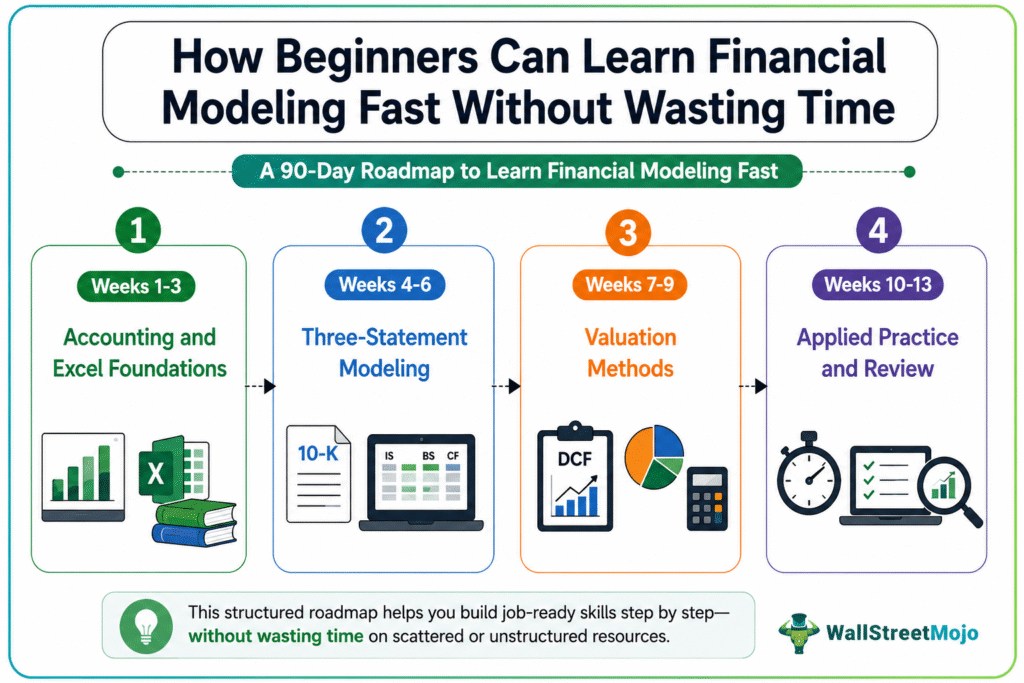
If you are wondering about the best way to learn financial modeling fast, following a structured roadmap is essential. The 90-day plan below builds your skills progressively, from accounting fundamentals to financial modeling and valuation:
- Weeks 1-3: Accounting and Excel foundations. Build fluency in reading the three financial statements and practice core Excel functions inside real company data, not isolated exercises.
- Weeks 4-6: Three-Statement Modeling. Build a fully linked model from a public company’s 10-K filing, sourced from SEC EDGAR, to practice forecasting revenue, expenses, and working capital.
- Weeks 7-9: Valuation methods. Layer DCF, comparable company analysis, and precedent transactions onto the completed model.
- Weeks 10-13: Applied practice and review. Rebuild a model from scratch under a time limit, simulating an interview case study. Review your model carefully to improve its structure, formatting, formula accuracy, and overall financial modeling logic.
This is precisely the structure that condensed, mentor-guided programs replicate, which is why many beginners choose a course rather than attempting to reverse-engineer this sequence from scattered resources.
Common Mistakes to Avoid to Learn Financial Modeling Fast
To learn financial modeling fast, it is just as important to avoid common mistakes as it is to develop technical skills. The following pitfalls can slow your progress and prevent you from building job-ready financial models:
- Building models without linking to real filings, which produces academic exercises rather than job-ready skills
- Ignoring circular references and iterative calculations that appear in debt schedules
- Skipping the “why” behind formulas, which limits the ability to adapt a model to a new industry.
- Treating certification as the end goal rather than the model-building competence it represents.
Conclusion
Learning to build professional financial models takes consistent practice rather than shortcuts. Those who combine accounting knowledge, Excel proficiency, and hands-on modeling experience develop the skills employers expect in investment banking, corporate finance, and FP&A roles.
If your goal is to learn financial modeling fast, following a comprehensive curriculum can help you stay focused and avoid the inefficiencies of piecing together scattered resources. For readers seeking a guided learning experience, the Financial Modeling and Valuation Course by WallStreetMojo offers a practical next step.
Frequently Asked Questions
How long does it take to learn financial modeling as a beginner?
Most beginners following a structured curriculum reach a job-ready standard in 6 to 10 weeks, while self-taught learners using free resources typically need 4 to 8 months to reach the same level.
Can I learn financial modeling fast without an accounting background?
Yes, but it requires dedicating the first two to three weeks specifically to accounting fundamentals before attempting any model-building, since valuation formulas depend entirely on correctly understanding the three financial statements.
Is Excel or VBA more important for financial modeling?
Excel is indispensable for financial modeling because every model is built in it. VBA complements Excel by automating repetitive tasks, but it is not a prerequisite for building strong financial modeling skills.
What is the fastest way to practice financial modeling on real data?
Building a three-statement model directly from a public company’s SEC filing, such as a 10-K, gives beginners realistic practice that free templates or fictional case studies cannot replicate.
Are online financial modeling courses worth it when compared to free tutorials?
Structured courses are generally worth the cost for beginners prioritizing speed. This is because they sequence accounting, Excel, and valuation logically and include feedback, which shortens the trial-and-error period common with free content.
What is the best way to learn financial modeling fast: online courses or free tutorials?
The best way to learn financial modeling fast depends on your goals, but structured online courses generally help beginners become job-ready more quickly than relying solely on free tutorials. They provide a logical progression from accounting and Excel to financial modeling and valuation, reducing the trial-and-error often associated with self-study.