


What Is REIT ETF?
REIT ETF refers to those exchange-traded funds that invest in the equity and derivatives of the publicly traded real estate investment trust. Thus, fund managers manage such an investment passively as they track the performance of the REIT indices without handling any physical property.
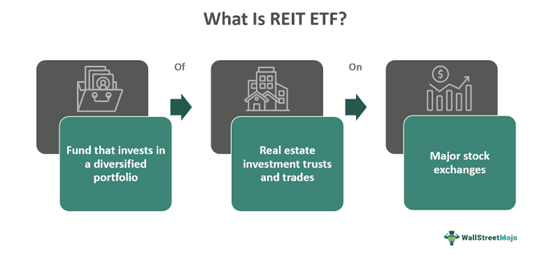
It is a low-cost investment option for those investors who want the benefits of investing in the real estate sector without any worries about property purchase, management, or sale. Moreover, it allows investors to include global real estate asset classes in their portfolios to ensure diversification. Also, these investment vehicles provide tax advantages to the holders.
Key Takeaways
- A REIT ETF (Real Estate Investment Trust Exchange-Traded Fund) is a passively managed fund designed to mirror the performance of equities and derivatives issued by publicly traded real estate investment trusts (REITs).
- This investment vehicle is suitable for retail investors who want to invest in the real estate sector with limited capital and aim to build wealth over the long term.
- REIT ETFs offer various advantages, including diversification, liquidity, tax efficiency, and potentially high-dividend yields.
- Unlike direct investments in REITs, these ETFs are passively managed funds that do not allow investors to control or manage the underlying assets directly.
How Does REIT ETF Work?
A REIT ETF is a passively managed exchange-traded fund that replicates the returns of the equities and derivatives that are invested in various real estate investment companies. These ETFs provide the benefits of both fixed-income securities through a high-dividend payment and equities due to their traceability in the stock exchange market.
These investments trace the returns of the equities and derivatives that are invested in the real estate investment trusts and majorly generate returns out of the rental or lease income derived from these properties. While some of these ETFs concentrate on high-risk mortgage assets, others track those equities or derivatives that are formed from investing in commercial mortgages.
However, investors must be careful of the high volatility nature of these funds since they are traded on public platforms and are sensitive to the changing economic scenario and adversities like recession or inflation. Such investments, though, benefit from the corporate tax exemption; however, the dividends earned on these assets are subjected to capital gain taxes.
Moreover, these assets are vulnerable to interest rate risk since any interest rate fluctuations result in a higher cost of capital and limited capital appreciation. Additionally, these funds charge a specific management fee from the investors.
Examples
The REIT ETFs are a feasible investment option for retail investors who often enter the market with limited capital to invest. Let us find out some promising ETFs in this category.
Example #1
Imagine an investor named Sarah who is looking to diversify her investment portfolio by adding real estate exposure without directly buying properties. She decided to invest in a REIT ETF called “Global Real Estate ETF” (GRE ETF). This ETF passively tracks an index of globally diversified REITs, including commercial properties, residential complexes, and industrial warehouses.
By investing in GRE ETF, Sarah gains indirect ownership in numerous real estate assets across different regions and sectors. This allows her to benefit from the rental and lease income generated by these properties, which is distributed to her as dividends. Since the GRE ETF is traded on the stock exchange, Sarah can easily buy or sell shares, adding liquidity to her investment.
Over the next few years, Sarah observed that her GRE ETF investment provided consistent dividend payments, contributing to her overall portfolio income. However, she also notices fluctuations in the ETF’s market price due to changes in economic conditions and interest rates. For instance, during a period of rising interest rates, the value of her GRE ETF shares decreases because of higher borrowing costs impacting the underlying REITs.
Despite this volatility, Sarah appreciates the diversification and tax efficiency offered by the GRE ETF. She remains confident in her investment strategy, knowing that the ETF’s broad exposure to different real estate sectors and regions helps mitigate some of the risks associated with individual property investments.
Example #2
During the fourth quarter, SageView Advisory Group LLC increased its position in the iShares Global REIT ETF (NYSEARCA: REET) by 43.1%, according to its latest 13F filing with the Securities and Exchange Commission. The firm purchased an additional 716,890 shares, bringing its total to 2,378,756 shares, which accounted for 1.9% of SageView’s investment portfolio. It made REET its 9th largest holding, valued at $55,449,000 at the end of the quarter.
Several other institutional investors also adjusted their holdings in REET. Janney Montgomery Scott LLC increased its stake by 19.1% in the third quarter, now holding 18,727 shares valued at $396,000. Envestnet Asset Management Inc. raised its stake by 33.0%, now owning 1,055,728 shares worth $22,350,000. These movements highlight the attractiveness of the iShares Global REIT ETF for gaining diversified exposure to global real estate markets through a passively managed fund.
Taxation
The REIT ETFs are known for having a tax transparency treatment. Also, these assets are considered to be tax-efficient since the earnings from these ETFs can be accounted for deferred taxes and tax-free growth, subject to certain conditions. However, these funds are exempted from the imposition of corporate taxes; they are still charged with the following tax liabilities:
- Income Tax on Dividends: The issuers need to allocate 90% or more of the taxable income from these funds to the investors. Thus, this income is charged at the ordinary income tax rate applicable to the investors when they receive it.
- Capital Gain Taxes: If the investors sell such an ETF over the period, then the capital gain from this asset is subjected to short-term or long-term capital gains based upon the holding period of the investors.
Advantages
The real estate investment trust exchange-traded funds are a viable investment option for the following reasons:
- Passive Management: These funds don’t require any active purchase, management, up-keeping, or sale of the physical real estate since they replicate the performance of a particular real estate index.
- Greater Liquidity: Such ETFs are traded on a daily basis over the stock exchanges and, therefore, can be easily bought and sold.
- Diversification: This type of investment spreads the investors’ funds across various geographically diversified real estate asset classes.
- Hedge Against Inflation: The asset shields the investors against the inflation risk since the real estate value appreciates over time in the usual economic scenario.
- Low Minimum Investment: It is a preferable investment category for retail investors who are allured by real estate assets but have low investment capacity.
- Tax Efficiency: While similar to REITs, the investors can expect a minimum of 90% taxable income distribution, but these funds are not subject to corporate taxes.
- Higher Returns: These funds offer capital appreciation benefits and high dividends compared to the other equity and debt securities.
- Low-Risk Profile: Such an asset involves low risk compared to direct real estate investment or REITs due to its diversification benefits.
REIT ETF Vs. REIT
The real estate sector has immense scope for wealth creation as it provides impressive returns in the long run. Let us understand the two prominent real estate investment vehicles – REIT ETF and REIT which are substantially dissimilar from one another in the following ways:
| Basis | REIT ETF | REIT |
| Definition | It is an exchange-traded fund that invests in equities or derivatives, tracking the returns of the real estate investment trust indexes. | REITs are the stocks issued by real estate asset management companies that invest in and manage physical properties. |
| Fund Management | Passive | Active |
| Yield | Fair returns but lower than the REITs | Higher return potential |
| Taxation | Tax efficient assets which are exempted from corporate tax imposition, but charged for income and capital gain taxes | Subjected to corporate taxes in certain cases |
| Risk Profile | Low risk involved due to passive holding | Comparatively higher risk involvement |
| Liquidity | Complete liquidity since it can be traded over the financial markets on daily basis | The non-traded REITs have no liquidity |
| Diversification | These investments hold various real estate asset classes from around the globe | Less diversified form of real estate investment |
| Cost | It is a low cost investment with minimal initial investment and management fees. | Requires high initial capital investment, and involves certain maintenance cost, management fees, and other charges |
| Ownership | Indirect | Direct |
| Suitable For | Retail investors | Institutional and retail investors |
| Control | No control over the underlying real estate | Greater control over underlying real estate |
| Examples | Invesco KBW Premium Yield Equity REIT (KBWY) | Piedmont Office Realty Trust Inc. |
Frequently Asked Questions (FAQs)
Frequently Asked Questions
Are REIT ETFs A good investment?
It is one of the best investment vehicles for retail investors who have low budget but aim to create wealth for their future. Moreover, since these ETFs invest across geographically diversified real estate assets and are managed by qualified professionals, they involve less risk than the REITs.
What is the best REIT ETF?
Some of the good REIT ETFs to consider in 2024 are as follows: 1. Vanguard Real Estate Index Fund (VNQ) 2. Real Estate Select Sector SPDR Fund (XLRE) 3. iShares Residential and Multisector Real Estate ETF (REZ)
What is the largest REIT ETF?
Schwab U.S. REIT ETF (SCHH) is, so far, the biggest REIT ETF, with assets worth $6.41 billion. It closely mirrors the Dow Jones Equity All REIT Capped Index†, which comprises REIT equities. This ETF is currently trading at $19.93 as of June 18, 2024.
Does Fidelity have a REIT ETF?
Yes, Fidelity Investments has a handful of ETFs that concentrate on the real estate asset classes. One such popular Fidelity ETF is the Fidelity MSCI Real Estate ETF (FREL), which is currently trading at $25.32 as of June 18, 2024.