


Introduction
Anyone typing “best M&A modeling courses for beginners” into a search bar is usually stuck between two bad options: piecing together free YouTube tutorials with no sequence, or paying for a course that assumes deal experience the learner doesn’t have.
Mergers and acquisitions modeling combines accounting, valuation, and Excel skills. A poorly structured course can leave beginners memorizing formulas without understanding how the underlying financial statements and pro forma model work together.
This guide compares the best M&A modeling courses for beginners available in the market today. These include WallStreetMojo’s Mergers & Acquisitions Modeling Course, Wall Street Prep’s Premium Package, Breaking Into Wall Street’s Advanced M&A Modeling course, and Corporate Finance Institute’s standalone M&A course. Each is evaluated on curriculum sequencing, case-study depth, instructor background, and whether it actually assumes zero prior modeling experience.
Readers will get a side-by-side comparison of each course, including its strengths, limitations, and ideal learner profile. A simple decision framework then helps them choose the right course based on their current skills and goals.
Key Takeaways
- Start with financial statement fundamentals before learning merger mechanics and advanced M&A modeling.
- A continuous case study can help beginners connect individual concepts into one complete M&A model.
- WallStreetMojo suits true beginners seeking a foundation-first approach with a complete deal-building sequence.
- Choose a learning path that matches your current modeling experience and career goals.
- Check prerequisites carefully to avoid starting with concepts that assume knowledge you have not yet developed.
What Makes A Course Beginner-Friendly For M&A Modeling
The best M&A modeling courses for beginners online should start with financial statement fundamentals and equity and enterprise value calculations.
It should then progress to merger modeling, sources and uses of funds, purchase accounting, and goodwill creation. The course should also cover pro forma balance sheet and income statement construction, accretion/dilution analysis, and sensitivity analysis.
Ideally, these concepts should be taught through one continuous deal rather than disconnected exercises.
The following four factors separate a strong beginner program from a generic one:
- Instructor experience on real deals, not just teaching experience
- A single, continuous case study that carries through every module and allows learners to build one deployable model instead of fragments
- Downloadable Excel templates that mirror the formats analysts actually use on the job
- Prerequisites stated upfront, allowing learners to know whether they need prior Excel or accounting exposure
The Best M&A Modeling Courses for Beginners In 2026, Compared
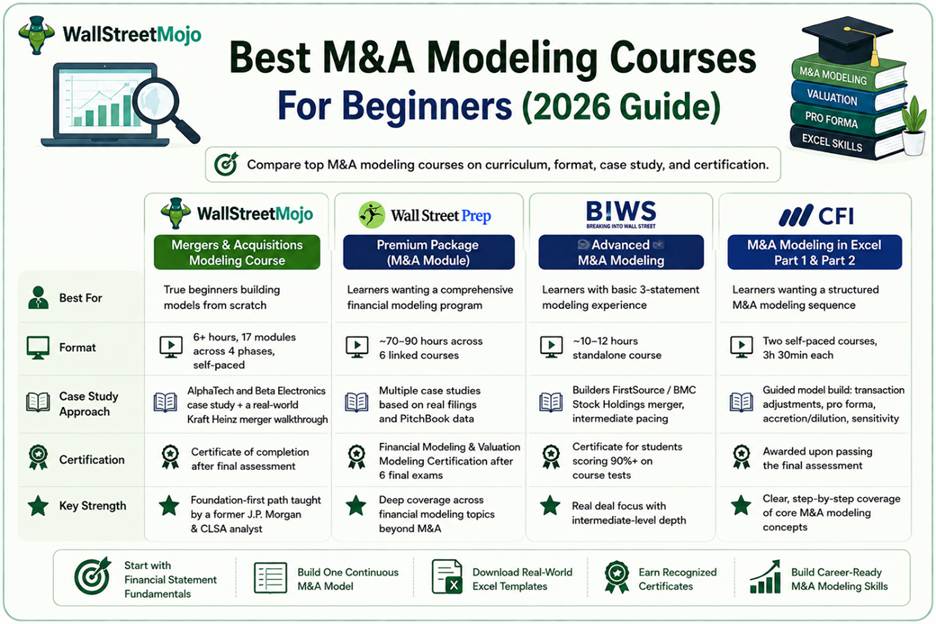
The table below compares the best M&A modeling courses for beginners based on publicly listed curriculum details from each provider:
| Course | Provider | Format | Case Study Approach | Certification |
| Mergers & Acquisitions Modeling Course | WallStreetMojo | 6+ hours, 17 modules across 4 phases, self-paced | AlphaTech and Beta Electronics case study, plus a real-world Kraft Heinz merger walkthrough | Certificate of completion after final assessment |
| Premium Package (M&A module) | Wall Street Prep | Roughly 70–90 hours across 6 linked courses | Multiple case studies built on real filings and PitchBook data | Financial Modeling & Valuation Modeling Certification after 6 final exams |
| Advanced M&A Modeling | Breaking Into Wall Street (BIWS) | Roughly 10–12 hours standalone | Builders FirstSource/BMC Stock Holdings merger, intermediate pacing | Certificate for students scoring 90%+ on course tests |
| Mergers & Acquisitions (M&A) Modeling in Excel Part 1 & Part 2 | Corporate Finance Institute (CFI) | Two self-paced online courses, 3h 30min each | Guided M&A model build covering transaction adjustments, pro forma integration, accretion/dilution, and sensitivity analysis | Awarded upon passing the final course assessment |
WallStreetMojo: A Foundation-First Path for True Beginners
WallStreetMojo’s Mergers & Acquisitions Modeling Course is one of the best M&A modeling courses for beginners seeking a foundation-first approach. It opens with financial statement basics and equity/enterprise value calculations before introducing the AlphaTech and Beta Electronics case study. Then, it moves through synergies, purchase accounting, proforma financials, accretion/dilution, and a Section 338 election module on asset purchases.
Instruction comes from Dheeraj Vaidya, CFA, FRM, a former J.P. Morgan and CLSA analyst, which gives the curriculum a practitioner’s grounding rather than a purely academic one.
Wall Street Prep: Comprehensive, But A Bigger Time Commitment
Wall Street Prep’s Premium Package takes a broader approach to financial modeling. Its M&A module sits within a six-course sequence covering 3-statement modeling, DCF, comps, M&A, and LBO.
This structure suits learners who want to develop a broader modeling skill set alongside M&A expertise. However, reaching the M&A-specific content requires completing several prerequisite courses, making it a larger time commitment than a standalone M&A course.
For beginners focused specifically on M&A modeling, this broader structure may be more than they need.
Breaking Into Wall Street (BIWS): Strong For Interview Prep, Less So For Absolute Beginners
BIWS’s Advanced M&A Modeling course is designed for learners who want the modeling skill set of an experienced M&A banker without spending years getting there. It uses a case study based on Builders FirstSource and BMC Stock Holdings. The course moves briskly, with most foundational concepts presented as a quick review rather than a first introduction. That pacing is a strength for someone who already understands 3-statement modeling and wants deal-specific depth fast, but BIWS itself frames the course as intermediate-to-advanced, which makes it a less natural entry point for someone starting from zero.
CFI: Two Separate M&A Modeling Courses
CFI’s M&A Modeling in Excel offering consists of two separate courses. Part 1 covers model setup and transaction adjustments, while Part 2 focuses on pro forma integration, accretion/dilution, and sensitivity analysis.
Each course is self-paced and 3 hours and 30 minutes long. The courses are designed for finance professionals and learners preparing for roles involving transaction modeling. CFI also lists 3-Statement Modeling and other related courses as recommended prerequisites. Therefore, learners starting completely from zero may need additional preparation before reaching the M&A-specific material.
Common Mistakes Beginners Make When Choosing An M&A Modeling Course
Let us look at the common mistakes that beginners should avoid when choosing among the best M&A modeling courses for beginners with certification.
- Buying an advanced-level course too early: Several well-known M&A modeling courses, including BIWS’s Advanced M&A track, explicitly assume prior 3-statement modeling experience.
- Judging a course by price alone: Beginners should also consider whether the case study is continuous or consists of disconnected exercises.
- Overlooking the instructor’s background: Instructors with real transaction experience can provide practical insights alongside technical modeling skills.
- Ignoring course prerequisites: Matching the stated prerequisites to your current skill level can help prevent wasted time and unsuitable course choices.
Which M&A Modeling Course Should You Choose?
Choosing among the best M&A modeling courses for beginners depends on your starting point and goals. Let’s match each course to the type of learner it suits best.
- No modeling background yet: A foundation-first, single-case-study course such as the Mergers & Acquisitions Modeling Course by WallStreetMojo is built to take a learner from financial statement basics through a complete deal recommendation without assuming prior exposure.
- Want the full modeling stack (3-statement, DCF, comps, LBO, and M&A) and have 70+ hours to invest: Wall Street Prep’s Premium Package delivers breadth across six linked courses.
- Already comfortable with merger basics and want interview-ready polish: BIWS’s Advanced M&A Modeling course sharpens deal-structuring skills at a faster pace.
- Want a structured M&A modeling sequence within a broader certification pathway: CFI’s two-part M&A Modeling in Excel offering provides separate courses covering transaction adjustments, pro forma integration, accretion/dilution, and sensitivity analysis.
For learners specifically searching for the best M&A modeling course for beginners rather than an advanced add-on, WallStreetMojo’s foundation-first sequencing is a strong fit. The course was built by a former J.P. Morgan and CLSA analyst and uses continuous AlphaTech and Beta Electronics case studies.
Conclusion
Choosing among the best M&A modeling courses for beginners comes down to an honest assessment of your starting point. Beginners benefit most from a foundation-first, single-case-study program, while learners with existing modeling experience can move straight into faster-paced, deal-specific training. WallStreetMojo, Wall Street Prep, BIWS, and CFI each serve a genuinely different stage of that journey, and none is universally “best.” Learners ready to start from financial statement basics and build a complete M&A model step by step can review the full curriculum on WallStreetMojo’s Mergers & Acquisitions Modeling Course page before enrolling.
Frequently Asked Questions
What is the best M&A modeling course for someone with no finance background?
A foundation-first course that begins with financial statement basics before introducing merger mechanics is generally the best fit. The M&A Modeling Course by WallStreetMojo, for example, opens with equity and enterprise value calculations before building into synergies, purchase accounting, and proforma financials.
How long does it take to learn M&A modeling?
It varies by course depth. Standalone M&A courses typically run 4 to 12 hours, while comprehensive programs that bundle 3-statement modeling, DCF, comps, M&A, and LBO training, such as Wall Street Prep’s Premium Package, can take 70 to 90 hours to complete.
Do I need to know Excel before taking an M&A modeling course?
Basic Excel proficiency and an understanding of financial statements are typically expected. Most beginner-oriented M&A modeling courses for beginners state such prerequisites clearly. For example, WallStreetMojo’s program specifies that it is not designed for learners with no prior exposure to financial statements or Excel.
Is a certificate from an M&A modeling course recognized by employers?
Certificates function best as evidence of applied skill rather than a substitute for a degree or work experience. Employers generally value the underlying ability to build and defend a model in an interview more than the certificate itself. That said, certificates from established providers can strengthen a resume or LinkedIn profile.
What’s the difference between M&A modeling and LBO modeling?
M&A modeling analyzes a strategic acquisition between two operating companies, focusing on synergies, purchase accounting, and accretion/dilution of earnings per share. LBO modeling analyzes a leveraged buyout by a financial sponsor, focusing on debt paydown, cash flow sweeps, and equity returns at exit.
Can I learn M&A modeling for free?
Free YouTube tutorials and blog walkthroughs cover individual M&A concepts, but they rarely offer a sequenced curriculum, a continuous case study, downloadable Excel templates, or a certificate. For learners who want structure and accountability rather than scattered content, a paid, sequenced course is generally more time-efficient.