
What Is Risk-Based Capital?
Risk-based Capital (RBC) is the capital amount that financial institutions must hold in reserve in proportion to the risks they encounter in business. It is a regulatory requirement imposed upon banks and insurance companies to ensure they can cover the risks they face at any given point in time.
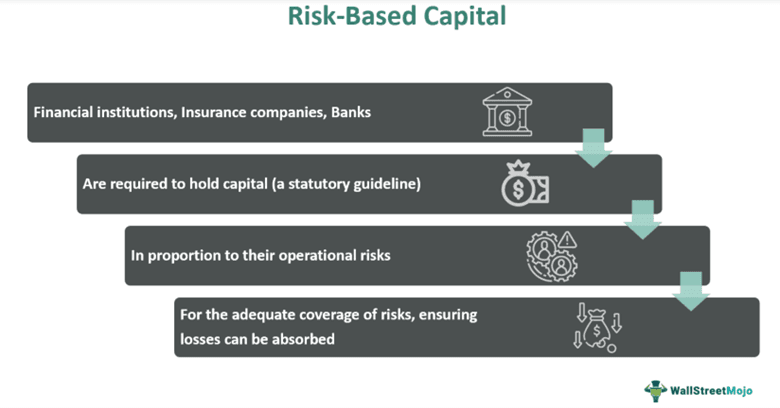
The risk-based capital framework not only protects financial institutions, banks, and insurers but also safeguards the financial interests of investors, clients, market participants, etc. In the banking and insurance industry, maintaining adequate capital as a buffer against losses is a statutory requirement. RBC cushions operational losses and protects insurers from insolvency. It is based on business volume, size, and the risks associated with an entity’s assets and operations.
Key Takeaways
- Risk-based Capital refers to the funds set aside by insurers, banks, and financial institutions in proportion to the operational risks they face while conducting business. It is a statutory requirement and part of robust risk management frameworks.
- In the US, the risk-based capital framework was established by the National Association of Insurance Commissioners (NAIC) to ensure entities maintain the minimum level of capital required to manage an insurer’s risk exposure.
- Many countries have customized RBC guidelines. It has three main components: capital adequacy, capital requirements, and risk-weighted assets.
- As Solvency II specifically applies to insurers in the European Union, it differs from RBC in terms of its purpose, with risk assessment and capital adequacy being at its fore.
Risk-Based Capital Explained
Risk-based capital is a statutory requirement where a defined amount of funds must be held by companies, banks, insurance companies, and other financial and depository institutions to ensure they remain solvent in times of a financial crisis. This reserve improves their financial stability and safeguards entities from varied risks, such as fraud, process/system failures, legal issues, non-compliance problems, etc. It is as important as handling credit risks or market risks. It defines how effective an entity’s risk management processes are and whether it will be able to survive a period of financial or economic crisis.
Capital Adequacy, Capital Requirements, and Risk-weighted Assets are the three components that make up an RBC framework. Together, these three ensure entities hold enough capital to mitigate the risks associated with their business, operations, and assets.
Insurance risk-based capital, a distinct requirement, accounts for all the risks that insurance companies might face. They maintain capital to mitigate such risks and protect their business from losses, insolvency, and penalties. The higher the risk, the higher the capital requirements. Hence, business size and volume and the existing risk management systems govern how much capital an entity will be required to maintain as RBC.
Two types of risks are primarily associated with the insurance business:
- Insurance Risks: These are connected to insurance policies and claims. They include mortality, lapse, and expense risks.
- Financial Risk: These are associated with an insurer’s financial and investment decisions. They include interest rate, spread, foreign exchange, and equity risks.
Risk-based capital adequacy regulations were introduced in the 1980s when the US encountered savings and loan difficulties. In the US, RBC standards are created by the National Association of Insurance Commissioners (NAIC). The model enforces that insurers must hold a minimum level of capital based on their risk exposure.
Following the US example, countries like Japan, Canada, Australia, and many others created their risk-based capital regulations. Each country has independent processes and a risk-based capital formula, which helps them customize the risk-based capital regulations according to their financial systems and requirements. Based on the changes witnessed in the insurance, banking, and financial sectors, RBC regulations are revised and updated to increase their effectiveness.
Requirements
It is evident that RBC guidelines are important from the point of view of ensuring compliance and maintaining financial stability. In this section, let us decode the concept further and understand how these requirements are defined.
- Capital requirements scope: The capital requirements are classified into two tiers: Tier 1 Capital and Tier 2 Capital. Tier 1 Capital includes retained earnings, disclosed reserves, and common stock. Tier 2 Capital comprises subordinated debt and other forms of capital.
- Statutory minimum maintenance requirement: Maintaining a minimum level of capital based on an insurance company’s size and the degree of weighted risks associated with its operations and financial assets is a statutory requirement.
- Adequacy of reserves: Entities must hold capital equivalent and commensurate to the risks they face in business.
- Regulatory standards: It is enforced as a regulatory standard, which means a company is not necessarily required to hold the full capital amount to meet its obligations as long as the objectives of compliance and financial stability are met.
- Additional capital: An additional capital requirement layer called a capital conservation buffer is needed. It offers a cushion against losses and minimizes insolvency risks.
- Countercyclical capital buffer: There is another risk-based capital layer called the countercyclical capital buffer that banks and depository institutions must hold to sustain high credit growth cycles. It acts as a mechanism to mitigate systematic crisis risks.
Examples
Risk-based capital is predominant in the insurance sector. Let us study some examples to understand the concept.
Example #1
Suppose a newly formed insurance company, FinSure, has multiple financial risks, such as mortality risk, lapse risk, equity risk, foreign exchange risk, and spread risks. Now, the risk-based capital for FinSure must be proportionate to the risks it undertakes in business.
To arrive at the right figure, Stacy, a senior executive at FinSure, used the Value at Risk (VaR) technique. It denotes the maximum loss FinSure can incur at a given time, along with a specific confidence level. There are two methods to calculate the risk-based capital.
- Internal Model Approach: Here, the VaR is the 99.5th percentile value of loss caused by each risk.
- Stress Testing: In this method, the value of assets and liabilities is first calculated on base assumptions and recalculated later on stressed assumptions. The difference between them is the risk-based capital directed from a particular risk. For instance, if FinSure has a 9% interest rate as a base assumption and a 3% stressed assumption at a 99.5% confidence level, the risk-based capital will be derived from the gap between the assets and liabilities measured at 9% and 3%.
Based on this information, Stacy decided to implement a risk mitigation strategy and ensure full compliance with regulatory requirements. She also considered underwriting process improvements, investment portfolio diversification, and hedging to mitigate the risks FinSure faced.
Example #2
In July 2023, Hong Kong announced a risk-based capital regime. The Insurance (Amendment) Ordinance 2023, enacted by the legislative council, changes the requirements insurers must meet as part of compliance. A new risk-based capital regime was implemented for insurers in Hong Kong under the principles issued by the International Association of Insurance Supervisors.
Hong Kong has a rule-based capital adequacy regime that considers premium income and insurance liabilities, while evaluating an insurance company’s capital adequacy requirements. The new RBC regime will replace this. Per the new rules, insurance companies will be required to maintain capital reserves in proportion to the risks they undertake in business. These newly introduced guidelines will require insurance companies to consider their asset-liability positions, risk profiles, and solvency needs, among other things while computing the RBC figure. The new regime is expected to come into effect in 2024.
This illustrates why risk-based capital is needed to combat operational risks in business and retain the confidence of the various parties involved.
Advantages
Based on the discussion in the section above, it can be seen that RBC offers distinctive advantages to various entities and stakeholders. In this section, we will study these benefits.
- It applies to banks, financial institutions, corporations, and other legal entities involved in financial markets. In this manner, it covers a nation’s economy, administering processes that promote financial stability.
- Companies gain the strength required to sustain and survive financial crises, ensuring they are financially prepared to face potential risks in business at all times.
- RBC helps companies avoid possible insolvency, losses, and financial distress through the availability of adequate funds at any given point in time.
- It improves the financial stability, market standing, and operational reliability of entities.
- It is part of a risk management structure that enables banks and financial institutions to stay afloat and compliant at all times.
Risk-Based Capital Vs. Solvency 2
The key differences between RBC and Solvency 2 (Solvency II) are given below.
- RBC is the financial regulation for banks, companies, and depository institutions to maintain a certain amount of funds to match the level of risks. Solvency II is a prudential regime that applies to insurance firms in the European Union.
- RBC provides a random or time-specific evaluation of capital levels. However, Solvency II follows a one-year capitalization time frame for evaluation.
- RBC was adopted by the National Association of Insurance Commissioners in 1993. In contrast, Solvency II was introduced in the European insurance sector in January 2016.
- As per NAIC, in the US, the risk-based capital for life insurance accounts for five types of risks – asset risk, business risk, underwriting risk, interest rate risk, and insurance risk. In comparison, Solvency II mainly focuses on underwriting, market, and operational risks.
Frequently Asked Questions (FAQs)
What are the disadvantages of risk-based capital (RBC) guidelines?
Some disadvantages of RBC that can weaken risk management practices, hamper administrative oversight, and impact the stability of financial systems include:
- Possible variations in the capital level designated by regulatory bodies compared to actual requirements
- Challenges due to untimely reporting and monitoring of risk profiles
- Non-compliance risks brought on by institutions that do not adhere to the required standards
What is a risk-based capital (RBC) ratio?
A risk-based capital ratio enables entities to measure capital adequacy in terms of the risks they are exposed to in business. Weights are assigned to each risk associated with an entity’s assets, outlining the risk-weighted assets. The ratio is obtained by dividing the institution’s total adjusted capital by these risk-weighted assets.
What is the role of risk-based capital (RBC) in ensuring effective risk management practices?
It ensures effective risk management by quantifying risk exposure, defining capital requirements, and assessing risk profiles to arrive at the right RBC figure. It promotes risk management and enhances oversight to enable entities to achieve financial stability.
What is a good risk-based capital ratio for a bank?
The ideal risk-based capital ratio for banks is a combination of Tier 1 and Tier 2 capital. A bank is considered financially resilient if it has a Tier 1 ratio of 8% or more. The total risk-based capital ratio should be at least 10% with a Tier 1 leverage ratio of at least 5%.