


Introduction
Every year, thousands of Big 4 auditors at Deloitte, PwC, EY, and KPMG look at their 80-hour busy seasons and wonder whether investment banking offers a faster, more lucrative path forward. The move from Big 4 audit to investment banking is possible, but it is rarely direct. Recruiters at bulge bracket and boutique banks generally view straight audit experience as a more challenging starting point, since audit work centers on verification rather than deal execution. That does not make the transition impossible. It means the path usually runs through an intermediate step, a sharper technical skill set, and a networking effort that most auditors underestimate.
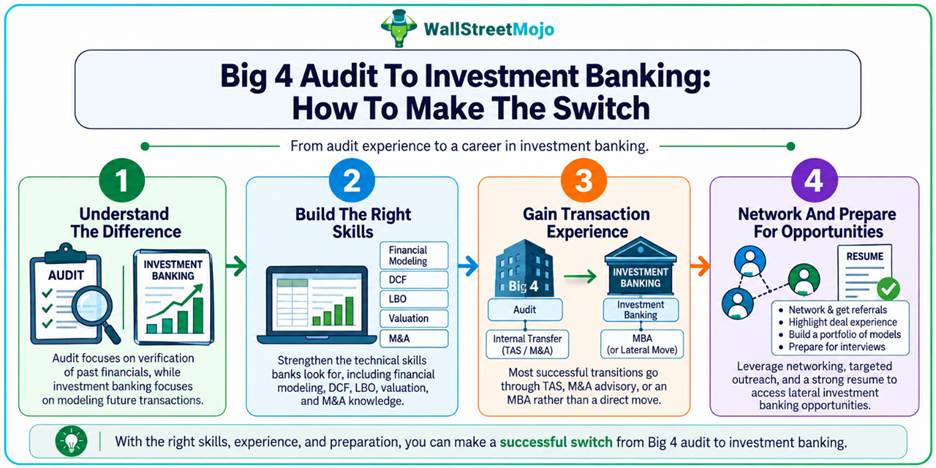
This article breaks down exactly how the Big 4 audit-to-investment-banking transition works in 2026, including the internal groups that can shorten the distance, the skills banks actually screen for, and how compensation compares at each stage. It also compares the two most common preparation routes: self-directed practice and structured financial modeling training. This comparison can help auditors choose the approach that best fits their goals before committing months of after-work hours to the transition.
Key Takeaways
- The switch from Big 4 audit to investment banking is possible, but the typical pathways include TAS, M&A advisory, or an MBA rather than a direct move.
- Auditors need to strengthen financial modeling, DCF, LBO, valuation, and M&A skills before pursuing banking roles.
- Internal TAS or M&A transfers can provide valuable transaction exposure and shorten the gap between audit and investment banking.
- Networking, referrals, and targeted outreach are important for accessing lateral investment banking opportunities.
- A strong resume should quantify deals, sectors, transaction values, and relevant financial due diligence experience.
- A structured portfolio of completed financial models can provide tangible evidence of technical skills during interviews and networking.
Why Big 4 Audit Professionals Consider Investment Banking
Auditors typically pursue investment banking for three reasons: significantly higher compensation ceilings, faster exposure to deal-driven work, and a shorter path to exit opportunities in private equity, corporate development, and venture capital.
Becoming a partner at a Big 4 firm typically takes 12 to 15 years and requires sustained business development alongside technical delivery.
At a similar career stage, total partner compensation can still fall below what a VP at a middle-market investment bank can earn. Audit work is largely retrospective, focusing on testing what has already happened in a company’s financials. Banking work, by contrast, is prospective, focusing on modeling what could happen next, such as a merger, leveraged buyout, or capital raise.
For professionals who enjoy accounting mechanics but want to apply that knowledge to live transactions, the Big 4 audit to investment banking switch can be a logical next step. It shifts the focus from historical verification toward analyzing what could happen next.
Why Direct Audit-To-IB Moves Are Rare
Audit sits furthest from actual deal execution among Big 4 service lines. Most successful transitions route through Transaction Advisory Services (TAS), M&A advisory, or an MBA program rather than moving straight from audit into a banking analyst seat.
Banks recruiting laterally want candidates who can build a three-statement model, run a DCF, and support live due diligence without a long ramp-up period. This makes the Big 4 audit to investment banking transition more challenging for candidates without transaction experience. Pure audit experience demonstrates strong accounting fundamentals and attention to detail.
However, it does not demonstrate valuation work, deal structuring, or transaction modeling. This is why career guidance from experienced practitioners consistently points auditors toward an internal transfer to a transaction-focused team first.
The table below outlines the main pathways from audit into investment banking and their relative difficulty.
| Path from Audit | What It Involves | Relative Placement Difficulty |
| Audit → Direct IB Lateral | Applying to banking roles straight from an audit seat | Hardest; success depends almost entirely on networking |
| Audit → Internal TAS/M&A Transfer → IB | Moving to Transaction Advisory Services or an internal M&A group before lateraling out | Moderate; TAS experience is viewed as closer to deal work |
| Audit → MBA → IB | Using a full-time MBA to reset the recruiting narrative | Moderate to strong; on-campus recruiting opens direct banking pipelines |
| Audit → Boutique/Middle-Market Bank | Targeting smaller banks with less rigid pedigree requirements | More accessible entry point, though deal flow may be thinner |
Internal transfer to a Big 4 firm’s Transaction Advisory Services or internal M&A advisory group tends to shorten the distance the most. This is because these teams handle actual financial due diligence, valuation support, and deal execution rather than historical financial statement testing.
The Skills Gap Between Audit And Investment Banking
Auditors bring strong accounting knowledge and financial statement literacy. However, they typically lack hands-on experience in financial modeling, DCF and LBO valuation, and M&A deal mechanics, which are the core technical skills banks test for in lateral interviews. Closing these gaps is essential for a competitive Big 4 audit to investment banking transition.
Audit training builds a deep understanding of how the income statement, balance sheet, and cash flow statement connect, along with strong Excel and documentation discipline. What it does not build is the ability to construct a fully integrated financial model from scratch, apply a weighted average cost of capital, or structure sources and uses for a leveraged buyout. Interviewers routinely test these gaps directly, asking candidates to walk through a DCF or explain how a debt paydown affects an LBO’s IRR.
The table below highlights the key skills auditors typically develop and how they compare with the technical requirements of investment banking:
| Skill Area | Typical Big 4 Audit Exposure | Investment Banking Requirement |
| Financial Statement Analysis | Strong (core of the audit function) | Strong (foundational, not differentiating) |
| Three-Statement Modeling | Limited or no direct exposure | Essential, tested in every technical interview |
| DCF and Trading Comps Valuation | Rare, unless in TAS | Core deliverable for pitch books and fairness opinions |
| M&A / LBO Modeling | Minimal | Central to deal execution work |
| Deal Process Exposure | Indirect, through audit client engagements | Direct, hands-on across every live mandate |
This is the gap structured financial modeling training is built to close. WallStreetMojo’s Investment Banking Master Program (IBMP) is sequenced to move learners from accounting and Excel foundations through financial modeling, DCF valuation, and integrated M&A and LBO modeling. These are the core technical skills that banking interviewers probe when evaluating an auditor’s readiness for deal work.
For a candidate coming from audit, that structured sequence matters more than random practice. After all, interviewers can usually tell the difference between someone who has built a full model end-to-end and someone who has only watched one built.
Compensation Comparison: Big 4 Audit vs Investment Banking
Compensation can also be a significant factor for professionals considering the Big 4 audit to investment banking transition. In India, AmbitionBox reports a typical salary range of of ₹14 lakh to ₹15.5 lakh per year for investment banking analysts with 0-4 years of experience. For audit associates having 5-6 years of experience, the typical annual salary range is ₹6.1 lakh to ₹6.8 lakh. These figures give a broad indication of the compensation difference. That said, they cover different experience ranges and should not be treated as a like-for-like comparison.
In the U.S., Indeed reports an average base salary of about $81,547 per year for audit associates. Investment banking compensation varies substantially by level and bonus structure, so the overall difference depends on seniority, firm, and market conditions. These figures are therefore best viewed as an indication of the compensation landscape rather than a definitive comparison.
Building the Case: Resume And Networking Strategy
A successful audit-to-banking resume translates verification-heavy experience into transaction-focused outcomes. A successful resume for the Big 4 audit to investment banking switch translates verification-heavy experience into transaction-focused outcomes.
Networking is also an important channel for accessing lateral banking opportunities, alongside traditional job applications.
Lateral banking opportunities are often filled through networking and referrals, making professional outreach an important part of the transition. Auditors should identify Big 4 alumni who have already moved into banking, as these professionals can provide useful perspective on the experience gap that hiring teams may assess.
For example, a resume line such as “performed financial due diligence on various transactions” is relatively generic. A stronger version quantifies the number of deals, sectors covered, and transaction values, giving recruiters a clearer picture of the candidate’s transaction experience. Professionals moving from Big 4 audit to investment banking should emphasize measurable transaction experience rather than simply listing audit responsibilities.
Candidates who have supplemented their audit background with formal financial modeling and valuation training, evidenced through a certificate or a portfolio of completed models, give networking conversations something concrete to point to rather than an unverified claim of interest.
The interview narrative matters just as much as technical preparation. Interviewers understand why auditors may want a change, but a stronger narrative explains what the candidate learned in audit and why banking is the logical next step. The goal is to present the transition as a deliberate progression rather than an escape from audit.
Realistic Timeline for the Transition
A Big 4 audit-to-investment-banking transition typically requires six to eighteen months of networking, technical skill-building, and interview preparation alongside a full-time audit role.
A realistic sequence begins with the first year focused on performing well in the audit role while gradually building relationships with bankers. Where available, candidates can also pursue an internal transfer to Transaction Advisory Services (TAS) or an internal M&A group to gain more transaction-focused experience.
Months twelve through eighteen can then shift toward active outreach and more structured interview preparation. This may include fifty or more networking emails and two dozen or more calls, alongside focused preparation in financial modeling, DCF, and LBO mechanics. Candidates pursuing the MBA route instead typically transition into a two-year full-time program, with on-campus recruiting providing a structured path into investment banking.
Conclusion
The path from Big 4 audit to investment banking rewards preparation over impatience. Auditors who route through TAS, an internal M&A group, or a targeted MBA can strengthen their transition prospects. Closing the financial modeling and valuation skills gap ahead of interviews is also important. Candidates who take these steps are more likely to see stronger outcomes than those who apply cold.
Building that technical foundation through a structured, case-study-based program, such as WallStreetMojo’s Investment Banking Master Program (IBMP), gives candidates a portfolio of completed models to discuss during networking conversations and interviews. This provides tangible evidence of their skills and helps make their career transition more credible.
Frequently Asked Questions
Can you go straight from Big 4 audit to investment banking?
It happens, but rarely. Most practitioners recommend moving through Transaction Advisory Services, an internal M&A advisory group, or an MBA program first. This is because direct audit-to-IB moves are considered a harder jump by banking recruiters.
What skills do Big 4 auditors need to learn before applying to investment banking?
Auditors generally need to build financial modeling, DCF valuation, trading comparables, and M&A or LBO modeling skills, since audit work rarely provides hands-on exposure to these areas.
How long does the Big 4 audit to investment banking transition usually take?
Most successful transitions take six to eighteen months of concurrent networking and technical preparation while still working full-time in audit.
Does an MBA help auditors break into investment banking?
For candidates evaluating how to switch from Big 4 audit to investment banking, an MBA can provide a structured recruiting pathway when direct lateral opportunities are limited. MBA resets the recruiting narrative and provides access to on-campus banking recruitment pipelines, which is why it is one of the more reliable routes for candidates without prior deal experience.
Is investment banking pay significantly higher than Big 4 audit pay in India?
Generally, yes, particularly from the associate level onward, where investment banking total compensation includes a bonus component that scales with deal performance, while Big 4 audit pay remains largely fixed.
What is the easiest internal move within a Big 4 firm to prepare for investment banking?
Transitioning into Transaction Advisory Services (TAS) or an internal M&A advisory group is typically viewed as the closest experience to actual banking work. These teams handle valuation support and deal execution rather than historical financial statement testing.