


Introduction
Financial modeling is a valuable technical skill in finance as it supports careers in investment banking, equity research, corporate finance, private equity, FP&A, and valuation. Employers increasingly expect candidates to build three-statement models, perform valuations, create forecasts, and analyze business scenarios using Microsoft Excel instead of simply understanding financial concepts.
According to the U.S. Bureau of Labor Statistics, employment of financial analysts is projected to grow 6% from 2024 to 2034, faster than the average for all occupations, highlighting the continued demand for professionals with strong financial modeling and valuation skills.
The growing demand has resulted in hundreds of online financial modeling courses. This is making it difficult for beginners to determine which program is worth the investment.
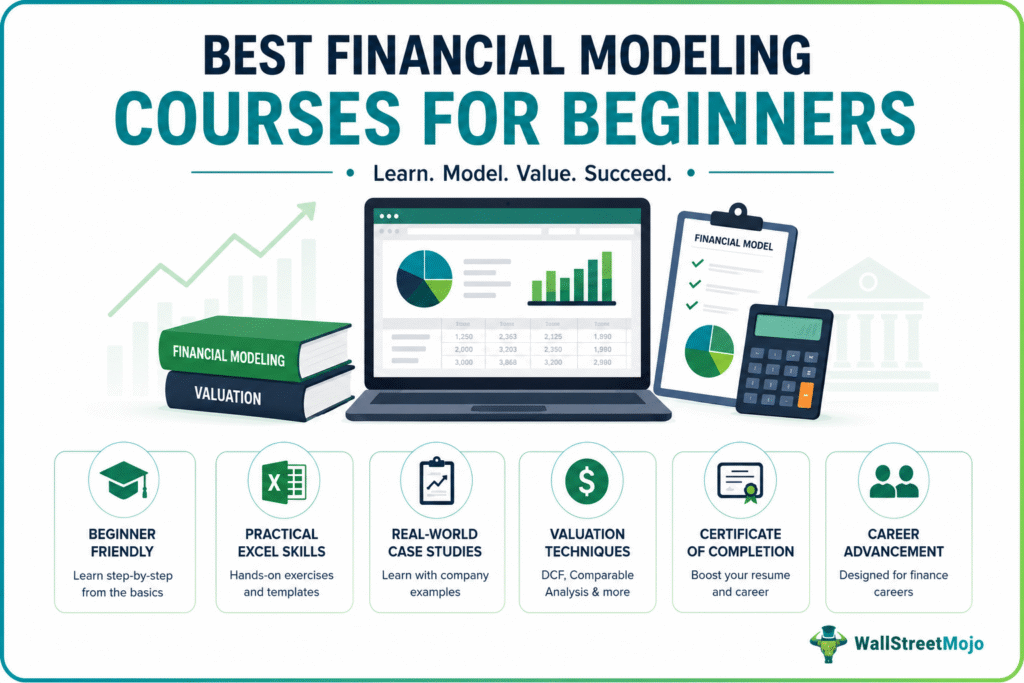
The best financial modeling courses for beginners in 2026 do not focus solely on theory. They teach practical Excel modeling, accounting fundamentals, valuation techniques, and real-world case studies. Ideally, the program you opt for should also align with your long-term career goals, whether that is investment banking, corporate finance, or financial analysis.
This guide compares the best financial modeling courses for beginners and explains the features that matter most. Moreover, it highlights common mistakes beginners make, and helps you select the right learning path for your career.
Key Takeaways
- Choose a financial modeling course that aligns with your career goals. Don’t base your decision solely on popularity or certification.
- Prioritize hands-on projects, real company case studies, and practical modeling over theory-based learning.
- Master Excel, accounting, and three-statement modeling before progressing to valuation, forecasting, and advanced financial models.
- Compare curriculum, valuation coverage, instructor expertise, and career relevance before enrolling in any of the best financial modeling courses for beginners.
- Strong financial modeling skills open opportunities in investment banking, equity research, corporate finance, FP&A, and valuation.
- Avoid choosing courses based only on price or certificates; practical skills and real-world projects deliver greater career value.
- A structured learning path helps beginners build job-ready skills more effectively than studying isolated topics through separate courses.
What Is A Financial Modeling Course?
A financial modeling course teaches learners how to build Excel-based financial models that forecast a company’s future performance and estimate its value.
Most beginner-friendly programs cover these topics:
- Financial statement analysis
- Excel for finance
- Three-statement modeling
- Forecasting assumptions
- Discounted Cash Flow (DCF) valuation
- Comparable company analysis
- Scenario and sensitivity analysis
- Presentation and formatting best practices
These skills are widely used by professionals working in the following areas:
- Investment banking
- Equity research
- Corporate finance
- FP&A
- Private equity
- Credit analysis
- Business valuation
Understanding these fundamentals makes it easier to evaluate the best financial modeling courses for beginners in 2026 based on your career goals and learning requirements.
How to Choose the Best Financial Modeling Course
Not every course is designed for the same audience. Beginners should evaluate programs using the following criteria:
| Evaluation Factor | Why It Matters |
| Beginner-friendly curriculum | Makes learning easier without prior modeling experience |
| Hands-on Excel exercises | Practical application builds confidence |
| Real company case studies | Simulates actual analyst work |
| Valuation coverage | Required for investment banking and equity research |
| Industry relevance | Helps during interviews and on the job |
| Instructor expertise | Learning from experienced finance professionals improves understanding |
| Career support | projects and certificates add value |
Using these evaluation criteria will help you confidently identify the best online financial modeling courses for beginners that offer practical, job-ready skills.
Best Financial Modeling Courses for Beginners Online Compared (2026)
The comparison below highlights some of the best financial modeling courses for beginners online, allowing you to compare curriculum, certificates, pricing, and career outcomes before making a decision.
| Course | Provider | Best For | Certificate | Pricing Model | Key Topics | Beginner Friendly |
| Financial Modeling & Valuation Course | WallStreetMojo | Investment Banking, Equity Research, Corporate Finance | ✔ Yes | One-time purchase | Excel, Accounting, Financial Modeling, DCF, Relative Valuation, Case Studies | ⭐⭐⭐⭐⭐ |
| FMVA® (Financial Modeling & Valuation Analyst) | Corporate Finance Institute | Corporate Finance Professionals | ✔ Yes | Annual Subscription | Excel, Modeling, FP&A, Valuation, Presentation & Visuals | ⭐⭐⭐⭐☆ |
| Financial Modeling & Valuation Certification | Wall Street Prep | Investment Banking Aspirants | ✔ Yes | One-time purchase | Financial Modeling, Valuation, M&A, LBO | ⭐⭐⭐⭐☆ |
| Financial Modeling Course | Breaking Into Wall Street | IB Recruiting | ✔ Yes | One-time purchase | 3-Statement Models, DCF, M&A, LBO | ⭐⭐⭐⭐☆ |
Note: Course duration, pricing model, and curriculum may change over time. Always verify details on the provider’s official website before enrolling.
Students pursuing analyst roles should compare the best financial modeling courses for beginners in investment banking based on practical modeling exercises, valuation coverage, and real-world case studies.
1. WallStreetMojo Financial Modeling & Valuation Course
This course is ideal for Students who want one structured program covering Excel, accounting, financial modeling, valuation, and practical projects.
Instead of learning isolated topics from multiple courses, individuals often benefit from following a single learning path. The Financial Modeling & Valuation Course by WallStreetMojo is designed around that philosophy.
Highlights
- Covers Excel from a finance perspective
- Financial statement analysis
- Three-statement modeling
- DCF valuation
- Comparable company analysis
- Forecasting
- Scenario analysis
- Real company case studies
- Practical assignments
- Certificate of Completion
- 3-Year access
- Self-paced learning
- Learn from an Ex-JPMorgan analyst
Ideal For
- Commerce students
- MBA students
- CFA candidates
- Aspiring Investment Bankers
- Equity Research Analysts
- Corporate Finance professionals
Explore the Financial Modeling & Valuation Course to build practical modeling skills with structured projects and valuation case studies.
2. Corporate Finance Institute FMVA®
The FMVA® (Financial Modeling & Valuation Analyst) program from Corporate Finance Institute is a well-known online certification that covers financial modeling, valuation, and corporate finance concepts.
What It Includes
- Multiple finance courses
- Excel
- Financial Modeling
- Budgeting
- Forecasting
- FP&A
Pros
- Recognized certification
- Comprehensive, self-paced curriculum
Cons
- Subscription pricing means continued access depends on an active membership.
- The breadth of the curriculum can feel overwhelming for learners who only want financial modeling.
3. Wall Street Prep Financial Modeling & Valuation Certification
Wall Street Prep is a popular training provider offering financial modeling and valuation courses for aspiring investment banking professionals.
Pros
- Strong investment banking focus
- Advanced modeling standards
- Practical valuation exercises
- M&A modeling
- LBO basics
Best For
Candidates already familiar with accounting and Excel who want to prepare for investment banking interviews. And Students specifically targeting front-office investment banking roles.
What It Covers
- Three-statement models
- DCF
- Comparable companies
- M&A
- LBO
Detailed Comparison
| Feature | WallStreetMojo | CFI FMVA | Wall Street Prep | BIWS | Valuation Master Class |
| Financial Modeling | ✔ | ✔ | ✔ | ✔ | ✔ |
| DCF Valuation | ✔ | ✔ | ✔ | ✔ | ✔ |
| Comparable Valuation | ✔ | ✔ | ✔ | ✔ | ✔ |
| Practical Projects | ✔ Extensive | ✔ | ✔ | ✔ | ✔ |
| Certificate | ✔ | ✔ | ✔ | ✔ | ✔ |
| Beginner Friendly | ⭐⭐⭐⭐⭐ | ⭐⭐⭐⭐☆ | ⭐⭐⭐⭐☆ | ⭐⭐⭐⭐☆ | ⭐⭐⭐⭐☆ |
Which Financial Modeling Course Should You Choose?
Choose a course based on your goals rather than simply selecting the most popular provider.
| Goal | Recommended Course |
| End-to-End Finance Learning Across Multiple Career Paths | Financial Modeling & Valuation Course by WallStreetMojo |
| Corporate Finance, FP&A & Financial Analysis | FMVA® by Corporate Finance Institute |
| Investment Banking Financial Modeling | Wall Street Prep |
| Investment Banking Interview Preparation | Breaking Into Wall Street |
Common Mistakes Beginners Make
Many learners struggle because they focus on certificates rather than practical skills.
Common mistakes when choosing a program for learning include:
1. Choosing The Cheapest Course
Price should not be the only deciding factor. Practical projects and instructor quality often provide greater long-term value.
2. Ignoring Accounting
Even the best Excel skills cannot compensate for weak accounting knowledge.
3. Memorizing Instead Of Building
Watching videos is not enough. The fastest learners repeatedly rebuild financial models from scratch.
4. Skipping Valuation
Some courses teach Excel extensively but spend little time explaining how businesses are valued. For careers in investment banking or equity research, understanding valuation is crucial.
5. Not Building A Portfolio
Employers increasingly ask candidates to demonstrate modeling ability through projects rather than relying solely on certifications.
6. Choosing A Certificate Over Practical Learning
The best financial modeling course for beginners with a certificate should include real-world financial modeling and valuation projects. A completion credential alone isn’t enough.
Avoiding these mistakes will help you gain maximum value from the best online financial modeling courses for beginners and build practical modeling skills faster.
Who Should Take a Financial Modeling Course?
Financial modeling is valuable for:
- Undergraduate commerce students
- MBA students
- CFA candidates
- CA aspirants
- Investment banking professionals
- Equity research analysts
- FP&A professionals
- Corporate finance executives
- Entrepreneurs evaluating business performance
Even professionals working outside traditional finance can benefit from understanding forecasting and valuation.
Whether you are a student or a working professional, the best financial modeling courses for beginners can help you build a strong foundation for finance careers.
Why Beginners Should Prioritize Structured Programs
Many beginners make the mistake of starting with advanced valuation techniques before mastering accounting and Excel.
A stronger learning sequence is:
- Accounting fundamentals
- Excel proficiency
- Financial statements
- Three-statement modeling
- Forecasting
- Valuation
- M&A and investment banking applications
Programs that follow this progression typically produce better long-term learning outcomes.
Before attempting complex LBO or merger models, beginners should master the fundamentals.
1. Excel for Finance
Key topics include:
- IF statements
- INDEX MATCH or XLOOKUP
- SUMIFS
- Dynamic formulas
- Named ranges
- Financial formatting
- Keyboard shortcuts
Strong Excel skills significantly improve modeling efficiency.
2. Accounting Fundamentals
Understanding how the income statement, balance sheet, and cash flow statement connect is essential before building forecasts.
3. Three-Statement Modeling
This is the foundation of every advanced financial model.
Students learn to:
- Build historical statements
- Forecast revenue and expenses
- Link financial statements
- Calculate free cash flow
4. Business Valuation
Beginners typically learn the following business valuation methods:
- Discounted Cash Flow (DCF)
- Trading Comparables
- Transaction Comparables
5. Scenario Analysis
Analysts rarely create only one forecast. Professional models usually include:
- Base Case
- Best Case
- Downside Case
Employers value candidates who understand sensitivity analysis and business assumptions.
Why the Right Learning Path Matters
Following the learning sequence discussed above is often easier with a structured program rather than learning each topic separately via individual courses.
Such a program combines Excel, accounting, valuation, and investment banking concepts into a single roadmap.
A comprehensive curriculum also provides a smoother learning experience. It is especially beneficial for learners pursuing careers in investment banking, valuation, equity research, or corporate finance.
The Investment Banking Master Program (IBMP) by WallStreetMojo is designed around this progression. It combines financial statement analysis, advanced Excel, financial modeling, valuation techniques, and investment banking concepts into a structured learning path. Because the program focuses on practical modeling exercises and real-world applications, it helps beginners build job-ready skills while preparing for analyst-level roles.
Conclusion
The best financial modeling courses for beginners are those that develop practical Excel skills and teach financial modeling concepts systematically. Moreover, they provide opportunities to apply learning through real-world projects. A structured curriculum that follows the right learning sequence can help beginners build stronger fundamentals and gain practical, job-ready skills.
For beginners pursuing careers in investment banking, equity research, corporate finance, or valuation, following the right learning sequence can reduce the learning curve and accelerate career readiness. Investing time in mastering financial modeling today can create long-term opportunities across the finance industry.
Frequently Asked Questions
Which is the best financial modeling course for beginners?
The best course depends on your career goals. Beginners should prioritize programs that teach accounting, Excel, three-statement modeling, forecasting, and valuation through practical exercises. When comparing the best financial modeling courses for beginners, focus on structured learning, hands-on projects, instructor expertise, and career relevance rather than price alone.
Do I need accounting knowledge before learning financial modeling?
Basic accounting knowledge is highly recommended because financial models are built around the relationships between the income statement, balance sheet, and cash flow statement.
Can I learn financial modeling without an MBA?
Yes, many investment banking analysts, equity researchers, and FP&A professionals learn financial modeling through specialized online courses and practical projects rather than formal MBA programs.
How long does it take to learn financial modeling?
Most beginners can develop a solid foundation within two to four months of consistent study and practice. That said, mastering advanced modeling techniques takes longer.
Is financial modeling still a valuable skill in the age of AI?
Yes, while AI can accelerate calculations and automate repetitive tasks. Professionals still need to build assumptions, interpret outputs, validate models, and make strategic business decisions.
Are financial modeling certificates worth it?
Yes, financial modeling certificates can strengthen your resume and demonstrate your commitment to developing practical finance skills. However, employers generally value hands-on experience and the ability to build financial models more than the certificate itself. Choosing the best financial modeling course for beginners with a certificate is beneficial when it combines structured learning, real-world case studies, and practical projects that prepare you for finance roles.