


Introduction
Most beginners who try to learn financial planning and analysis fast end up doing the opposite. They jump between random YouTube tutorials, unrelated Excel templates, and disconnected resources instead of following a structured learning path that reflects how FP&A works in real organizations.
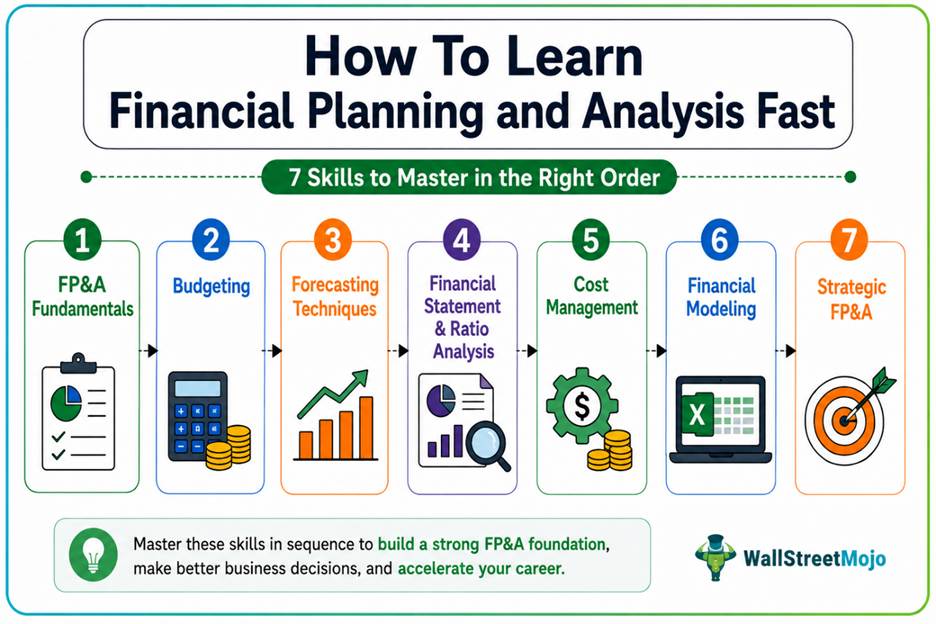
The best way to learn financial planning and analysis fast is to follow a logical learning sequence that builds one skill upon another instead of mastering disconnected tools or topics.
This guide compares the three most common learning approaches, explains the sequence beginners should follow, and shows how a structured learning path can help you become job-ready in less time.
Before exploring the fastest learning path, it is important to understand the common mistakes that prevent beginners from making steady progress.
Key Takeaways
- Follow a structured learning sequence instead of jumping between random resources.
- Master FP&A fundamentals before moving to advanced financial modeling.
- Learn budgeting, forecasting, and financial statement analysis in the correct order.
- Build practical skills through case studies, Excel templates, and hands-on projects.
- Certifications can wait; practical FP&A skills matter more for beginners.
- Consistent practice and a structured roadmap help you become job-ready faster.
Common Mistakes That Slow Down Beginners
Individuals who try to learn financial planning and analysis fast typically fall into one of three traps:
1. Learning Tools Before Frameworks
Many beginners jump straight into Excel formulas or Power BI dashboards instead of first understanding the FP&A cycle, which includes planning, budgeting, forecasting, variance analysis, and reporting. Without this foundation, the tools become difficult to apply effectively in real-world business scenarios.
2. Studying Financial Modeling Before Financial Statements
Learners who cannot read a balance sheet or interpret key liquidity and profitability ratios often struggle to build reliable three-statement models or discounted cash flow (DCF) models. Copying templates without understanding the underlying financial statements rarely develops practical modeling skills.
3. Treating FP&A And Financial Accounting As Interchangeable
Although the two functions are closely related, they serve different purposes. FP&A focuses on budgeting, forecasting, and supporting business decisions. On the other hand, financial accounting emphasizes recording historical transactions and ensuring regulatory compliance. Confusing these roles can lead to weak interview responses and an inefficient learning path.
Avoiding these common mistakes is only half the equation. Choosing the right learning approach is equally important if you want to learn financial planning and analysis fast as a beginner.
The Fastest Path to Learn Financial Planning and Analysis: Three Options Compared
Beginners generally weigh three routes before committing time and money. The table below compares each option based on learning structure, cost, templates or downloadable resources, certification, and the time required to become job-ready.
| Learning Path | Structure | Cost | Templates or Downloadable Resources | Certification | Time to Job-Ready |
| Free YouTube videos + blogs | None; scattered by topic | Free | Rarely included | No | Slowest; high risk of knowledge gaps |
| Multiple standalone courses | Inconsistent sequencing across providers | Higher overall cost | Partial, non-uniform | Varies | Moderate; duplication of effort |
| Structured FP&A course (e.g., Financial Planning & Analysis Course by WallStreetMojo) | Phased: fundamentals → forecasting → cost management → modeling → strategic FP&A | Single fixed fee | Downloadable resources/ templates, and case study with practical examples | Certificate of completion | Fastest for most beginners |
Whether you choose to learn financial planning and analysis fast online through free resources or a structured course, following a logical learning sequence is essential for building practical, job-ready skills. Free resources cost nothing upfront but often require learners to organize forecasting, budgeting, cost management, and financial modeling topics on their own.
The Best Way to Learn Financial Planning and Analysis Fast: Master the Right Skills First
Beginners who want to learn financial planning and analysis fast should master the following skills in sequence rather than studying topics randomly.
- FP&A Fundamentals: Learn the FP&A cycle, understand how FP&A differs from financial accounting, and become familiar with the typical responsibilities of an FP&A professional.
- Budgeting: Study fixed, flexible, zero-based, activity-based, and master budgeting techniques, along with the key differences between budgeting and forecasting.
- Forecasting Techniques: Understand common forecasting methods, including time series analysis and regression analysis, and learn how to select the most appropriate technique for different business scenarios.
- Financial Statement and Ratio Analysis: Develop the ability to interpret the income statement, balance sheet, and cash flow statement. Learn to evaluate business performance using liquidity, profitability, efficiency, and solvency ratios.
- Cost Management: Build a strong understanding of job order costing, process costing, activity-based costing, standard costing, and cost-volume-profit analysis.
- Financial Modeling: Understand the role of financial modeling in FP&A, learn the prerequisites, build multi-period financial projections, and perform discounted cash flow (DCF) valuation.
- Strategic FP&A: Learn capital budgeting techniques such as net present value (NPV), internal rate of return (IRR), and payback period. Also, understand FP&A’s role in mergers and acquisitions (M&A) and financial risk management.
How a Structured Course Compresses the FP&A Learning Curve
A structured, sequenced course removes the guesswork that slows self-taught learners down. The Financial Planning & Analysis Course by WallStreetMojo follows the exact seven-stage sequence outlined above. The course is directed by Dheeraj Vaidya, CFA, FRM, a former JPMorgan and CLSA analyst who has trained more than 100,000 finance professionals.
The emphasis on practical application helps learners connect theory with real-world business scenarios. Through downloadable Excel templates, real case studies, and a structured learning sequence, the course enables beginners to build job-ready FP&A skills progressively rather than learning isolated concepts.
Upon successful completion, learners receive a certificate of completion that validates their training. As they gain professional experience, they can decide whether pursuing an industry certification such as the FPAC aligns with their long-term career goals.
FP&A Career Outlook and Earning Potential
Demand for FP&A professionals is supported by the broader outlook for financial analysts. According to the U.S. Bureau of Labor Statistics, employment of financial analysts is projected to grow 6% between 2024 and 2034. This represents faster growth than the average for all occupations. The BLS also projects approximately 29,900 job openings each year, on average, reflecting continued demand for professionals with strong financial analysis and decision-support skills.
As of July 2026, FP&A analysts in the US earn $66,417 per year, on average, whereas in India, the average annual salary for the same position is ₹10.6 lakh.
Beyond building practical skills and gaining experience, some individuals choose to pursue industry certifications to strengthen their credentials.
Professional certifications such as the Certified Corporate FP&A Professional (FPAC) can add value later in your career, but they are not essential when you’re just starting out. Most beginners benefit more from first building practical skills in budgeting, forecasting, financial statement analysis, cost management, and financial modeling before deciding whether to pursue a certification.
Conclusion
Learning financial planning and analysis fast is less about consuming more content and more about following the right sequence: fundamentals, budgeting, forecasting, statement analysis, cost management, modeling, and strategic application.
Beginners who skip steps end up relearning them later, which defeats the purpose of speed.
A structured course with case studies and practical examples, for example WallStreetMojo’s Financial Planning & Analysis Course, gives learners that sequence built in, along with downloadable resources and a certificate that supports job applications. Reviewing the curriculum is a reasonable next step before committing to a self-taught path.
Frequently Asked Questions
How long does it take to learn financial planning and analysis fast as a beginner?
Most beginners can build a solid foundation in FP&A within 40 to 60 hours of focused study by following a structured learning path. This includes developing core skills in budgeting, forecasting, financial statement analysis, cost management, and financial modeling. However, becoming proficient in advanced financial modeling, discounted cash flow valuation, and real-world business analysis requires continued practice through case studies and hands-on projects.
Do I need a finance degree to learn FP&A?
No, a finance degree is not required to learn FP&A. While a bachelor’s degree in finance, accounting, or a related field can make it easier to understand core concepts, beginners from other educational backgrounds can also learn financial planning and analysis fast online by following a structured learning path that starts with the fundamentals.
Is FPAC certification worth it for someone just starting in FP&A?
FPAC can be a valuable credential, but it is not essential for someone just starting in FP&A. Beginners typically benefit more from first building practical skills in budgeting, forecasting, financial statement analysis, cost management, and financial modeling. Once you have gained relevant work experience and a strong foundation in FP&A, you can evaluate whether pursuing the FPAC aligns with your long-term career goals.
What is the difference between FP&A and financial accounting?
FP&A is forward-looking and supports business decisions through budgeting, forecasting, and modeling. On the other hand, financial accounting is historical and focused on recording transactions and regulatory compliance.
Can I learn financial modeling before learning FP&A fundamentals?
It is possible, but not efficient. Financial modeling assumes familiarity with financial statements, ratio analysis, and cost behavior. So, skipping fundamentals typically produces models built on shaky assumptions.
What tools do FP&A professionals use daily?
Excel remains the primary tool for budgeting, forecasting, and financial modeling. It is often supplemented by pivot tables, dashboarding tools, and increasingly, AI-assisted workflows for scenario analysis and reporting automation.