


Introduction
Most beginners who try to learn investment banking fast waste months on the wrong sequence. They watch scattered YouTube tutorials, skim a few online articles, and attempt a discounted cash flow model before they understand how the three financial statements connect. The result is a shallow, disorganized skill set that falls apart the moment a recruiter asks a technical follow-up question.
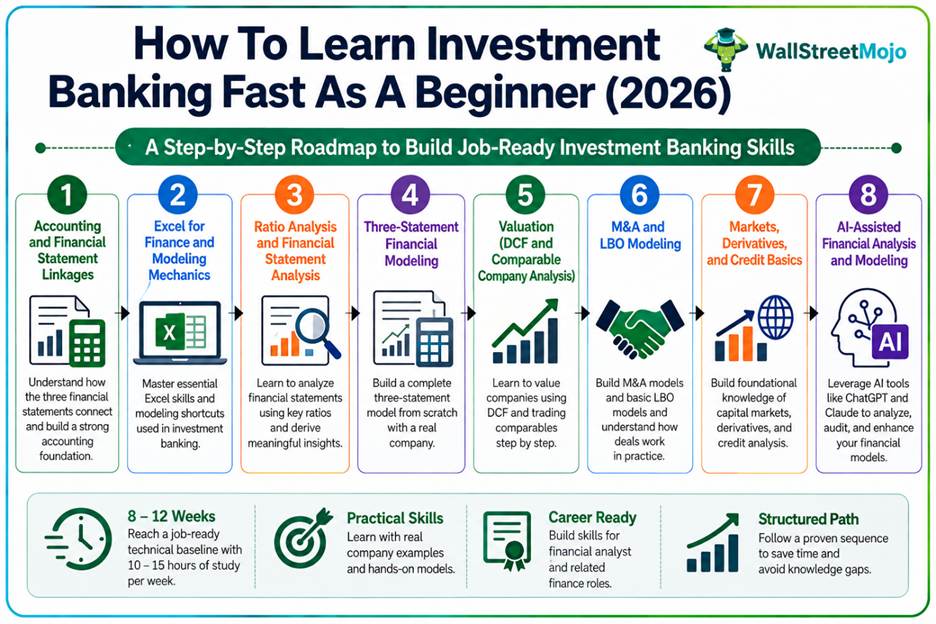
To learn investment banking fast, you need a structured learning path rather than a rushed approach. The sequence includes accounting, financial modeling, valuation, and deal mechanics, in the order recruiters and analysts use them on the job.
This article breaks down how to learn investment banking fast as a beginner and compares the main learning routes available in 2026. Moreover, it identifies the mistakes that quietly waste the most time. Readers will leave with a clear, prioritized roadmap and the criteria to evaluate any course or program before committing to it.
Key Takeaways
- A structured learning path helps beginners build investment banking skills in the right sequence without wasting time on advanced topics too early.
- Accounting, Excel, and three-statement modeling provide the foundation for valuation, M&A, and LBO modeling.
- Ratio analysis, markets, derivatives, and credit basics broaden the technical skills needed for investment banking.
- Rebuilding financial models from scratch improves retention more effectively than passively watching modeling tutorials.
- A disciplined beginner can reach a job-ready technical baseline in roughly 8 to 12 weeks with consistent study and practice.
- AI-assisted financial analysis and modeling can complement traditional investment banking skills and modern analyst workflows.
What Beginners Actually Need To Learn First
Beginners should master accounting fundamentals and three-statement modeling before touching valuation techniques like DCF or comparable company analysis. This is because every valuation model depends on a correctly built financial statement structure. Building this foundation is essential for beginners who want to learn investment banking fast without creating gaps in their technical knowledge.
A common beginner mistake is starting with advanced topics like leveraged buyouts or M&A modeling. Investment banks do not test candidates that way. Interview technicals almost always begin with accounting logic. For example, candidates may be asked how a $10 depreciation expense flows through the income statement, balance sheet, and cash flow statement before advancing to modeling and valuation. Skipping this foundation is a major reason self-taught learners often plateau.
The sequence below shows how beginners learn investment banking through a structured progression:
- Accounting and financial statement linkages
- Excel for finance and modeling mechanics
- Ratio analysis and financial statement analysis
- Three-statement financial modeling
- Valuation: DCF and comparable company analysis
- M&A and LBO modeling
- Markets, derivatives, and credit basics
- AI-assisted financial analysis and modeling
Programs built around this exact sequence, such as WallStreetMojo’s Investment Banking Master Program (IBMP), tend to save beginners’ time. This is because the curriculum order removes the guesswork of “what to study next.”
Comparison: The Four Realistic Ways To Learn Investment Banking
Beginners generally choose between four paths. Each has a real trade-off in speed, depth, and credibility, and no path is objectively “best” for everyone. The table below compares these four learning paths for beginners who want to learn investment banking fast.
| Learning Path | Typical Time to Job-Ready | Structured Sequence? | Certification | Best Suited For |
| Free YouTube + blogs | 6–12 months (inconsistent) | No | No | Early exploration, budget-constrained learners |
| University finance degree | 2-4 years | Partially | Degree | Career switchers with time and funding |
| Specialized IB course/bundle (e.g., Wall Street Prep, Breaking Into Wall Street, CFI FMVA, WallStreetMojo IBMP) | 2-4 months | Yes | Yes | Beginners targeting analyst roles within a year |
| Self-taught from textbooks only | 8-14 months | No | No | Highly disciplined self-learners with finance background |
Structured, paid programs consistently compress the timeline because they remove trial-and-error. Beginners who rely on scattered free content often spend extra time deciding what to study next and filling knowledge gaps. In contrast, a sequenced program provides a clear learning path, with each topic building on the previous one.
Comparing Investment Banking Course Providers
Since course choice is often the deciding factor in how fast a beginner progresses, it helps to compare providers on the dimensions that matter most: curriculum breadth, case study depth, and instructor credibility. The table below compares these providers based on curriculum breadth, case study depth, instructor background, and key strengths and limitations:
| Provider | Core Focus | Instructor Background | Notable Strength | Notable Limitation |
| Wall Street Prep | Modeling and valuation, corporate training | Wall Street practitioners | Practical investment banking modeling training | More focused on modeling and valuation than broader markets topics |
| Breaking Into Wall Street (BIWS) | Modeling, technical interview prep | Investment banking and finance professionals | Strong technical interview preparation | Less emphasis on markets/derivatives |
| CFI (FMVA) | Broad finance certification | Finance professionals and subject-matter experts | Broad finance and financial modeling curriculum | Broader finance focus rather than investment-banking specialization |
| WallStreetMojo IBMP | End-to-end IB, modeling, markets, M&A, derivatives | Dheeraj Vaidya, CFA, FRM, former analyst at JPMorgan and CLSA | Comprehensive end-to-end investment banking curriculum with modeling, valuation, M&A, LBO, markets, derivatives, and AI workflows. | Best suited to learners wanting one consolidated program rather than standalone modules |
Dheeraj Vaidya’s background as a former analyst at JPMorgan and CLSA adds relevant industry credibility. His experience brings practical investment banking and financial modeling exposure to the training.
Programs like the Investment Banking Master Program (IBMP) fold accounting, financial modeling, DCF, M&A, LBO, and derivatives into a single sequenced bundle. This reduces the need to piece together separate courses from different providers.
Mistakes That Waste The Most Time
Certain learning mistakes can significantly slow down beginners who want to learn investment banking fast. Let us look at the most common mistakes.
- Jumping straight to LBO or M&A modeling: Not mastering the three-statement model first results in repeated backtracking.
- Treating Excel shortcuts as optional: Analysts who rely on the mouse instead of keyboard shortcuts model noticeably slower under deadline pressure.
- Ignoring markets and derivatives: Many beginners focus only on modeling and are caught off guard by interview questions on bond pricing, forex, or hedging basics.
- Passive video-watching without rebuilding models from scratch: Retention is weaker when learners watch a DCF model being built instead of reconstructing it independently.
- No credential or certificate to validate the effort: Recruiters and hiring managers use certificates as a filtering signal, especially for candidates without a traditional finance pedigree.
A Realistic Roadmap to Learn Investment Banking Fast
A disciplined beginner can reach a job-ready technical baseline in roughly 8 to 12 weeks by following a fixed sequence rather than an open-ended list of resources. The roadmap below outlines what to learn at each stage and the skills to develop along the way:
| Weeks | Focus Area | Milestone |
| 1–2 | Accounting fundamentals, statement linkages | Explain how a transaction flows through all three statements |
| 3–4 | Excel modeling mechanics, formatting standards | Build a clean three-statement model from a blank sheet |
| 5–6 | DCF and comparable company valuation | Independently value a public company end-to-end |
| 7–8 | M&A modeling and accretion/dilution | Build a basic merger model |
| 9–10 | LBO modeling and credit basics | Build a simplified LBO with debt schedules |
| 11–12 | Markets, derivatives, AI workflows, mock interviews | Apply AI to financial analysis and modeling while answering technical and markets questions |
This timeline assumes 10 to 15 focused hours of study per week. The skills developed through this roadmap can prepare beginners for financial analyst and related finance roles.
Conclusion
If you want to learn investment banking fast, following a structured learning path and ensuring consistent practice is imperative. Start with accounting and Excel, then progress to financial modeling, valuation, and deal modeling. After that, build on these skills with market knowledge, AI-assisted workflows, and interview practice. Beginners who skip foundational steps often have to relearn concepts later, slowing their overall progress.
Programs such as WallStreetMojo’s Investment Banking Master Program (IBMP) can shorten this curve by combining the full sequence in one place. Review the current curriculum and access details directly on the program page before enrolling.
Frequently Asked Questions
How long does it take to learn investment banking as a beginner?
Most disciplined beginners can reach a job-ready technical baseline in 8 to 12 weeks. This covers accounting, three-statement modeling, valuation, M&A, and basic LBO modeling. The timeline assumes 10 to 15 focused hours of study per week.
Can I learn investment banking without a finance degree?
Yes, many analysts enter investment banking through structured courses and certifications rather than a finance degree. That said, strong Excel fluency and accounting literacy remain non-negotiable regardless of academic background.
What is the fastest way to learn financial modeling for investment banking?
The fastest way is to rebuild three-statement models and DCF valuations from scratch rather than only watching tutorials. This is because active reconstruction reinforces retention far more than passive viewing.
Is a certification necessary to break into investment banking?
A certification is not strictly required, but it functions as a credibility signal for recruiters, especially for candidates without a traditional finance pedigree or prior banking internship.
What topics do investment banking interviews test most?
Interviews typically test accounting logic, statement linkages, valuation methodology (DCF, comps, precedent transactions), and basic markets and derivatives knowledge, roughly in that order of frequency.
How much do investment banking analysts earn?
The compensation varies based on different factors like the company, location, and experience level of the individual. On average, in the USA, investment banking analysts earn $119,962 as of September 01, 2026. In India, the compensation for the same designation is ₹14 lakh/yr to ₹15.5 lakh/yr for 0-4 years of experience.