


Introduction
Every company that raises capital, evaluates an acquisition, or forecasts next year’s revenue relies on someone who can translate financial statements into decisions. That person is a financial analyst, and demand for this role continues to outpace many other business occupations.
According to the U.S. Bureau of Labor Statistics, financial analyst positions are projected to grow 6% between 2024 and 2034. This estimated growth is faster than the average for all occupations, with roughly 29,900 openings expected each year.
So, how does someone actually become a financial analyst? In short, the path requires a bachelor’s degree and hands-on skills in accounting, ratio analysis, financial modeling, and valuation.
Moreover, it requires familiarity with Excel-based and increasingly AI-assisted analysis, and a portfolio of practical work that proves competence before the first job offer arrives. This guide breaks the journey into a step-by-step roadmap covering education, certifications, tools, and the mistakes that slow candidates down. It is written for career switchers, recent graduates, and anyone asking how to build an illustrious career as a financial analyst with no experience.
This financial analyst roadmap focuses on building practical skills in the right order, helping learners develop confidence before moving to advanced finance topics.
Key Takeaways
- Start with accounting and Excel before learning financial modeling and valuation.
- Build practical skills through real-world projects and financial models.
- Learn DCF, comparable company analysis, and M&A modeling to strengthen technical expertise.
- Certifications enhance credibility but should complement hands-on experience.
- AI tools like ChatGPT and Claude are becoming essential for modern financial analysts.
- A structured financial analyst roadmap improves job readiness and accelerates career growth.
What Does a Financial Analyst Actually Do?
A financial analyst evaluates financial data to guide investment, budgeting, or corporate decisions. Analysts examine financial statements, build forecasting models, assess company valuations, and prepare reports that inform whether to buy, hold, or sell an asset, or whether a business should pursue a specific strategy.
The role splits broadly into buy-side analysts, who work for institutional investors such as hedge funds and pension funds, and sell-side analysts, who support banks and brokerages in advising clients. Related specializations include investment analysts, portfolio managers, and financial risk specialists. Across all these variations, the core skill set remains constant: interpreting numbers and communicating what they mean for future performance.
A structured financial analyst learning plan helps learners master the right concepts in the right order instead of trying to learn everything at once.
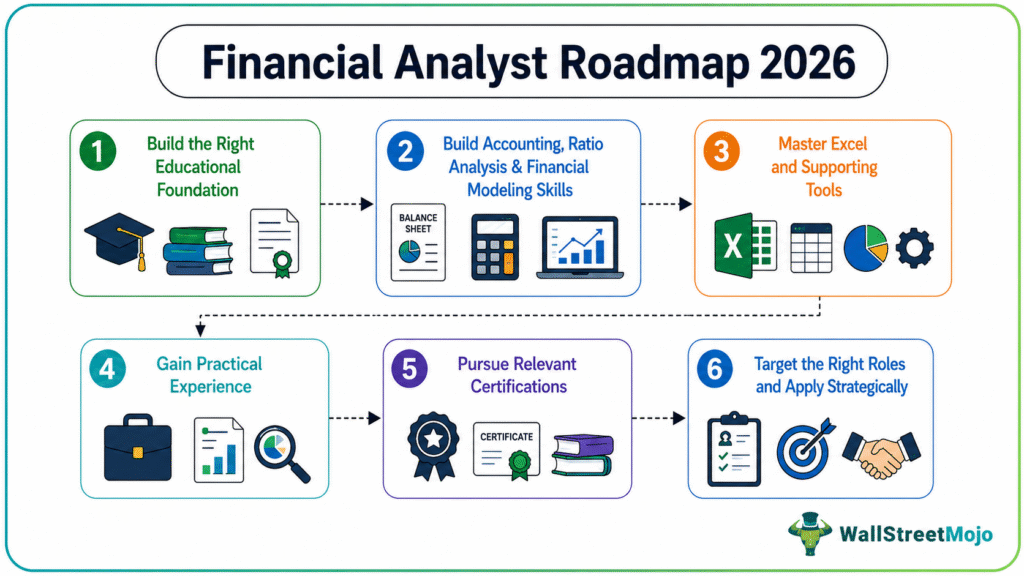
Financial Analyst Roadmap: Step-by-Step Learning Path
This financial analyst roadmap is designed for beginners, career switchers, and graduates who want a structured path into finance.
Step 1: Build the Right Educational Foundation
Most entry-level financial analyst roles require a bachelor’s degree, commonly in finance, accounting, economics, or business administration. Some employers favor candidates with a master’s degree, particularly for roles in investment banking or asset management. A finance-adjacent degree is not mandatory, but candidates without one typically need to demonstrate equivalent technical skill through certifications and projects.
For most learners, a financial analyst roadmap for beginners should start with accounting fundamentals before progressing to financial modeling and valuation.
Step 2: Build Accounting, Ratio Analysis, and Financial Modeling Skills Together
This is the step most self-taught candidates underestimate. Employers do not just test financial modeling skills. They also assess whether candidates can read financial statements, calculate key ratios, and translate those insights into reliable financial forecasts.
Analysts need working fluency in accounting fundamentals, liquidity and profitability ratio analysis, three-statement modeling, discounted cash flow (DCF) analysis, comparable company analysis (trading comps), and increasingly, basic M&A modeling.
A structured, project-based program accelerates this stage far more effectively than scattered YouTube tutorials.
The Financial Analyst Fast Track Program, taught by Dheeraj Vaidya, CFA, FRM, a former J.P. Morgan and CLSA equity analyst, sequences this exact learning path across 83+ hours.
It begins with Excel for Finance and accounting fundamentals, progresses to ratio analysis, a complete three-statement financial model using McDonald’s, DCF valuation, comparable company (trading comps) analysis, and M&A modeling. The program concludes with practical training on using ChatGPT and Claude for AI-assisted financial modeling and model audits.
Programs structured this way compress months of trial-and-error into a guided curriculum with downloadable Excel templates and multiple course certificates, which matters when a candidate needs a portfolio-ready model before an interview rather than fragmented knowledge across a dozen sources.
At this stage of the financial analyst roadmap, technical proficiency becomes essential because Excel and analytical tools are used daily by finance professionals.
Step 3: Master Excel and Supporting Tools
Excel remains the backbone of financial analysis. Analysts should be comfortable with formulas, sensitivity tables, pivot tables, NPV/IRR calculations, and circular reference management within models.
Beyond Excel, growing familiarity with Power BI for dashboarding and Python for data-heavy analysis is increasingly valued, though not always required for entry-level roles. Employers increasingly expect candidates to understand how AI tools such as ChatGPT and Claude can review formulas, audit financial models, and automate routine analysis. As a result, many structured training programs now integrate AI-assisted workflows into their curriculum rather than treating them as optional add-ons.
Step 4: Gain Practical Experience
Building real-world projects and experience is often the biggest differentiator for anyone pursuing a financial analyst career path.
Internships, part-time analyst roles, or self-initiated valuation projects on public companies all count as experience. Analyzing a real company’s 10-K and 10-Q filings and building an independent DCF valuation gives candidates something concrete to discuss in interviews, even without formal work history.
A complete financial analyst roadmap includes practical experience alongside technical training because employers value applied skills as much as theoretical knowledge.
Step 5: Pursue Relevant Certifications
Certifications signal commitment and technical depth, particularly for candidates transitioning from another field. The following table compares some of the most recognized options based on their focus areas.
| Certification | Provider | Typical Focus |
| CFA Charter | CFA Institute | Investment analysis, portfolio management, ethics |
| FMVA | Corporate Finance Institute | Financial modeling and valuation |
| Financial Analyst Fast Track Program (FAFTP) | WallStreetMojo | Excel, accounting, ratios, financial modeling, DCF, comps, M&A, AI workflows |
While certifications differ in their focus and time commitment, today’s employers increasingly value programs that combine core finance concepts with practical AI-assisted workflows.
The CFA charter, administered by CFA Institute, requires passing three exam levels plus 4,000 hours of qualified work experience over a minimum of three years, making it a longer-term investment suited to candidates already committed to investment management.
For those seeking a complete, job-ready skill stack faster, a sequenced program that starts at accounting basics and ends at AI-assisted modeling is often the more practical starting point, with certifications like CFA layered on later for career advancement.
A complete financial analyst roadmap should balance technical knowledge, recognized credentials, and hands-on projects so candidates are prepared for real-world analyst responsibilities.
Step 6: Target the Right Roles and Apply Strategically
The final stage of this financial analyst roadmap focuses on translating technical knowledge into interview-ready skills and job applications.
Entry-level titles to search include junior financial analyst, research associate, and financial planning and analysis (FP&A) analyst. Tailoring a resume to highlight specific modeling and valuation projects, rather than generic coursework, consistently performs better with recruiters screening for technical readiness.
Learners who follow a financial analyst roadmap step by step are generally less likely to overlook foundational concepts or jump into advanced topics too early.
Common Mistakes to Avoid
Avoiding the following common mistakes can help you build the right skills faster and improve your job readiness:
- Relying only on theory without building an actual financial model
- Ignoring Excel and accounting proficiency in favor of certifications alone
- Applying broadly without a portfolio project to reference in interviews
- Underestimating how long the CFA path takes relative to job-market timelines
- Skipping practice with real company filings and AI-assisted workflows before interviews
Conclusion
A well-designed financial analyst roadmap in 2026 reflects today’s hiring expectations, where accounting, Excel, financial modeling, valuation, and AI skills work together.
Following a structured financial analyst roadmap helps learners build skills in the right sequence, making the transition into finance more efficient. Education provides the foundation, but accounting fluency, financial modeling, and valuation skills determine who actually gets hired.
Candidates who combine a degree with hands-on modeling practice, whether through self-study, certification, or a sequenced program like the Financial Analyst Fast Track Program by WallStreetMojo, consistently move faster from learning to job offer. The next step is simple: pick one company, build one model, and start proving the skill rather than just studying it.
Frequently Asked Questions
How long does it take to complete a financial analyst roadmap?
Most candidates can become job-ready within 6 to 12 months by combining a relevant degree with a structured accounting-to-valuation program. That said, pursuing the CFA charter while working full-time typically extends the completion timeline to three years or more.
Can I become a financial analyst with no experience?
Yes, building independent valuation projects using public company filings, completing a structured program covering accounting through modeling and valuation, and applying for internships or junior analyst roles are the most effective ways to enter the field without prior work history.
Do financial analysts need to be certified?
Certification is not always mandatory, but a certificate like the one obtained after completing the Financial Analyst Training Program strengthens a resume considerably, particularly for candidates without a finance-specific degree.
What is the difference between a financial analyst and an investment banker?
Financial analysts typically evaluate investments, forecast performance, and support decision-making across industries. On the other hand, investment bankers focus specifically on raising capital and advising on mergers and acquisitions. Many investment bankers begin their careers as financial analysts.
What financial analyst skills matter most for job interviews?
Interviewers commonly test accounting fundamentals, ratio analysis, three-statement modeling logic, DCF assumptions, comparable company analysis, and Excel proficiency. Candidates should also be prepared to build and explain a live financial model rather than simply describe theoretical concepts.
Is a finance degree required to become a financial analyst?
A finance, accounting, or economics degree is common, but candidates from other backgrounds can qualify by demonstrating equivalent modeling and valuation skills through certifications, coursework, and portfolio projects.