


Introduction
Companies across banking, consulting, and Fortune 500 finance teams are hiring FP&A professionals faster than most other business roles. The U.S. Bureau of Labor Statistics projects that financial analyst positions will grow 6% between 2024 and 2034, adding roughly 29,900 openings annually. Yet many finance graduates enter the job market without the specific financial planning and analysis skills recruiters test for at the interview stage.
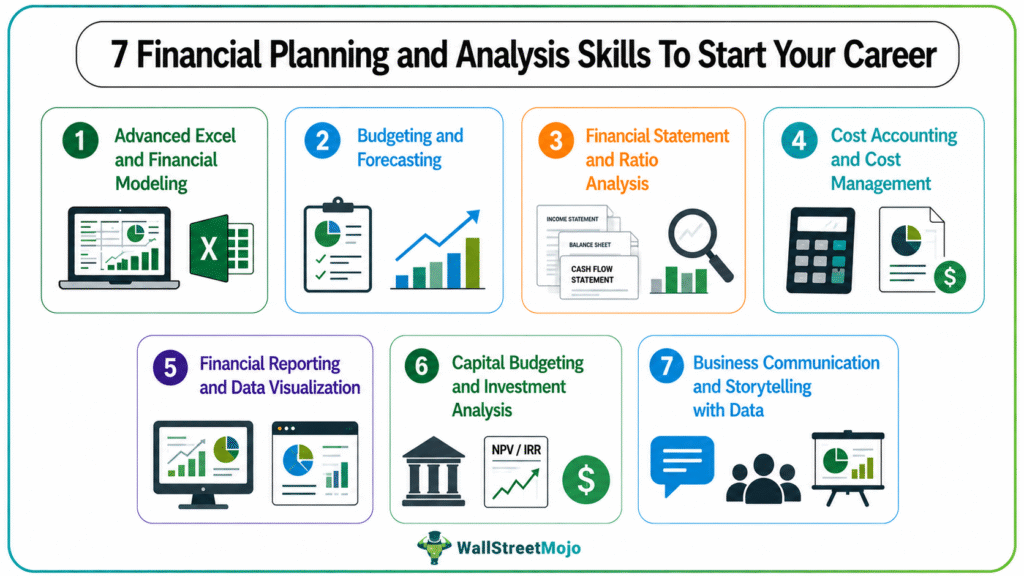
Financial planning and analysis skills refer to the technical and analytical competencies required to budget, forecast, model, and interpret financial data for business decision-making. This article breaks down the seven skills that separate a job-ready FP&A candidate from a struggling applicant and compares self-study against structured training. Moreover, it explains how each skill connects to real hiring criteria at banks, corporates, and private equity firms.
Key Takeaways
- Excel and financial modeling remain foundational FP&A skills, alongside budgeting, forecasting, and financial statement analysis.
- Capital budgeting skills such as NPV and IRR support strategic decisions involving investments, acquisitions, and capital expenditures.
- Business communication and data storytelling are essential for translating financial analysis into clear recommendations for management.
- Structured learning can accelerate FP&A skill development by connecting budgeting, forecasting, modeling, and strategic applications in sequence.
The 7 Core Financial Planning And Analysis Skills
The seven skills below form the core capabilities employers increasingly look for in FP&A candidates:
1. Advanced Excel and Financial Modeling
Excel remains the operating system of FP&A. Recruiters expect fluency in pivot tables, INDEX-MATCH, sensitivity analysis, and three-statement model construction. Building a discounted cash flow (DCF) model or a rolling forecast template is a common technical-interview requirement, not merely a supplementary skill.
2. Budgeting And Forecasting Methods
Employers test candidates on fixed, flexible, zero-based, and activity-based budgeting, along with forecasting methods such as time series and regression analysis. Knowing when to apply a rolling forecast versus a static annual budget signals real operational judgment.
3. Financial Statement And Ratio Analysis
FP&A analysts must interpret the income statement, balance sheet, and cash flow statement together. Then they must calculate liquidity, profitability, efficiency, and solvency ratios to flag performance trends before leadership asks.
4. Cost Accounting And Cost Management
Understanding job order costing, process costing, activity-based costing, and cost-volume-profit analysis helps FP&A analysts evaluate cost behavior, monitor performance, and understand the drivers behind budget and actual results.
5. Data Visualization And Financial Reporting
FP&A analysts need to present financial information in a clear, decision-useful format. Skills in Excel-based dashboards, reporting, and data visualization help turn financial data into concise insights that management can use for planning and performance evaluation.
6. Capital Budgeting And Strategic Decision Support
FP&A professionals use NPV, IRR, and payback period analysis to evaluate capital investments and support decisions involving capital expenditures, acquisitions, and other strategic initiatives. These skills help analysts quantify expected returns, assess risk, and provide decision-ready insights to management.
7. Business Communication And Storytelling with Data
FP&A analysts must translate financial analysis into clear, actionable insights for non-finance stakeholders. The ability to summarize financial performance and explain key variances help management understand what changed, why it changed, and what action may be required.
Financial Planning And Analysis Skills For Beginners: DIY vs. Structured Learning
Aspiring analysts researching financial planning and analysis skills for beginners typically choose between free scattered resources and a structured, sequenced course. The table below compares these learning paths based on coverage, practical resources, certification, and overall cost:
| Learning Path | Coverage | Templates/Case Studies | Certification | Cost |
| YouTube + free blogs | Inconsistent, no sequence | Rarely included | None | Free, but time-intensive |
| Buying individual courses separately | Fragmented across platforms | Limited overlap | Varies by provider | ₹24,000+ combined |
| WallStreetMojo Financial Planning and Analysis (FP&A) Course | Budgeting, forecasting, DCF modeling, ratio analysis, cost management, M&A, capital budgeting | Downloadable Excel templates, JPMorgan Chase case study | Certificate of completion | Single structured price |
Candidates who want to build the financial planning and analysis skills needed for real job interviews generally benefit from a sequenced curriculum rather than piecing together fragmented tutorials. Employers often test how well candidates connect different concepts, not just their knowledge of individual topics.
How To Develop Financial Planning And Analysis Skills Without Wasting Time
If you are wondering how to develop financial planning and analysis skills, the fastest route for a beginner is to follow a foundation-first sequence. Start with FP&A fundamentals and budgeting, and move into forecasting and financial statement analysis. Then, advance into cost management, dynamic modeling, and strategic FP&A applications like capital budgeting and M&A. This is precisely how the FP&A course by WallStreetMojo structures its seven-module curriculum. It helps learners avoid the common mistake of jumping straight into modeling without first mastering budgeting mechanics.
Common Mistakes Candidates Make When Building FP&A Career Skills
Many candidates focus heavily on advanced financial modeling while overlooking foundational skills such as budgeting, forecasting, and ratio analysis. Others try to learn too many tools at once without developing the ability to connect financial analysis to business decisions.
A third mistake is assuming that earning a certification or course completion certificate is enough to demonstrate job readiness. Credentials can strengthen a resume and show that a candidate has completed structured learning, but employers still expect candidates to demonstrate practical skills in modeling, analysis, and business communication.
Conclusion
Breaking into FP&A requires more than a finance degree. It requires demonstrable, sequenced skills in budgeting, modeling, and communication that hiring managers can verify. Candidates who combine Excel fluency, forecasting knowledge, and data storytelling consistently outperform peers who rely on scattered self-study. For a structured path covering all seven skills with real case studies and templates, the WallStreetMojo Financial Planning and Analysis (FP&A) Course offers a practical starting point.
Frequently Asked Questions
What skills are needed to start a career in financial planning and analysis?
Candidates need the following skills if they wish to start a career in FP&A: – Excel modeling – Budgeting and forecasting – Financial statement analysis and ratio analysis – Cost accounting – Data visualization – Capital budgeting – Business communication
Is FP&A a good career path in 2026?
Yes, the salaries around the world for FP&A professionals suggest it remains a great career path. For example, FP&A analysts earn an average base salary of $97,547 per year in the United States based on data published on Indeed as of August 3, 2026. In India, the typical salary range is 10.1 lakh to 11.2 lakh per annum for 1-10 years of experience, according to AmbitionBox. Note that the salary varies based on different factors, like company, location, and experience.
Do I need a certification to work in FP&A?
Certification is not mandatory but strengthens candidacy. The AFP’s Certified Corporate FP&A Professional credential positions holders as trusted financial experts and advisors within their organizations, and course completion certificates earned by completing structured programs serve a similar resume purpose for entry-level candidates.
What is the difference between a financial analyst and an FP&A analyst?
An FP&A analyst focuses specifically on budgeting, forecasting, and internal planning cycles. That said, a general financial analyst role may involve investment analysis, valuation, or external-facing research depending on the employer.
How long does it take to learn financial planning and analysis skills?
A structured course covering budgeting, forecasting, financial statement analysis, and modeling typically takes 10 to 15 hours of focused study. That said, building genuine job-readiness through templates and case studies often takes several weeks of practice.
Which tools should FP&A beginners learn first?
Excel remains foundational for FP&A, followed by Power BI or Tableau for dashboarding. Python can then help automate repetitive reporting and data-processing tasks, particularly in large organizations.
What skills are needed to start a career in financial planning and analysis?
The key skills needed to become an FP&A analyst include Excel modeling, budgeting and forecasting, financial statement and ratio analysis, cost accounting, data visualization, capital budgeting, and business communication.