


Introduction
Financial analysts remain among the most sought-after professionals across finance, banking, private equity, consulting, and fintech. Organizations are increasingly relying on data-driven decision-making and AI-assisted financial analysis. As a result, recruiters are looking for candidates who combine strong finance fundamentals with practical analytical and technology skills.
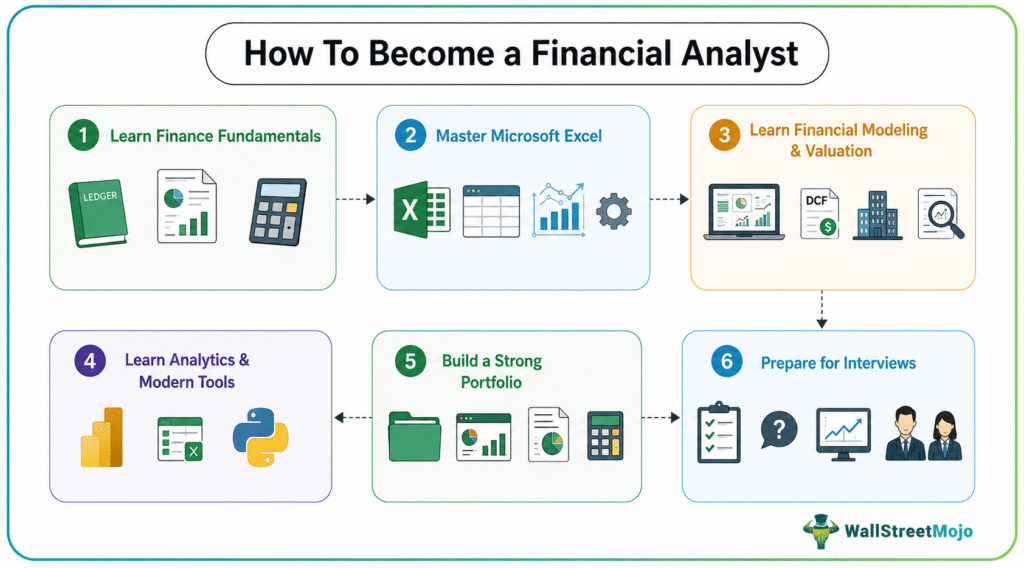
If you’re wondering how to become a financial analyst, understanding the skills, qualifications, and practical experience employers value is the best place to start.
A financial analyst evaluates financial data, builds valuation models, and forecasts business performance, Moreover, they analyze investments and provide recommendations that influence strategic business decisions.
A finance degree still remains valuable in 2026. That said, employers now prioritize practical skills in Excel, financial modeling, Power BI, and AI over degrees. Understanding these evolving expectations is essential for anyone planning a career in finance. That’s exactly why going through the sections below is essential.
This guide explains how to become a financial analyst in 2026, covering the skills employers expect, salary trends, career progression, and certifications worth pursuing. Moreover, it offers a practical learning roadmap. So, precisely, it includes everything you need to launch a successful career as a financial analyst.
Key Takeaways
- Build strong accounting fundamentals before learning financial modeling and valuation.
- If you are wondering how to become a financial analyst in India or any other country, master Excel, financial modeling, and valuation to become job-ready.
- Develop Power BI, Python, and AI skills to meet evolving employer expectations.
- Build a portfolio using real-world finance projects to showcase practical expertise.
- Practice technical and behavioral interviews to improve your hiring prospects.
- Prioritize practical skills and project experience over certifications alone.
What Does A Financial Analyst Do?
A financial analyst analyzes financial information to support business, investment, and strategic decisions. Typically, the responsibilities of such professionals are extensive. Some of them are as follows:
- Analyzing financial statements
- Building financial models
- Forecasting revenue, costs, and cash flows
- Performing company valuation
- Preparing management reports
- Conducting industry and competitor analysis
A few more noteworthy responsibilities are supporting budgeting and planning, creating dashboards and presentations, and evaluating investment opportunities. Also, financial analysts have to present recommendations to stakeholders.
Understanding these responsibilities is an important first step in learning how to become a financial analyst. Employers expect candidates to combine technical expertise with business acumen and strong analytical thinking.
Although the core objective remains the same, financial analysts perform different functions across industries. Let us understand this better with the help of the table below:
| Industry | Typical Role |
| Investment Banking | Financial Modeling & Valuation |
| Equity Research | Company Analysis |
| Corporate Finance | Budgeting & Forecasting |
| FP&A | Business Planning |
| Consulting | Financial Analysis |
| Private Equity | Investment Evaluation |
| Asset Management | Portfolio Analysis |
| Startups | Business Finance |
Skills Required To Become A Financial Analyst in 2026
To succeed as a financial analyst, you need a combination of technical expertise, analytical thinking, and business acumen. The following skills are among the most sought after by employers in 2026:
1. Financial Statement Analysis
Employers expect analysts to understand:
- Income Statement
- Balance Sheet
- Cash Flow Statement
- Financial ratios
- Working capital analysis
Without strong accounting fundamentals, financial modeling becomes difficult.
2. Advanced Excel
Excel remains the most important tool for finance professionals.
Key Excel skills include:
- XLOOKUP
- INDEX-MATCH
- Dynamic Arrays
- Pivot Tables
- Power Query
- Scenario Analysis
- Data Validation
- Financial functions
- Dashboard creation
Without strong Excel skills, analyzing large datasets and building reliable financial models becomes challenging.
3. Financial Modeling
Financial modeling is one of the highest-value skills employers seek.
Professionals should have practical knowledge of the following:
- Three-statement models
- Revenue forecasts
- Cost models
- DCF valuation
- Comparable Company Analysis (Comps)
- Precedent Transactions
- Sensitivity analysis
- Scenario analysis
Practical modeling experience often differentiates candidates during interviews.
4. Business Valuation
Analysts should understand multiple valuation approaches, for example:
- Discounted Cash Flow (DCF)
- Comparable Companies
- Precedent Transactions
- Asset-based valuation
- Trading multiples
5. Data Analysis & Business Intelligence
Finance is becoming increasingly data-driven. A few useful tools for professionals include:
- Power BI
- Python
- Microsoft Power Query
These tools help automate reporting and uncover business insights.
6. AI Skills
Modern finance teams increasingly use AI to improve productivity.
Noteworthy practical applications are as follows:
- Financial model documentation
- Formula generation
- Report drafting
- Industry research
- Data cleaning
- Financial forecasting support
- Investment research assistance
Candidates who know how to combine finance expertise with AI tools often gain a competitive advantage.
The next step in your journey on how to become a financial analyst involves choosing the right educational background and professional certifications.
Educational Qualifications and Certifications
A bachelor’s degree in one of the following is commonly accepted:
- Finance
- Accounting
- Economics
- Commerce
- Business Administration
- Mathematics
- Engineering (with finance skills)
Professional certifications can further strengthen a candidate’s profile.
Common options include:
| Certification | Best For |
| CFA | Investment roles |
| FMVA | Financial Modeling |
| CPA / CA | Accounting |
| FRM | Risk Management |
| MBA Finance | Leadership roles |
While certifications help, recruiters typically prioritize practical skills and demonstrable project experience.
Many professionals exploring how to become a financial analyst with no experience also want to understand the earning potential at different career stages. So, let us cover that in the next section.
Financial Analyst Salary In 2026
Financial analyst salaries vary by location, industry, experience, and technical expertise.
Financial Analyst Salary in India (2026)
According to AmbitionBox, the typical salary range for financial analysts in India with 1–7 years of experience is ₹6.4–₹7.1 LPA. Salaries generally increase with experience, skill set, employer, and industry.
| Experience | Average Salary (Approx.) in India |
| 1–3 Years | ₹5.3–₹5.9 LPA |
| 3–6 Years | ₹6.8–₹7.5 LPA |
| 6–9 Years | ₹8.4–₹9.3 LPA |
Source: AmbitionBox (Updated July 19, 2026)
Professionals with expertise in financial modeling, valuation, Excel automation, Power BI, and AI generally command stronger compensation than those with only theoretical knowledge.
Financial Analyst Salary in the United States (2026)
According to salary.com, In the US, the average annual salary for financial analysts is $68,089 as of July 21, 2026. The table below shows the salaries for a financial analyst by percentile:
| Hourly Wage | Weekly Pay | Monthly Pay | Annual Salary | |
| 25th Percentile | $30 | $1,194 | $5,175 | $62,009 |
| Average | $33 | $1308 | $5,667 | $68,009 |
| 75th Percentile | $36 | $1,426 | $6,178 | $74,130 |
Stepwise Learning Path: How to Become a Financial Analyst After Graduation
If you’re serious about learning how to become a financial analyst step by step, the roadmap below provides a structured path from building core finance knowledge to becoming job-ready.
Step #1
Learn how businesses record, classify, and report financial information. Build a strong understanding of accounting principles before moving to financial modeling or valuation. Practice the following topics regularly to strengthen your fundamentals.
- Journal entries
- Financial statements
- Ratio analysis
- Corporate finance basics
Step #2
Become highly proficient in Microsoft Excel. Learn formulas, data analysis, charts, and automation techniques. Practice with real business datasets and financial reports. Strong Excel skills improve your productivity, accuracy, and decision-making.
Here are certain things you must practice:
- Real business datasets
- Dashboards
- Financial reports
- Automation
Step #3
Learn financial modeling and valuation. Understand how to build models from scratch using real company financial data. Practice different valuation techniques to estimate a company’s intrinsic value. Focus on accuracy, logical assumptions, and clear model structure.
Here are the topics that you need to master
- Three-statement modeling
- DCF
- Comps
- Forecasting
- Sensitivity analysis
Step #4
Learn tools that improve reporting, automation, and business analysis. Start with beginner-friendly applications before progressing to advanced technologies. Develop hands-on skills by working on real business and financial datasets.
Some recommended skills are as follows:
- Power BI
- Power Query
- Basic Python
Step #5
In your portfolio, include projects that demonstrate financial analysis, modeling, and problem-solving abilities. Use real company data whenever possible to make your work more credible. Recruiters increasingly value practical projects over certificates alone.
A few examples of what you can include are as follows:
- Company valuation models
- Industry analysis
- Dashboard projects
- Budget models
- Forecasting assignments
Recruiters increasingly value demonstrable work over certificates alone.
If you’re exploring how to become a financial analyst with no experience, a portfolio of real-world financial models, valuation projects, and dashboards can help demonstrate your practical skills to employers.
Step #6
Prepare for interviews. Revise accounting concepts, valuation methods, and financial modeling techniques regularly. Practice Excel assessments and case studies using real business scenarios. Stay updated on market trends and prepare for behavioral interview questions with confidence.
Let us look at a few things you can practice to stay prepared:
- Accounting questions
- Valuation concepts
- Excel tests
- Financial modeling case studies
- Market awareness
- Behavioral interviews
Now that you have gone through the learning path, you should have a clear idea of how to become a financial analyst step by step,
Common Mistakes to Avoid
Avoiding common mistakes can accelerate your learning and improve your chances of becoming a successful financial analyst. Pay attention to the following pitfalls as you build your skills.
- Learning only concepts without projects
- Ignoring Excel
- Skipping valuation practice
- Not understanding financial statements
- Avoiding presentation skills
- Building no portfolio
- Depending entirely on AI without understanding the underlying finance concepts
Best Course to Become Job-Ready
For students and professionals aiming for investment banking, equity research, FP&A, corporate finance, or valuation roles, learning isolated topics is often insufficient. Employers expect candidates to integrate accounting, Excel, financial modeling, valuation, and AI-assisted workflows into practical business analysis.
The Financial Modeling & Valuation Core + AI Bundle by WallStreetMojo is designed around this practical approach. The program combines:
- Financial statement analysis
- Advanced Excel
- Financial modeling
- Business valuation
- AI applications in finance
- Real-world case studies
- Hands-on projects
- Portfolio development
Upon successful completion of the bundle, learners receive multiple certificates of completion that validate their skills and showcase their expertise to potential employers. So, this program can be ideal for individuals looking to become a financial analyst in India.
Conclusion
Knowing how to become a financial analyst can open the door to one of the most rewarding careers in finance for professionals who enjoy solving business problems with numbers.
As finance teams adopt AI, automation, and advanced analytics, the most successful analysts will combine traditional financial expertise with modern technical skills.
Building proficiency in accounting, Excel, financial modeling, valuation, business intelligence, and AI can create opportunities across investment banking, corporate finance, equity research, consulting, and fintech.
A structured, project-based learning path supported by practical experience offers one of the strongest foundations for launching a successful financial analyst career in 2026.
Frequently Asked Questions
Which skills are most important for financial analysts?
Some of the most valuable skills for financial analysts include financial statement analysis, Excel, financial modeling, valuation, Power BI, business communication, and analytical thinking.
Do I need CFA to become a financial analyst?
No, many entry-level financial analyst roles do not require the CFA designation. Practical experience, strong technical skills, and relevant projects can be sufficient for many corporate finance and FP&A positions.
Can AI replace financial analysts?
AI can automate repetitive tasks, but financial analysts remain essential for interpreting results, assessing business context, communicating insights, and providing strategic recommendations.
How long does it take to become a financial analyst?
If you’re wondering how to become a financial analyst, focused learning, practical projects, and consistent practice can help you become job-ready within six to twelve months. The actual time taken depends on your background and the depth of skills you develop.
How to become a financial analyst with no experience?
One can become a financial analyst in 2026 by focusing on building job-ready skills, completing real-world finance projects, creating a strong portfolio, and preparing for technical interviews. Employers usually value practical abilities over prior work experience.
Is financial analyst a good career in 2026?
Financial analysts continue to be in high demand across investment banks, corporations, consulting firms, asset management firms, and fintech companies. The role also offers strong long-term career growth, competitive salaries, and opportunities to specialize in areas like FP&A, equity research, and corporate finance. So, if you are doing research on how to become a financial analyst after graduation, you are on the right track.