


Introduction
Investment banking remains one of the most prestigious and competitive careers in finance. Despite the rise of artificial intelligence, automation, and changing capital markets, investment bankers continue to play a vital role in the financial industry. They advise clients on mergers and acquisitions, capital raising, financial restructuring, initial public offerings (IPOs), and other strategic transactions.
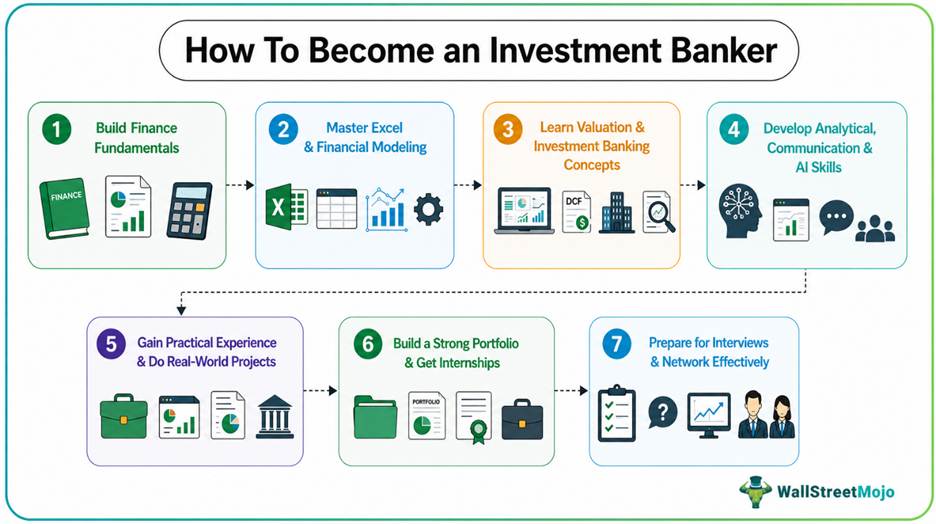
If you are wondering how to become an investment banker in 2026, the answer is straightforward: build strong financial knowledge, master valuation and financial modeling, develop analytical and communication skills, gain practical experience, and continuously learn the technologies shaping modern finance.
This guide explains how to become an investment banker step by step. It covers the required qualifications, essential skills, salary expectations, certifications, and career path. You’ll also find a practical learning roadmap that will help you get started.
Whether you are a student, commerce graduate, MBA candidate, engineer, or working professional planning a career switch, this guide provides a structured action plan to enter investment banking.
Key Takeaways
- Build a strong foundation in accounting, Excel, corporate finance, valuation, and financial modeling.
- Practical projects and a professional portfolio improve your chances of securing investment banking roles.
- Technical interview preparation is as important as developing finance and valuation skills.
- AI tools, Excel, and financial modeling are essential skills for modern investment bankers.
- Structured learning combined with hands-on practice helps you become job-ready faster.
- Continuous learning and practical experience matter more than theoretical knowledge alone.
What Does An Investment Banker Do?
An investment banker assists companies and governments in raising capital while advising them on strategic financial transactions.
Typically, the responsibilities of investment bankers include the following:
- Financial statement analysis
- Financial modeling
- Company valuation
- Pitch book preparation
Beyond financial analysis, investment bankers also play a key role in supporting strategic transactions and client advisory activities, including:
- Mergers & acquisitions or M&A
- IPO and capital raising support
- Due diligence
- Industry and market research
- Client presentations
- Deal execution
Investment bankers primarily work with:
- Investment Banks
- Private Equity firms
- Venture Capital firms
- Corporate Finance teams
- Consulting firms
- Big Four firms
- Boutique advisory firms
Common Investment Banking Divisions
| Division | Primary Responsibility |
| M&A Advisory | Buy-side and sell-side transactions |
| Equity Capital Markets | IPOs, Follow-on offerings |
| Debt Capital Markets | Bonds and debt issuance |
| Leveraged Finance | Acquisition financing |
| Restructuring | Financial turnaround advisory |
| Industry Coverage | Sector-specific client advisory |
If individuals are serious about how to become an investment banker, getting clear on these core responsibilities is where their journey starts.
Skills Required to Become an Investment Banker in 2026
Successful investment bankers combine technical finance expertise with strong analytical and interpersonal skills. The following are some of the most important skills every aspiring investment banker wondering how to become an investment banker with no experience should develop:
1. Financial Modeling
Financial modeling remains the most important technical skill.
Professionals should know how to build:
- Three-statement models
- DCF models
- Comparable company analysis
- Precedent transaction analysis
- LBO models
- Merger models
Employers increasingly expect candidates to build models from scratch instead of only understanding theoretical concepts.
2. Business Valuation
Investment bankers frequently estimate company value using methods such as the following:
- Discounted Cash Flow (DCF)
- Comparable Company Analysis (Trading Comparables)
- Precedent Transactions
- Asset-Based Valuation
- Sum-of-the-Parts Valuation
Strong valuation skills differentiate candidates during interviews.
3. Excel Expertise
Microsoft Excel remains the industry’s primary modeling tool.
Ideally, candidates should master the following:
- Advanced formulas
- INDEX-MATCH/XLOOKUP
- Dynamic arrays
- Pivot Tables
- Power Query basics
- Keyboard shortcuts
- Scenario analysis
- Sensitivity analysis
- Data visualization
4. PowerPoint and Pitch Books
Investment bankers spend significant time preparing client presentations.
Some essential presentation skills are as follows:
- Storytelling with financial data
- Creating executive summaries
- Building valuation slides
- Industry overview presentations
- Company profiles
5. Accounting Knowledge
Understanding financial statements is essential.
Candidates should confidently be able to analyze a company’s income statement, balance sheet, and cash flow statement.
They should also understand working capital, Deferred tax, depreciation, revenue recognition, and capital expenditure.
6. AI and Data Analytics
Modern investment banking increasingly incorporates AI tools.
Useful technologies include:
- ChatGPT
- Microsoft Copilot
- Python
- Power BI
- Bloomberg Terminal
- Capital IQ
- PitchBook
- FactSet
Professionals who combine finance with AI gain a competitive advantage. The next step in learning how to become an investment banker is choosing the right educational qualifications and certifications.
Educational Qualification and Certifications
Most investment bankers possess a bachelor’s degree, although certifications significantly improve employability. Common educational backgrounds are as follows:
- B.Com
- BBA
- BA Economics
- Engineering
- MBA Finance
- Chartered Accountancy
- CFA Program
- FRM (for specialized finance roles)
Recommended Certifications
The following certifications can help strengthen your investment banking knowledge and improve your career prospects:
- Financial Modeling
- Business Valuation
- Investment Banking
- Excel for Finance
- Power BI
- Python for Finance
- AI for Finance Professionals
Recruiters increasingly value practical certifications that demonstrate job-ready skills over purely theoretical knowledge.
For anyone exploring how to become an investment banker after graduation, the following roadmap offers a practical blueprint for building skills and getting job-ready.
How to Become an Investment Banker: Step-by-Step Learning Path
This learning path outlines the key stages involved in preparing for a successful career in investment banking.
Step #1
Develop a solid understanding of accounting, as every investment banking task relies on accurate financial information. Before learning valuation or financial modeling, become comfortable with how businesses prepare and interpret financial statements.
Start with the following topics:
- Financial statements
- Accounting adjustments
- Ratio analysis
Step #2
Strengthen your Excel skills because investment bankers spend a significant amount of time analyzing data and building financial models. Regular practice will improve both speed and accuracy.
Pay special attention to:
- Financial functions
- Dynamic formulas
- Dashboard creation
- Modeling shortcuts
Step #3
Build your knowledge of corporate finance to understand how organizations make financing, investment, and capital allocation decisions. These concepts are fundamental to investment banking advisory work.
Focus on learning:
- Cost of capital
- Capital budgeting
- Working capital management
- Dividend policy
- Risk-return concepts
Step #4
Learn the major valuation approaches used by investment banks to estimate a company’s value. Practice applying each technique using publicly available financial data.
The following methods are essential:
- Discounted Cash Flow (DCF)
- Trading Comparables
- Transaction Comparables
- Football Field Valuation
Step #5
Apply your knowledge by creating financial models based on real business scenarios. Practical experience is one of the best ways to improve your analytical and decision-making skills.
Consider building projects such as:
- IPO valuation models
- Startup valuation models
- Acquisition models
- M&A analysis
Step #6
Dedicate time to interview preparation by reviewing technical finance concepts and practicing common investment banking interview questions. Strong communication skills are equally important during the selection process.
Practice questions related to:
- Enterprise Value vs. Equity Value
- DCF assumptions
- WACC
- Accounting adjustments
- Merger modeling
- Technical finance concepts
- Behavioral interviews
Step #7
Build a professional portfolio that highlights your practical finance skills. A strong portfolio helps recruiters evaluate your abilities beyond your academic qualifications.
Your portfolio may include:
- Financial models
- Valuation reports
- Pitch books
- Case studies
- Industry research reports
For candidates exploring how to become an investment banker with no experience, a portfolio containing real-world finance projects can demonstrate practical expertise and improve your chances of securing interviews.
This step-by-step roadmap shows how to become an investment banker by building the technical skills, practical experience, and interview readiness employers value.
Investment Banker Salary in 2026
Investment banking remains one of the highest-paying finance careers worldwide. Compensation varies by country, firm size, deal activity, performance bonuses, and experience. In both the United States and India, bonuses often represent a significant portion of total annual compensation.
Investment Banker Salary in the United States
On average, an investment banker earns $85,905 per year as of July 1, 2026. That said, if you’re exploring how to become an investment banker after graduation, understanding the salary progression in the United States can help you set realistic career expectations. The table below outlines the estimated annual salary based on experience level.
| Salary | Level & Experience |
| $75,490 | Entry-Level (below 1 year) |
| $85,191 | Early Career (1 to 2 years) |
| $101,163 | Mid-Level (2-4 years) |
| $133,522 | Senior-Level (5-8 years) |
| $179,701 | Expert (Over 8 years) |
Some noteworthy employers in the US include:
- Goldman Sachs
- J.P. Morgan
- Morgan Stanley
- Bank of America
- Citigroup
- Evercore
- Lazard
- Moelis & Company
- PJT Partners
- Jefferies
Investment Banker Salary in India
The average yearly salary of investment bankers in India is ₹28.9 lakh. That said, Professionals exploring how to become an investment banker in India should understand the salary potential at different experience levels. So, here is a table that can provide you with a clear idea of the same.
| Average Yearly Salary | Experience |
| ₹17.1 Lakh | 0-1 |
| ₹22.6 Lakh | 1-3 |
| ₹30.6 Lakh | 3-6 |
| ₹18.2 Lakh | 6-9 |
| ₹36 Lakh | 9-12 |
Top employers in India include:
- Goldman Sachs India
- J.P. Morgan India
- Morgan Stanley India
- Barclays
- Deutsche Bank
- HSBC
- Nomura
- Citi
- Avendus Capital
- Axis Capital
- ICICI Securities
- Kotak Investment Banking
Those researching how to become an investment banker after graduation should focus on internships, technical skills, and practical finance projects to improve their chances of securing analyst roles.
Factors That Influence Investment Banker Salary
Compensation depends on several factors, including:
- Firm type (bulge bracket, elite boutique, middle market, or boutique)
- Geographic location
- Years of experience
- Deal volume and transaction size
- Technical expertise in financial modeling and valuation
- Performance bonuses
- Educational qualifications and certifications
- Specialized industry coverage (technology, healthcare, energy, etc.)
Common Mistakes Aspiring Investment Bankers Should Avoid
- Avoiding common mistakes can help you build the right skills, improve your employability, and accelerate your investment banking career. Some of the most common mistakes include:
- Ignoring financial modeling
- Weak Excel skills
- No practical projects
- Poor networking
- Generic resumes
- Limited interview preparation
- Lack of AI and automation skills
- Not following financial markets
Always keep in mind that practical experience often outweighs academic scores during recruitment.
Learning how to become an investment banker step by step often becomes easier with structured training that combines theory, practical projects, and real-world case studies.
Best Course to Become an Investment Banker
A structured investment banking program significantly shortens the learning curve by combining technical knowledge with practical application.
The WallStreetMojo Investment Banking Master Program (IBMP) is designed to prepare students and professionals for real investment banking roles through hands-on learning. The program covers financial modeling, company valuation, mergers and acquisitions, Excel, accounting, pitch books, and AI-enabled finance workflows using industry-relevant case studies.
For anyone looking to understand how to become an investment banker in 2026, the program provides a comprehensive curriculum aligned with current industry practices and employer expectations.
It is particularly suitable for:
- Commerce students
- MBA aspirants
- CA and CFA candidates
- Engineers entering finance
- Working professionals transitioning into investment banking
Conclusion
Knowing how to become an investment banker is the first step toward building a successful career in investment banking. Investment banking continues to offer exceptional career opportunities for professionals who combine strong financial knowledge with practical analytical skills.
As AI automates routine tasks, employers increasingly seek candidates who can interpret financial data, build sophisticated valuation models, communicate strategic recommendations, and leverage technology effectively.
Following a structured learning path covering accounting, Excel, financial modeling, valuation, AI, and practical projects improves your investment banking prospects. Developing these skills today can help you build a successful investment banking career in 2026 and beyond.
Frequently Asked Questions
1. Is investment banking a good career in 2026?
Yes, it remains a great career option in 2026 as it continues to offer excellent salaries, rapid career growth, and exposure to major corporate transactions.
2. Which degree is best for investment banking?
Common degrees include B.Com, BBA, Economics, Engineering, MBA Finance, and Chartered Accountancy. That said, practical finance skills are equally important.
What skills are most important for investment banking?
Financial modeling, valuation, Excel, accounting, PowerPoint, communication, analytical thinking, and the ability to use AI-enabled finance tools are among the most valuable skills.
Can I become an investment banker without an MBA
Yes, many professionals enter investment banking through certifications, financial modeling programs, internships, and relevant work experience. So, an MBA is not a necessity to build a career in investment banking.
How long does it take to become an investment banker?
Most candidates spend 6-18 months developing the technical skills, completing projects, and preparing for interviews before securing an entry-level investment banking role.
Is AI replacing investment bankers?
AI is automating repetitive tasks such as data collection and document drafting. That said, investment bankers remain essential for strategic decision-making, complex valuation, negotiations, and client advisory.
How to become an investment banker with no experience?
To become an investment banker with no experience, one has to develop strong accounting, Excel, financial modeling, and valuation skills. Also, individuals need to complete practical projects, build a portfolio, pursue internships whenever possible, and prepare thoroughly for technical interviews.